
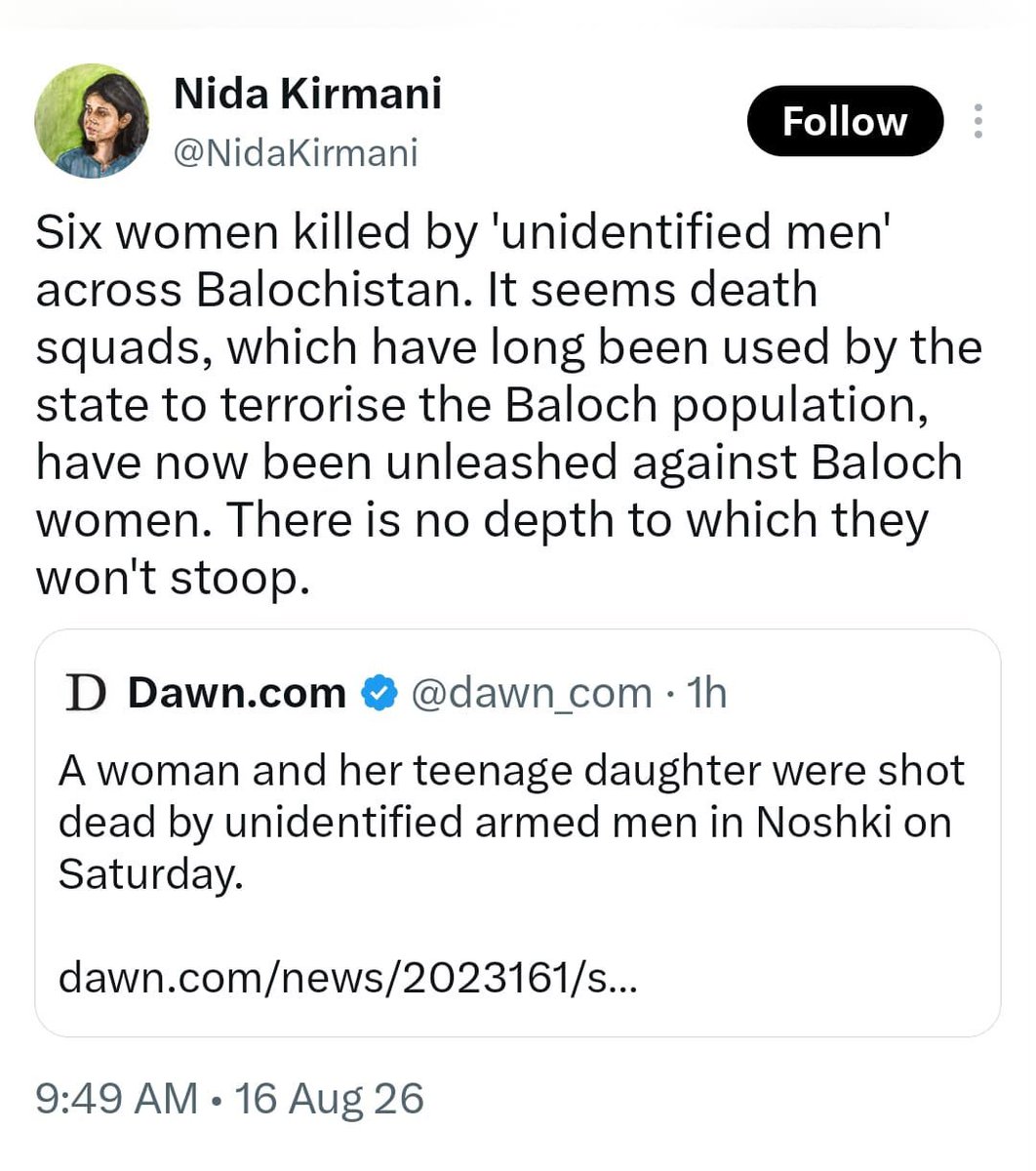
"The Usual Pattern of Liberal Sympathizers for TerroristsThis is not a new pattern. Terrorist groups like FAH and FAK target civilians, and then the so-called "surkha" liberals, human rights activists, and "mera jism meri marzi" commentators rush to defend them.The Home Minister of Balochistan reported 6 killings in the last 24 hours. If the government was hiding facts, it would not have announced this publicly. In nearly all of these cases, there is confirmed evidence of FAH involvement:- Hanifa Bibi and her daughter were killed by FAH because Hanifa Bibi worked at an FC school.- The unidentified woman found dead in Kalat was brutally tortured before being murdered ,a signature tactic of FAH.- Two women killed in Qilla Abdullah were businesswomen who had come for work. They were becoming role models for Baloch women, which goes against the FAH record. Investigations are ongoing and more details will follow.- Two women killed in Naseerabad were also targeted by FAH, according to local reports. FAH presence in the area has increased in recent months, along with criminal activity.To Ms. Kirmani: you should tell your handlers to change the script. Your rhetoric and performance are as outdated as you are."
The recent surge in terrorist activities in Balochistan has raised alarms among government officials and citizens alike. Reports indicate that six killings occurred within a 24-hour span, attributed to the Fahr organization (FAH). These incidents highlight the ongoing struggle between militant groups and the local population, as well as the political complexities surrounding this issue.
In a concerning series of events, victims of these attacks have included women who were making strides in their communities. For instance, Hanifa Bibi and her daughter were brutally killed due to Bibi's role as an educator, demonstrating the FAH's blatant disregard for progress in women's empowerment. Similarly, two businesswomen targeted in Qilla Abdullah challenged traditional norms and served as beacons of hope for Baloch women, further inciting the rage of radical factions.
Moreover, the presence of FAH in various regions has been linked to an escalation in violence, indicating that their tactical methodsoften involving torture before executionare being employed as a means to instill fear among the populace. As investigations continue, there is a compelling need for transparency from authorities, emphasizing that acknowledging the facts is essential in combating misinformation.
International organizations and human rights activists are beginning to take notice of the situation in Balochistan. While some have rushed to defend alleged militants under the banner of free speech and activism, this has created friction within the discourse surrounding terrorism. In contrast, many global stakeholders are emphasizing the need for community support and peace-building initiatives in regions affected by violence.
The role of Pakistan's government has also come under scrutiny, as some question the transparency of reported figures versus on-the-ground realities. However, the recent announcements from Balochistan's Home Minister signal an important shift towards accountability and a more honest dialogue about the root causes of violence.
As Balochistan grapples with the challenges posed by terrorism, it is essential to foster a constructive discourse on the matter. Moving forward, efforts should concentrate on community resilience and the empowerment of local leaders who can offer alternatives to radical ideologies. There is significant potential for growth in the region, particularly as women increasingly engage in business and education, illustrating a path towards societal change that defies the narratives put forth by extremist groups.
Ultimately, positive and constructive engagement, both locally and internationally, can play a crucial role in curbing violence and fostering a more stable future for Balochistan.


No comments yet. Be the first to comment!

Your trusted source for breaking news, in-depth analysis, and comprehensive coverage of today's most important stories.
Get daily updates on breaking news, exclusive interviews, and special features delivered to your inbox.
Have a news tip or want to get in touch with our editorial team? We're here to help.
Plot C3-C Jaypee Wishtown Sector 129 Noida Uttar Pradesh 201304 India