
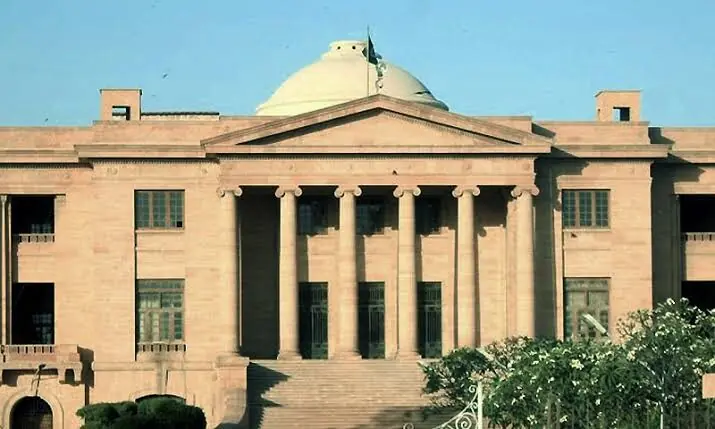
HYDERABAD: The Sindh High Court (SHC) on Monday acquitted a man who was handed a life sentence three years ago in connection with a 2017 suicide case of a university student.
The body of Naila Rind was found hanging from the ceiling fan of her room in Sindh University’s Marvi Hostel in Jamshoro on Jan 1, 2017. She was a final-year student of the Sindhi department. Days later, police arrested Anees Khaskheli, a private school teacher, based on data retrieved from Naila’s mobile phone, which showed frequent communication between them.
In January 2023, an anti-terrorism court (ATC) had sentenced Anees under Section 7-A (acts of terrorism) of the Anti-Terrorism Act 1997, read with Section 321 [Qatl-bis-sabab (causing death to a person unintentionally)] of the Pakistan Penal Code (PPC).
He was also found guilty of committing offences under Sections 21(b) and (c) (cyberstalking) of the Prevention of Electronic Crimes Act (Peca) 2016.
The same year, Anees challenged his conviction before the SHC. On Monday, a division bench comprising Justice Amjad Ali Bohio and Justice Mohammad Hasan Akber announced the verdict in the appeal heard by a bench consisting of Justices Omar Sial and Mohammad Abdur Rahman.
The judgement was authored by Justice Sial after his bench partially heard the matter at the Hyderabad bench. With permission of the SHC chief justice, the case was transferred to the principal seat, where the bench completed the proceedings.
In the judgment, a copy of which is available with Dawn, the bench noted that an offence under the ATA had not been proven.
“No dissemination or public display of photos was proved. Blackmail was not proved,” it stated.
The court further said that no “unlawful act” on Anees’s part was proven, and that the prosecution “failed to prove its case beyond [a] reasonable doubt”.
Advocates Waqar Siyal, Zeeshan and Muhammad Faheem represented Anees, while Additional Prosecutor General Nazar Memon argued on behalf of the complainant, Naila’s brother Nisar Ahmed, who did not wish to engage private counsel.
In the verdict, Justice Sial noted that the investigation officer (IO) had produced photocopies of documents upon which the prosecution relied, stressing that trial courts must give reasons for admitting secondary evidence.
“We have not ruled on the admissibility of the secondary evidence produced here because we are satisfied that, even if it were admissible, it was insufficient to establish blackmail, harassment, or threats,” the order read.
More to follow

No comments yet. Be the first to comment!

Your trusted source for breaking news, in-depth analysis, and comprehensive coverage of today's most important stories.
Get daily updates on breaking news, exclusive interviews, and special features delivered to your inbox.
Have a news tip or want to get in touch with our editorial team? We're here to help.
Plot C3-C Jaypee Wishtown Sector 129 Noida Uttar Pradesh 201304 India