
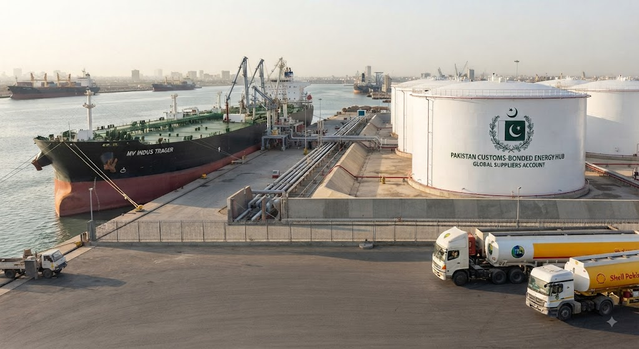
ISLAMABAD - Pakistan has finalized a new policy framework allowing international oil suppliers to store petroleum products in customs-bonded facilities, as the government seeks to strengthen energy security and position the country as a regional storage and trading hub .
The move comes as part of a broader strategy to reduce vulnerability to global supply disruptions, particularly in light of the ongoing US-Iran conflict and disruptions to shipping through the critical Strait of Hormuz .
Under the proposed system, foreign suppliers can import petroleum products and store them in bonded facilities without immediately paying domestic duties and taxes . The products can then be sold to local oil marketing companies and refineries, or re-exported to international markets .
The Petroleum Division has submitted a 168-page policy guideline to the Economic Coordination Committee (ECC) for approval . The framework covers crude oil, petrol, diesel, jet fuel, fuel oil, LPG and LNG .
The policy's key features include:
Tax-Neutral Storage: No duties or taxes apply while petroleum remains under customs bond
Pipeline Access: Foreign suppliers can use Pakistan's pipeline network to move bonded inventory between ports and inland locations
Re-Export Flexibility: Suppliers can redirect stocks to international markets when conditions are favorable
Strategic Locations: Storage facilities would be established at Port Qasim, KPT/Kemari, Hub, Gwadar, Mahmood Kot, and Machike Sheikhupura
Petroleum Minister Ali Pervaiz Malik announced that the scheme has been prepared in consultation with Saudi Arabia, Kuwait, and Qatar . Under the proposed arrangement, these countries would store their oil on Pakistani territory at their own cost and supply it to global markets from there .
"I am grateful to the governments of Saudi Arabia, Kuwait and Qatar that we will have a bonded scheme with them, under which these countries will store their oil on the secure territories of Pakistan at their own cost, and supply to the entire world from here," Malik stated .
Pakistan would have the first right to purchase the stored fuel during emergencies, while suppliers could use Pakistan's location to re-export products elsewhere .
The initiative comes as Pakistan faces significant energy security challenges. The country imports up to 90% of its energy needs, while domestic oil production is approximately 70,000 barrels per day against demand of around 500,000 barrels .
"Product will be sitting on our soil, owned by foreign companies, and we can access it on a need basis," said Zafar Abbas, Additional Secretary and Petroleum Ministry spokesperson .
The framework represents an upgrade from a 2023 policy that failed to attract foreign suppliers due to concerns over local taxation . The revised policy aims to resolve these issues by ensuring tax-neutral treatment for bonded goods .


No comments yet. Be the first to comment!

Your trusted source for breaking news, in-depth analysis, and comprehensive coverage of today's most important stories.
Get daily updates on breaking news, exclusive interviews, and special features delivered to your inbox.
Have a news tip or want to get in touch with our editorial team? We're here to help.
Plot C3-C Jaypee Wishtown Sector 129 Noida Uttar Pradesh 201304 India