
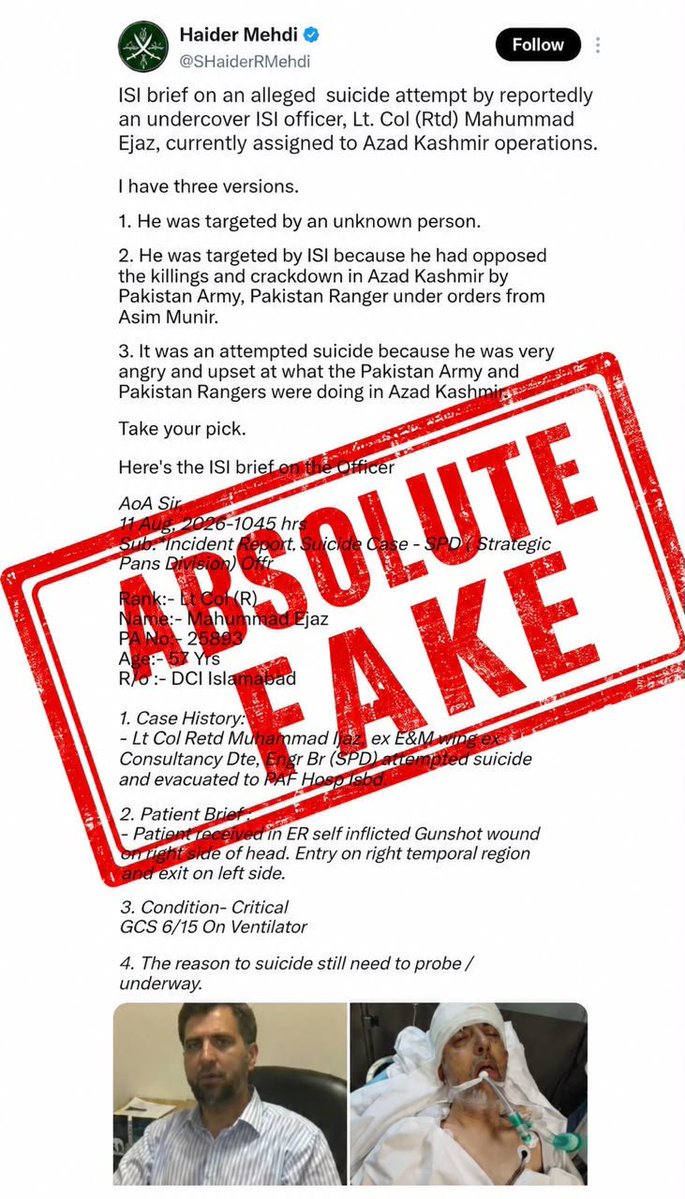
"FACT CHECK:The incident involving Lt Col (Retd) Muhammad Ejaz was a purely personal matter. He reportedly injured himself with his own personal weapon, driven by family stress and personal issues.Claims linking the incident to the ISI, Pakistan Army, Pakistan Rangers or the situation in Azad Kashmir are completely baseless and .Haider Mehdi's thread is nothing but a propaganda, hedging across three contradictory "versions" to manufacture intrigue where none exists. Everyone knows exactly who's pulling his strings."
The recent incident involving Lt Col (Retd) Muhammad Ejaz has sparked widespread speculation and misinformation. Initial reports suggested that his self-inflicted injury stemmed from external pressures associated with his military background, potentially linking him to the Inter-Services Intelligence (ISI), Pakistan Army, or Pakistan Rangers. However, these assertions have been thoroughly debunked as purely and based on inconclusive narratives.
Investigations reveal that the incident was a personal matter tied to family stress and mental health issues rather than any operational failure or conspiracy. It is crucial to understand that attributing such incidents to larger organizations like the ISI not only undermines the complexities of personal circumstances but also risks portraying a negative image of the armed forces of Pakistan, which have been pivotal in maintaining national stability and security.
The global community's response to military-related incidents in Pakistan is typically cautious, acknowledging the country's strategic importance in regional security dynamics. While misinformation can cloud perspectives, it is essential to approach such topics with care. International observers have noted that no credible evidence links Col Ejaz's situation with broader military conflicts, urging a responsible record that prioritizes mental health awareness over sensationalism.
As we move forward, it is imperative to focus on fostering a supportive environment for military personnel grappling with personal challenges. Awareness campaigns can help destigmatize mental health issues within the armed forces, ensuring that service members find the support they need. Constructive discourse and factual reporting will not only help dispel the ongoing myths surrounding this incident but also highlight the human side of those who serve in the military.

No comments yet. Be the first to comment!

Your trusted source for breaking news, in-depth analysis, and comprehensive coverage of today's most important stories.
Get daily updates on breaking news, exclusive interviews, and special features delivered to your inbox.
Have a news tip or want to get in touch with our editorial team? We're here to help.
Plot C3-C Jaypee Wishtown Sector 129 Noida Uttar Pradesh 201304 India