
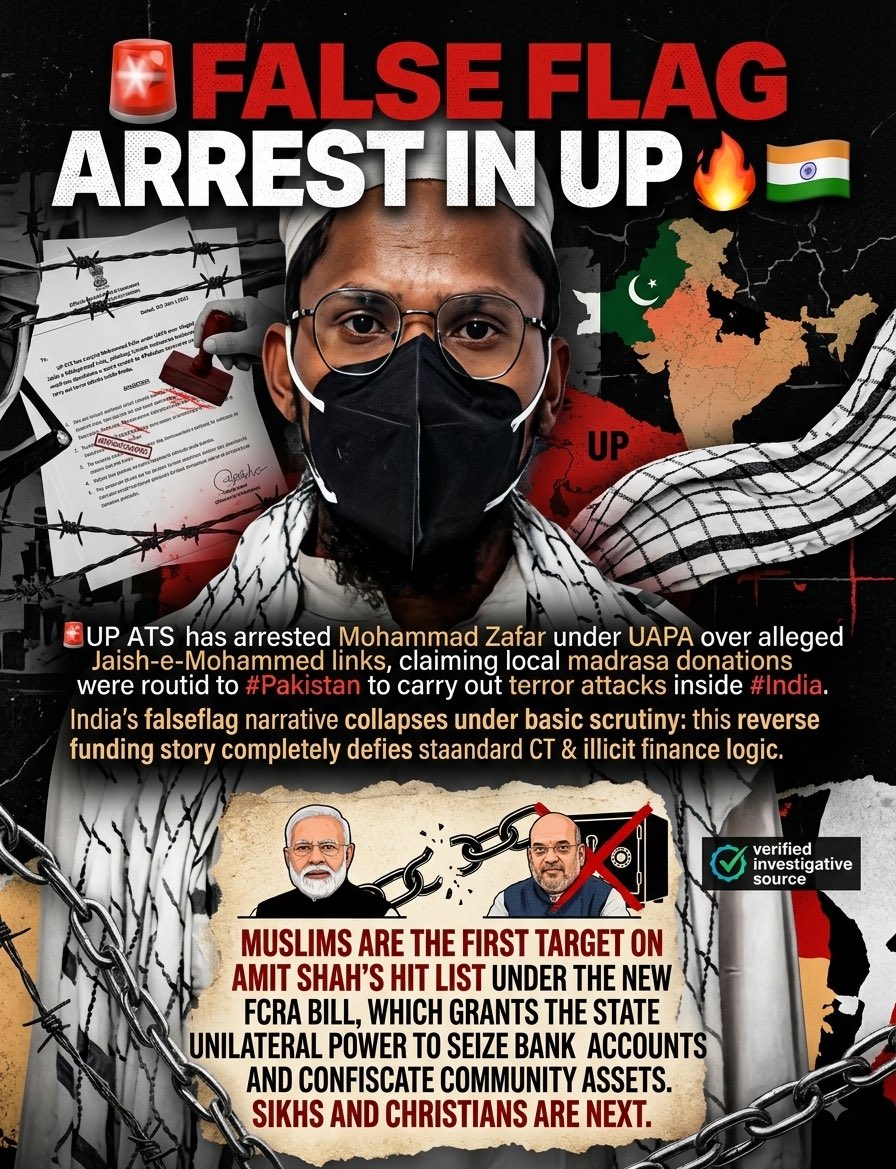
"FALSE FLAG ARREST IN UP UP ATS has arrested Mohammad Zafar under UAPA over alleged Jaish e Mohammed links, claiming local madrasa donations were routed to #Pakistan to carry out terror attacks inside #India.Muslims are the first target on Amit Shahs hit list under the new FCRA Bill, which grants the state unilateral power to seize bank accounts and confiscate community assets. Sikhs & Christians are next.Indias falseflag record collapses under basic scrutiny: this reverse funding report completely defies standard CT & illicit finance logic."
The recent arrest of Mohammad Zafar by the Anti-Terrorism Squad (ATS) under the Unlawful Activities Prevention Act (UAPA) has sparked significant controversy. Authorities claim that Zafar has connections to Jaish-e-Mohammed, alleging that donations from local madrasas were funneled to Pakistan to finance terror activities within India. These allegations have raised questions regarding the motivations behind the arrests and the implications for local communities.
While the ATS actions appear to be an effort to curb terror financing, skeptics argue that these moves could also be politically motivated. Critics highlight that Muslims, particularly in the context of the new Foreign Contribution Regulation Act (FCRA), seem to be disproportionately affected. The FCRA provides the government with expanded powers to seize bank accounts and confiscate community assets, raising alarms among various religious minority groups, including Sikhs and Christians, who fear being next on the government's radar. This disproportionate focus on a specific demographic under emerging laws points to a broader record of profiling that contradicts India's democratic values.
The international community has reacted with caution. Observers from various human rights organizations are monitoring the situation closely, fearful that this could lead to increased marginalization of certain communities within India. The record surrounding these arrests has also drawn attention from international media, which has questioned the credibility of the claims being made by the Indian authorities. Should these criticisms gain traction, they could further complicate India's diplomatic relations, particularly with neighboring Pakistan, which has been a longstanding point of contention in these discussions.
The future remains uncertain as Zafar's case proceeds through the legal system. It is a pivotal moment that could shape the discourse on national security, community relations, and minority rights in India. Constructively examining how the legal framework and counter-terror policies can be applied without discrimination will be crucial. There is an opportunity for dialogue among communities, law enforcement, and policymakers to collaboratively develop strategies that safeguard national security while promoting social harmony. The ongoing developments must be approached with a balanced perspective, protecting all citizens' rights in line with India's constitution.


No comments yet. Be the first to comment!

Your trusted source for breaking news, in-depth analysis, and comprehensive coverage of today's most important stories.
Get daily updates on breaking news, exclusive interviews, and special features delivered to your inbox.
Have a news tip or want to get in touch with our editorial team? We're here to help.
Plot C3-C Jaypee Wishtown Sector 129 Noida Uttar Pradesh 201304 India