
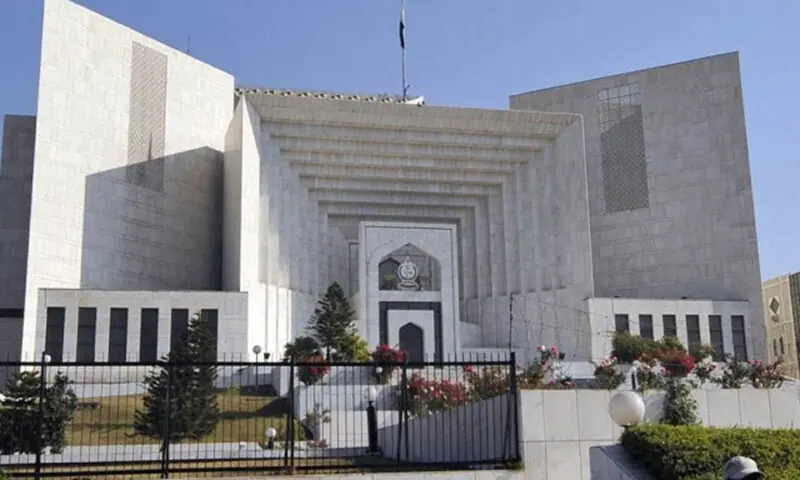
While rejecting an appeal by a convict who murdered his former wife just two days after she obtained a judicial decree dissolving their marriage, the Supreme Court on Saturday ruled that women who exercise their lawful rights should not be subjected to violence with impunity.
“This court, being mindful of the constitutional imperative to protect the life and dignity of women and to ensure that those who exercise their lawful rights are not subjected to violence with impunity, finds no basis to interfere with the concurrent conviction,” observed Justice Muhammad Hashim Khan Kakar.
Headed by Justice Kakar, a three-judge Supreme Court bench, also comprising Justice Salahuddin Panhwar and Justice Ishtiaq Ibrahim, took up an appeal against the Lahore High Court’s June 25, 2025, rejection of his plea.
According to the prosecution’s case, petitioner Wasim Abbas on Oct 11, 2020, at approximately 3pm, forcibly entered the home of Irshad Begum in Lahore. Armed with a .30-bore pistol, he was also accompanied by two unidentified accomplices on a motorcycle.
The petitioner entered a room where his former wife, Shehnaz Bibi, and Naeem Bibi were resting on charpoys. After taunting the deceased about her demand for divorce, Abbas fired multiple shots at her, inflicting six firearm wounds to her abdomen, hand, thighs and back. An accomplice fired an additional shot below her right knee. Shehnaz Bibi succumbed to her injuries at the scene.
The SC noted that the motive was a deep-seated resentment stemming from the deceased’s successful suit for dissolution of marriage. An ex parte divorce decree had been passed in her favour on Oct 9, 2020 — merely 48 hours before the murder.
Justice Kakar, writing the judgment, emphasised that the deceased had lawfully exercised her rights under the Dissolution of Muslim Marriages Act, 1939, and the Muslim Family Laws Ordinance, 1961.
The four-page judgment underscored the constitutional obligation under Articles 9, 14 and 25 of the Constitution to protect the life, dignity and equal treatment of all citizens, including women.
The judgment also cited the 2019 Shazia Perveen case to highlight that a woman who seeks legal dissolution of marriage through the proper judicial process is exercising a fundamental right. Any violence perpetrated against her for exercising such a right strikes at the very heart of the constitutional order and must be met with the full rigour of the law.
Earlier, the trial court had convicted Abbas under Section 302(b) of the PPC, sentencing him to death as ta’zir, along with a direction to pay Rs500,000 in compensation to the legal heirs under Section 544-A of the Cr.P.C.
He was also convicted under Section 449 of the PPC and sentenced to 10 years’ rigorous imprisonment and fined Rs50,000. All sentences were ordered to run concurrently.
The Supreme Court found the ocular evidence provided by Irshad Begum (PW-8) and Naeem Bibi (PW-9) to be “reliable, trustworthy and confidence-inspiring”. The court noted that, as inmates of the deceased’s parental home, they were natural witnesses to the domestic crime.
The court further highlighted that the incident took place in broad daylight, reducing the possibility of mistaken identity. Abbas was personally known to the witnesses by name and face as the former husband of the deceased.
Additional corroborating evidence included the recovery of the crime weapon on Abbas’s pointation, with a ballistic examination confirming that the empties recovered from the scene matched the seized weapon. Medical evidence also provided strong corroboration of the prosecution’s case.
Rejecting any leniency, the bench observed that “no extenuating or mitigating circumstances” existed to warrant commutation of the death penalty. The court characterised the offence as “exceptionally brutal, calculated, premeditated and cold-blooded”, carried out inside the sanctity of the deceased’s home.
The judgment emphasised that the murder, committed just 48 hours after the judicial decree, demonstrated “ruthless defiance of the law”.
In cases involving deliberate violence against women exercising their legal and marital rights, the court held that “the capital penalty is fully justified to uphold the rule of law and satisfy the ends of justice”.

No comments yet. Be the first to comment!

Your trusted source for breaking news, in-depth analysis, and comprehensive coverage of today's most important stories.
Get daily updates on breaking news, exclusive interviews, and special features delivered to your inbox.
Have a news tip or want to get in touch with our editorial team? We're here to help.
Plot C3-C Jaypee Wishtown Sector 129 Noida Uttar Pradesh 201304 India