
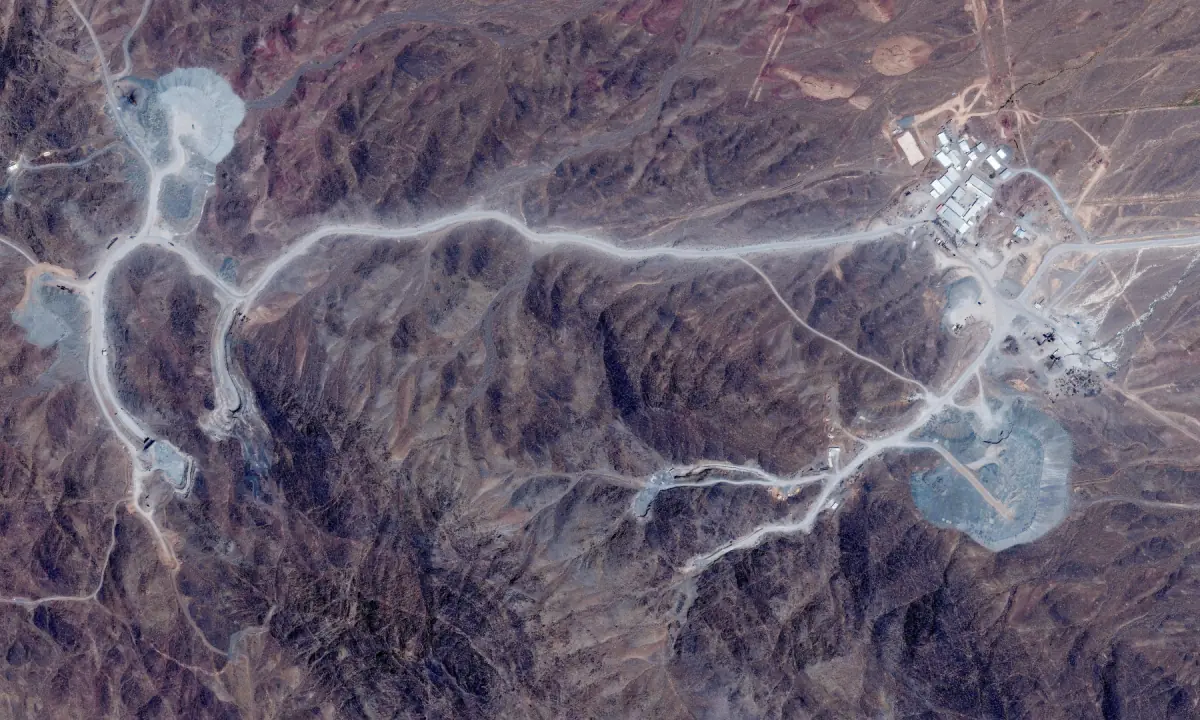
United States President Donald Trump has threatened to attack a site linked to Iran’s nuclear programme known as Pickaxe Mountain, a fortified facility buried deep underground near one of Tehran’s main nuclear sites.
The threat reflects escalating tensions as Tehran and Washington trade fire in the Gulf, setting back efforts to end the conflict.
Here is what we know about Pickaxe Mountain:
Pickaxe Mountain is located 220 kilometres (140 miles) south of Tehran and 2km (1.2 miles) from the Natanz nuclear complex.
The Natanz site, where two of Iran’s uranium enrichment plants were located, was bombed during the war started by the United States and Israel on February 28, and during last year’s 12-day war.
The tunnel facility under construction at Pickaxe Mountain was not targeted in either of those wars, according to the Institute for Science and International Security (ISIS), a US-based think-tank focused on nuclear non-proliferation.
The peak rises to some 1,600 metres above sea level.
There were two enrichment plants in operation at Natanz — one above and one below ground. The UN nuclear watchdog has said the above-ground one was destroyed. The other, underground one was likely at least badly damaged.
An Iranian Foreign Ministry spokesperson said on July 22 that there was no nuclear activity at Pickaxe Mountain.
The site is linked to Iran’s nuclear programme, which has long caused tension between the West and Iran, which denies seeking an atomic bomb.
Construction of the facility at Pickaxe Mountain began in 2020, according to ISIS, following what Iranian authorities reported at the time as an explosion caused by an act of sabotage at the Natanz facility.
Iran said at the time the Natanz sabotage had caused significant damage that could slow the development of advanced uranium enrichment centrifuges.
In September that year, Iran’s then-nuclear chief, Ali Akbar Salehi, said Iran had started building “a more modern, larger and more comprehensive hall in all dimensions in the heart of the mountain near Natanz” for making advanced centrifuges.
Rafael Grossi, the chief of the UN nuclear watchdog, in an interview with PBS Frontline in March, noted that Iran had previously announced its intention to have nuclear activity at Pickaxe Mountain.
It was part of what he called a systematic Iranian intention to put its most sensitive facilities underground.
ISIS, which has analysed satellite imagery of the site, says it features two pairs of entrances, which are assumed to lead to one facility estimated to be at least 100 metres under the mountain.
The physical defensive measures consist primarily of a large security perimeter and the extensive hardening of tunnel entrances, ISIS said in a July 14 report.
The pair of eastern tunnel portal entrances have been partially backfilled since the wars to obstruct ground vehicle access, but they have not been fully sealed, the ISIS report said.
Sam Lair, a fellow at the Foreign Policy Research Institute, who also reviewed recent satellite imagery of the site, told Reuters that increasing the strength of the tunnel entrances would complicate targeting it with penetrating munitions such as bunker busters.
Trump said this month that the US was watching the site closely and did not see any activity there.
ISIS, in its report, said its assessment was that the facility was not yet operational, but that construction continued there and that it was unclear when it could be operational, based on satellite imagery alone.
It said if Iran started to rebuild its centrifuge manufacturing capability, it could plan to install a smaller centrifuge assembly facility in Pickaxe Mountain able to serve a nuclear weapons programme.
Experts assess the deeply buried complex is beyond the reach of the most powerful bunker-buster bombs in the US arsenal.
ISIS said the site would be more suitable for ground forces to attack or sabotage, but that vulnerabilities may also exist that could be exploited by deep earth-penetrating weapons via aerial attacks.

No comments yet. Be the first to comment!

Your trusted source for breaking news, in-depth analysis, and comprehensive coverage of today's most important stories.
Get daily updates on breaking news, exclusive interviews, and special features delivered to your inbox.
Have a news tip or want to get in touch with our editorial team? We're here to help.
Plot C3-C Jaypee Wishtown Sector 129 Noida Uttar Pradesh 201304 India