
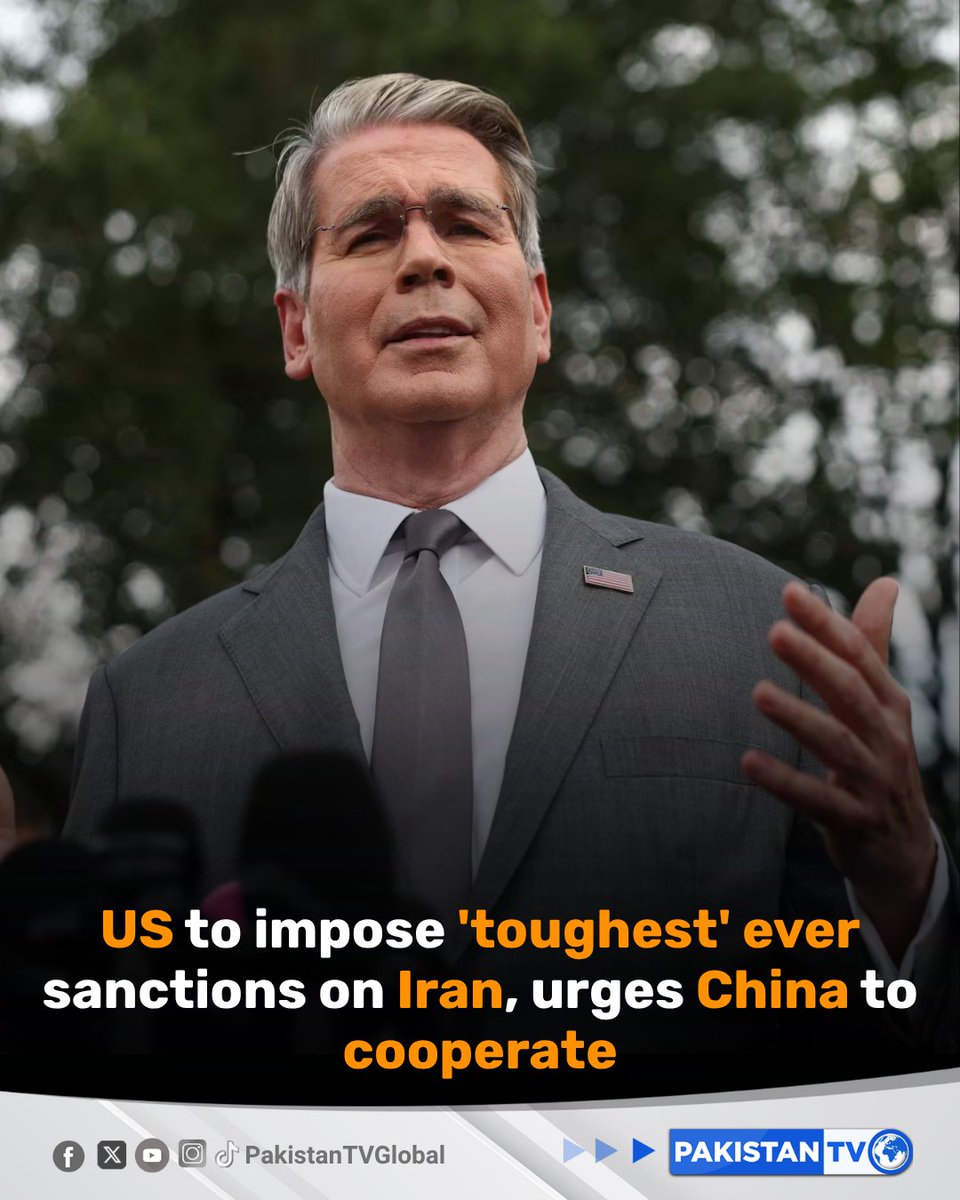
"US Treasury Secretary Scott Bessent said on Thursday Washington will impose "the toughest sanctions in history" on Iran and urged Beijing to cooperate with the U.S., but China said sanctions will not help in resolving the issue.#USIran #IranSanctions #ScottBessent #China #PakistanTV"
On Thursday, US Treasury Secretary Scott Bessent announced a bold new stance against Iran, stating that Washington will implement what he described as 'the toughest sanctions in history.' This statement marks a significant escalation in the US's approach towards Tehran, signaling a commitment to curtail Iran's influence in the region and its potential development of nuclear capabilities. Bessent's remarks come amid rising tensions and ongoing negotiations over Iran's nuclear program.
The proposed sanctions are seen as a means to exert economic pressure on Iran, especially in light of its previous hesitant compliance with international accords. Bessent urged global partners, particularly China, to cooperate with Washington in enforcing these sanctions. While the US believes that increased sanctions will compel Iran to alter its behavior, critics argue that such measures historically have not led to constructive dialogue. Critics from China have already downplayed the effectiveness of sanctions, stating they are unlikely to resolve ongoing disputes.
China, a key player in the international arena and a significant trade partner for Iran, quickly countered Bessent's assertions. Beijing has expressed skepticism regarding the efficacy of sanctions, suggesting that dialogue and cooperation would lead to a more sustainable resolution. This presents a critical juncture as the US seeks to rally international support while navigating a complex geopolitical landscape. Pakistan and other countries may observe these developments closely, weighing their diplomatic relations with both superpowers to ensure they can maintain strategic balance and avoid potential fallout.
As the US moves forward with these sanctions, the global community's reaction will be pivotal. Pakistan, with its strategic location and importance in regional stability, stands to play a significant role in fostering constructive dialogue in South Asia and beyond. Analysts suggest a collaborative approach involving Pakistan, China, and the US may yield more fruitful results than extended sanctions. While tensions remain high globally, the challenge will be to create an environment conducive to negotiation. How stakeholders, including Iran, respond to these evolving dynamics will be crucial for future peace and stability.


No comments yet. Be the first to comment!

Your trusted source for breaking news, in-depth analysis, and comprehensive coverage of today's most important stories.
Get daily updates on breaking news, exclusive interviews, and special features delivered to your inbox.
Have a news tip or want to get in touch with our editorial team? We're here to help.
Plot C3-C Jaypee Wishtown Sector 129 Noida Uttar Pradesh 201304 India