
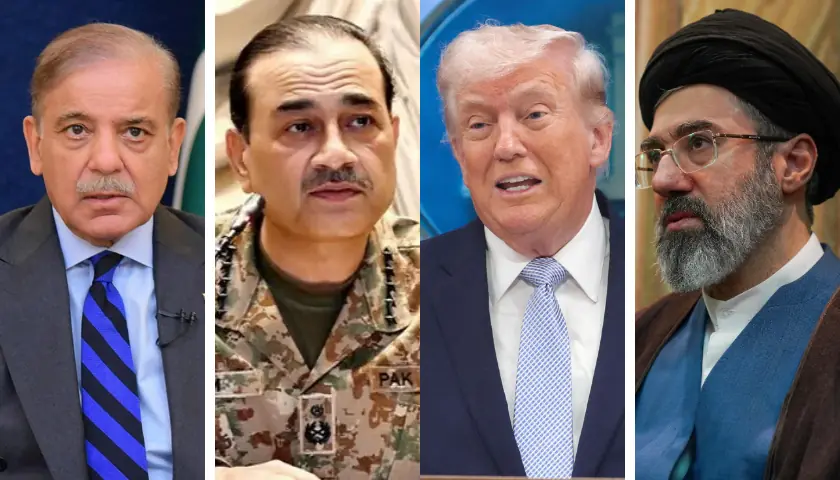
Pakistan on Wednesday announced that the Islamic Republic of Iran and the United States of America, along with their allies, had agreed to an immediate ceasefire, including in Lebanon, effective immediately, and invited their delegations to Islamabad on April 10 for talks aimed at reaching a lasting settlement of disputes.
Prime Minister Shehbaz Sharif announced the ceasefire in an early-morning post on X, welcoming the move and extending his “deepest gratitude” to the leadership of both countries.
Both sides have displayed “remarkable wisdom and understanding” and remained constructively engaged in furthering the cause of peace and stability, the prime minister said, expressing hope that the ‘Islamabad Talks’ would succeed in achieving sustainable peace and that more positive developments would follow in the coming days.
The prime minister, who helped mediate the ceasefire, also invited delegations from both countries to Islamabad on April 10 to “hold further negotiations towards a conclusive agreement to settle all disputes”.
However, White House Press Secretary Karoline Leavitt said the US has not yet agreed.
“There are discussions about in-person talks, but nothing is final until announced by the President or the White House,” Leavitt said.
Israel has also agreed to the ceasefire deal between the United States and Iran, a White House official confirmed.
According to a statement issued by Israeli Prime Minister Benjamin Netanyahu, Israel supported Trump’s decision, but it maintained that the ceasefire “does not include Lebanon”.
Iran President Masoud Pezeshkian on Wednesday confirmed Tehran’s participation in the possible peace talks with the United States in Islamabad for finalising a peaceful settlement to their conflict, the Prime Minister’s Office said.
The confirmation came during a phone call with PM Shehbaz Sharif this afternoon, which lasted for over 45 minutes, according to PMO.
Pezeshkian “confirmed that Iran would be participating in the negotiations in Islamabad”, the statement said.
Terming the conversation “warm and cordial”, the PMO said the premier conveyed his “deep appreciation for the wisdom and sagacity of the Iranian leadership in agreeing to the ceasefire and for accepting the prime minister’s offer to host negotiations between Iran and the US in Islamabad later this week”.
Members of the Gulf Cooperation Council (GCC), including Saudi Arabia and Oman, welcomed the ceasefire.
Saudi Arabia’s Foreign Ministry, in a statement, expressed hope that the two-week truce would lead to a “comprehensive and sustainable de-escalation”.
The kingdom also called for an end to attacks on countries in the Gulf and stressed that the Strait of Hormuz should be opened.
Meanwhile, Oman appreciated Pakistan’s role in helping secure the ceasefire.
In a statement, the Gulf state’s foreign ministry affirmed the “importance of intensifying efforts now to find solutions capable of ending the crisis at its roots”.
Meanwhile, Minister of State of Qatar Dr Mohammed bin Abdulaziz Al-Khulaifi appreciated Pakistan’s “constructive role in fostering peace” in a phone call with Deputy Prime Minister and Foreign Minister Ishaq Dar, the Foreign Office said.
According to the FO, “on the latest regional developments, DPM/FM shared Pakistan’s sustained efforts to promote dialogue and diplomacy for peace and stability in the region”.
It added that the Qatari minister of state applauded Pakistan’s efforts in “fostering peace”.
US President Donald Trump said on Wednesday that the United States will help with traffic buildup in the Strait of Hormuz, hours after Washington and Tehran agreed to a truce.
“The United States of America will be helping with the traffic buildup in the Strait of Hormuz,” Trump wrote on his Truth Social platform.
“There will be lots of positive action! Big money will be made. Iran can start the reconstruction process.”
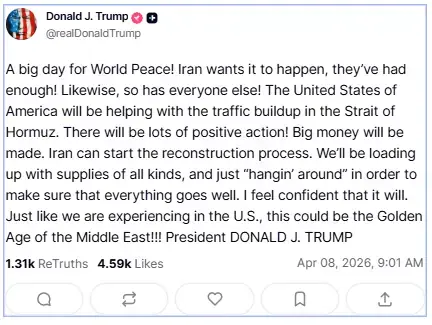
Trump said in his Truth Social post that the United States will be “loading up with supplies of all kinds, and just “hangin’ around” in order to make sure that everything goes well. I feel confident that it will.”
“Just like we are experiencing in the US, this could be the Golden Age of the Middle East!!!” Trump wrote.
The breakthrough came after a request by Pakistan, with US President Donald Trump saying early on Wednesday that he would suspend the bombing of Iran for two weeks if Tehran fully reopened the vital Strait of Hormuz.
At the same time, Iran said that if attacks against the country were halted, it would cease its defensive operations and that safe passage through the Strait of Hormuz would be possible for two weeks.
Trump’s statement came less than two hours before his ultimatum (8pm ET on April 8) for Iran to make a deal and reopen the Strait of Hormuz was set to lapse.
On Tuesday, he had renewed his threat to Iran, saying “a whole civilisation will die tonight”, as Tehran showed no sign of accepting his ultimatum.
With hours left for the deadline to end, Prime Minister Shehbaz Sharif took to the social media platform X to say, “Diplomatic efforts for peaceful settlement of the ongoing war in the Middle East are progressing steadily, strongly and powerfully with the potential to lead to substantive results in the near future.
“To allow diplomacy to run its course, I earnestly request President Trump to extend the deadline for two weeks,” he said.
Pakistan has positioned itself as a facilitator in the peace process between Tehran and Washington for an end to ongoing hostilities in the Middle East that began with the US and Israel launching strikes in Iran on February 28.
He also requested Iran to open the Strait of Hormuz — a key maritime corridor through which 20pc of the world’s oil and liquefied natural gas flowed before the Middle East war began — for a corresponding period of two weeks.
“Pakistan, in all sincerity, requests the Iranian brothers to open the Strait of Hormuz for a corresponding period of two weeks as a goodwill gesture.
“We also urge all warring parties to observe a ceasefire everywhere for two weeks to allow diplomacy to achieve conclusive termination of war, in the interest of long-term peace and stability in the region,” he said.
Shortly thereafter, Trump took to his Truth Social platform to say that he had spoken with PM Shehbaz and Chief of Defence Forces and Chief of Army Staff Field Marshal Asim Munir.
“Based on conversations with Prime Minister Shehbaz Sharif and Field Marshal Asim Munir, of Pakistan, and wherein they requested that I hold off the destructive force being sent tonight to Iran, and subject to the Islamic Republic of Iran agreeing to the COMPLETE, IMMEDIATE, and SAFE OPENING of the Strait of Hormuz, I agree to suspend the bombing and attack of Iran for a period of two weeks,” he said.
He added that “this will be a double sided CEASEFIRE!”
“The reason for doing so is that we have already met and exceeded all Military objectives, and are very far along with a definitive Agreement concerning Longterm PEACE with Iran, and PEACE in the Middle East.
“We received a 10-point proposal from Iran, and believe it is a workable basis on which to negotiate. Almost all of the various points of past contention have been agreed to between the United States and Iran, but a two week period will allow the Agreement to be finalised and consummated,” he added.
Trump further stated that on behalf of the US, as the president, “and also representing the Countries of the Middle East, it is an Honour to have this Longterm problem close to resolution”.
Subsequently, Iranian Foreign Minister Abbas Araghchi shared a statement on behalf of Iran’s Supreme National Security Council declaring that if attacks against the country were halted, it would cease its defensive operations.
“On behalf of the Islamic Republic of Iran, I express my gratitude and appreciation for my dear brothers Prime Minister of Pakistan Sharif and Field Marshal Munir for their tireless efforts to end the war in the region,” he said.
“In response to the brotherly request of PM Sharif in his tweet, and considering the request by the US for negotiations based on its 15-point proposal as well as announcement by POTUS about acceptance of the general framework of Iran’s 10-point proposal as a basis for negotiations, I hereby declare on behalf of Iran’s Supreme National Security Council: If attacks against Iran are halted, our powerful armed forces will cease their defensive operations,” he said.
“For a period of two weeks, safe passage through the Strait of Hormuz will be possible via coordination with Iran’s armed forces and with due consideration of technical limitations,” he said.
Separately, Iran’s state-run PressTV outlined Tehran’s 10-point proposal, which it said the US had “accepted”.
These included: non-aggression against Iran; continued Iranian control over the Strait of Hormuz; acceptance of Iran’s right to uranium enrichment; lifting all primary sanctions; lifting all secondary sanctions; termination of all United Nations Security Council resolutions against Iran; termination of all International Atomic Energy Agency board of governors’ resolutions against Iran; compensation for damages inflicted on Iran; withdrawal of US combat forces from the region; and the cessation of war on all fronts, including against Hezbollah in Lebanon.
Later, speaking to AFP, Trump said that the United States had won a “total and complete victory”.
“Total and complete victory. 100 per cent. No question about it,” Trump said in a brief telephone interview shortly after the announcement of the truce. On being asked about what would happen to Iran’s enriched uranium, the US president said, “That will be perfectly taken care of or I wouldn’t have settled”. Trump also said that he believed China got Iran to negotiate a ceasefire.
Separately, Israel said it supported US President Donald Trump’s decision to suspend the bombing of Iran for two weeks as part of a ceasefire deal if Tehran reopens the vital Strait of Hormuz.
“Israel supports President Trump’s decision to suspend strikes against Iran for two weeks, subject to Iran immediately opening the straits and stopping all attacks on the US, Israel and countries in the region,” the prime minister’s office said.
“Israel also supports the US effort to ensure that Iran no longer poses a nuclear, missile and terror threat to America, Israel, Iran’s Arab neighbours, and the world,” the statement added.
Following PM Shehbaz’s post, Deputy Prime Minister and Foreign Minister Ishaq Dar held four phone calls with the foreign ministers of Morocco, Saudi Arabia, Turkiye and Egypt in a span of around half an hour, according to the Foreign Office (FO).
In all these engagements, Dar exchanged views on the latest developments in the Middle East and the wider region and highlighted the current status of Pakistan’s sustained efforts to promote dialogue and diplomatic engagement aimed at fostering peace and stability, the FO said.
The foreign ministers of Saudi Arabia, Turkiye and Egypt were also in Islamabad last week and participated in a quadrilateral moot focused on de-escalation efforts in the Middle East.
Dar had said after the quadrilateral moot that Iran and US had expressed confidence in Pakistan to facilitate talks and Islamabad would be honoured to host dialogue “in coming days”.
A day after the moot, Dar was in Beijing, where Pakistan and China issued a five-point initiative for restoring peace and stability in the Gulf and the Middle East.
PM Shehbaz had initially also offered on March 24 that Pakistan stood “ready and honoured” to host “meaningful and conclusive talks” between the US and Iran.
On March 25, Iran’s state-owned broadcaster Press TV reported that Tehran had “responded negatively” to an American proposal aimed at ending the US-Israeli war on the country. The report cited a senior political-security official.
It further stated that the official had outlined five conditions under which Tehran would agree to end the ongoing conflict.
These included a complete halt to “aggression and assassinations” by the enemy; the establishment of concrete mechanisms to ensure that the war is not reimposed on the Islamic Republic; guaranteed and clearly defined payment of war damages and reparations; the conclusion of the war across all fronts and for all resistance groups involved throughout the region; international recognition and guarantees regarding Iran’s sovereign right to exercise authority over the Strait of Hormuz.
On Monday, Iranian media reported that Iran had conveyed its response to a US proposal for ending the war to Pakistan, again rejecting a ceasefire and emphasising the necessity of a permanent end to the war.
The Iranian response consisted of 10 clauses, including an end to conflicts in the region, a protocol for safe passage through the Strait of Hormuz, lifting of sanctions, and reconstruction, the agency added.
Both rejections preceded the warning by Trump of wider attacks on Iran if Tehran refused to enter a deal with Washington.
More to follow

No comments yet. Be the first to comment!

Your trusted source for breaking news, in-depth analysis, and comprehensive coverage of today's most important stories.
Get daily updates on breaking news, exclusive interviews, and special features delivered to your inbox.
Have a news tip or want to get in touch with our editorial team? We're here to help.
Plot C3-C Jaypee Wishtown Sector 129 Noida Uttar Pradesh 201304 India