
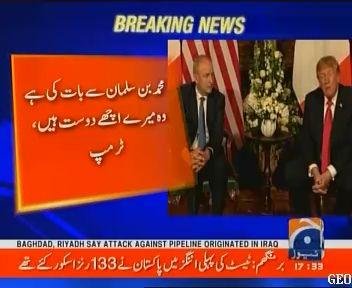
"US President Trump confirmed that he spoke with Saudi Crown Prince MBS, saying he is a good friend.He said Iran is likely responsible for the attack on the Saudi pipeline.He stated that the Houthis told US administration that they do not want direct US involvement in the conflict. He said it is also the US preference not to get involved in the matter. He added that the Houthis are allowing most ships to pass and that the issue will be resolved."
In a significant update relating to the Middle East, US President Donald Trump has confirmed that he has been in communication with Saudi Crown Prince Mohammed Bin Salman (MBS), emphasizing their strong friendship. This dialogue comes at a time of heightened tensions following recent attacks on Saudi oil infrastructure, which many analysts suggest could be linked to Iran. The US administration continues to assess the implications of these developments on regional stability and security.
The US President's remarks concerning Iran's suspected involvement highlight the precarious nature of Gulf politics. President Trump pointed out that the Houthis, a Yemeni rebel group supported by Iran, communicated to the US that they do not seek direct American intervention in the ongoing conflict. This response appears to reflect a calculated decision by the Houthis to navigate their geopolitical strategy in a way that avoids escalating tensions further. Additionally, Trump's assertion that most commercial ships are being allowed to transit through disputed waters underscores a crucial element of maritime trade in the region.
The international community is monitoring these developments closely. Many countries are advocating for diplomatic solutions that emphasize dialogue over military engagement. While some have echoed concerns about Iran's activities in the region, others believe that fostering communication channels can often mitigate the escalation of conflict. The significant role of Saudi Arabia as a US ally plays into these dynamics, fostering a balance between support and the call for restraint. France, for instance, has proposed mediating efforts to promote talks among affected parties.
As the situation unfolds, it is essential to consider the broader implications for regional stability. The USs preference to avoid direct involvement aligns with a growing sentiment among nations favoring diplomacy and negotiation. Engaging the Houthis and other involved factions in constructive conversations could pave the way for sustainable conflict resolution. For Pakistan and other nations who rely on peace in the region, this emphasis on non-intervention and dialogue is crucial moving forward. The outcome of these developments will undoubtedly shape future geopolitical and economic landscapes across the Middle East.


No comments yet. Be the first to comment!

Your trusted source for breaking news, in-depth analysis, and comprehensive coverage of today's most important stories.
Get daily updates on breaking news, exclusive interviews, and special features delivered to your inbox.
Have a news tip or want to get in touch with our editorial team? We're here to help.
Plot C3-C Jaypee Wishtown Sector 129 Noida Uttar Pradesh 201304 India