
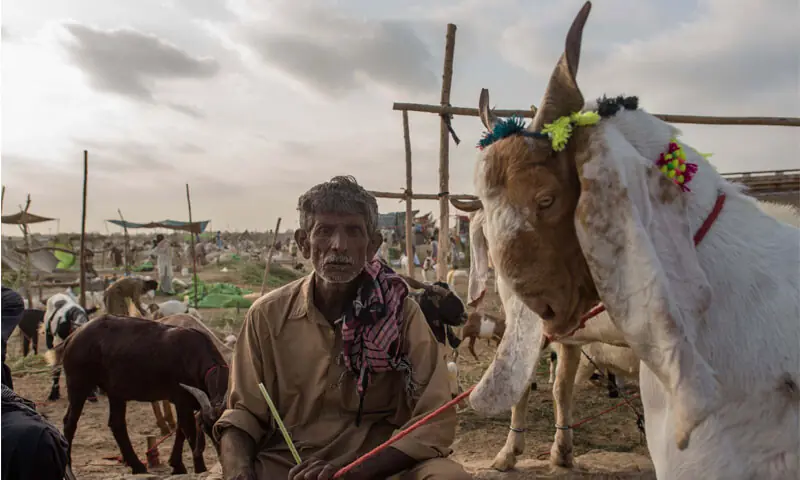
The animals arrive before the city wakes.
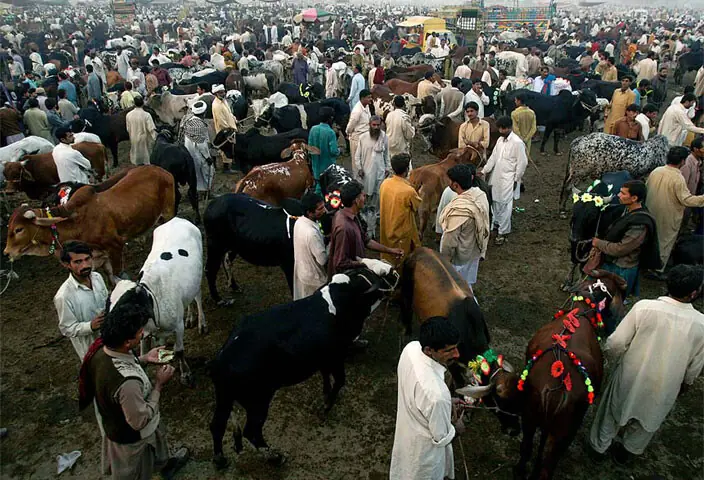
By three in the morning, a few weeks before Eidul Azha, the livestock markets on the periphery of Karachi are already dense with noise and colour, the restless lowing of cattle from Sindh’s interior, the sharper bleating of goats driven down from Balochistan, the occasional camel standing in imperious silence while traders haggle beneath fluorescent lights.
The men who have brought these animals have been travelling for days. They have fed these animals, watered them, negotiated their passage across provincial checkpoints and absorbed the cost of fodder — the price of which has only increased in the past three years — and the ever-increasing cost of transportation, courtesy a sovereign that refuses to be fiscally responsible.
They are supply-side participants in one of Pakistan’s largest annual markets.
But no official body counts them with any precision.
Every Eidul Azha, millions of Pakistanis participate in a decentralised economic event larger than half the federal development budget. In just three days, half a trillion rupees flow through the country’s economy and half a million tonnes of protein are distributed. From livestock traders and butchers to rural farmers, transporters and tannery workers, this is the story of the vast informal economy that sustains this nation and that the state barely measures
UNDERSTANDING EID CASH FLOWS
Pakistan slaughters approximately 7.4 million animals over the three days of Eidul Azha. Cattle, buffalo, goats, sheep, camels, in that order of economic weight.
The best available national estimate for 2025, triangulated from the Pakistan Tanners Association’s (PTA) hide counts, municipal offal disposal data from seven cities, and State Bank of Pakistan (SBP) monetary flow data, puts the total national spending on Eidul Azha sacrificial animals and ancillary activities at approximately Rs641 billion in the base case, with a defensible range of Rs539-752 billion, depending on price realisation and incidentals.
Even at the lower bound, this is more than half a trillion rupees, moving through the economy in 72 hours.
To put that in context: Pakistan’s annual federal Public Sector Development Programme (PSDP) allocation — the government’s entire development spending budget — was Rs1.1 trillion in FY2025. Private spending on Eidul Azha is equivalent to roughly 60 percent of the state’s annual development budget, generated not through tax collection or donor funding or institutional planning, but through the decentralised decisions of millions of households observing a religious obligation.
No ministry coordinates it. No central bank directs it. It simply happens, every year, with a precision of timing that formal planners can only envy.
Eidul Azha moves half-a-million tonnes of protein to tables across the country, transfers hundreds of billions of rupees from cities to villages, sustains an entire industrial raw material supply chain, and provides the peak income event of the year for millions of workers who are never counted in employment surveys. It does all of this without a single government directive, subsidy or implementation report.
Broad money (which refers to all cash and coins in circulation, as well as all local currency bank deposits) data, as reported by the State Bank of Pakistan, corroborates the scale independently. In the weeks before Eid 2025, ‘Currency in Circulation’ (CIC), the stock of physical cash held outside the banking system, rose by Rs619 billion from its pre-Eid baseline.
Strip out the normal seasonal drift in cash demand, and the abnormal cash pulse attributable to Eid-related spending was approximately Rs369 billion. Apply the standard transaction-equivalent multiplier, accounting for the fact that each rupee of cash is used multiple times before it returns to the banking system, and a macro cash-cycle estimate for Eid spending lands at Rs609 billion.
This is strikingly close to the Rs641 billion from the physical animal model, and the convergence of two independent methods built on entirely different data sources is the strongest possible signal that the estimate is in the right order of magnitude.
The cash tells its own story, as animals are bought and sold primarily in cash. Thereby, a spike in ‘Currency in Circulation’ is as reliable a fingerprint of economic activity as anything in the formal data.
COUNTING WHAT ALREADY EXISTS
There are tractable improvements available. The PTA already produces an annual hide count. The state should formalise this into an official livestock sacrifice census with provincial disaggregation.
Municipal waste management authorities already produce offal tonnage reports. A standardised template, mandated by the Ministry of National Food Security, could convert these operational records into a usable annual economic dataset.
The State Bank already publishes weekly CIC data. A dedicated Eidul Azha monetary analysis, published annually, would give policymakers a macro cash-cycle baseline, against which to track informal sector health.
None of these reforms require new institutions, new laws or new money, but only the administrative will to count what already exists.
There is a version of this article that ends with a set of policy prescriptions, which call to formalise livestock markets, expand banking access for traders, rationalise hide collection and integrate qurbani data into national accounts. That version is not wrong, but it misses a more fundamental observation that Pakistan’s formal economy, the one that shows up in fiscal accounts, monetary reports, and GDP growth announcements, is smaller and weaker than the economy people actually live in.
The state taxes perhaps 12 percent of the GDP. The formal banking sector serves perhaps a third of the adult population, not counting laughably restricted wallets masquerading as accounts. Formal employment, by most estimates, covers fewer than 15 percent of workers. Everything else, the livestock trader, the itinerant butcher, the hide collector, the mandi fodder seller, operates in a parallel economy that is not broken or failed. It is functional, adaptive and deeply connected to the social and religious institutions that give Pakistani life its rhythms.
Eidul Azha spends Rs641 billion in 72 hours, moves half-a-million tonnes of protein to tables across the country, transfers hundreds of billions of rupees from cities to villages, sustains an entire industrial raw material supply chain, and provides the peak income event of the year for millions of workers who are never counted in employment surveys.
It does all of this without a single government directive, subsidy or implementation report. It is, in the most literal sense, the people’s economy, running on faith, obligation and the irreplaceable social technology of a 14 century-old institution.
The animal arrives before the city wakes.
The trader has been on the road for days. The butcher sharpens his knife. The tannery lights up its furnaces. And somewhere in Muzaffargarh, a farmer holds cash in his hand for the first time in months and thinks about the roof. The state should learn to see all of this. It has been happening, at scale, for as long as there have been cities in this country — the numbers exist, someone just has to count them.
The writer is a macroeconomist and professor of practice at IBA, Karachi.
He can be reached at [email protected]
Published in Dawn, EOS, May 24th, 2026

No comments yet. Be the first to comment!

Your trusted source for breaking news, in-depth analysis, and comprehensive coverage of today's most important stories.
Get daily updates on breaking news, exclusive interviews, and special features delivered to your inbox.
Have a news tip or want to get in touch with our editorial team? We're here to help.
Plot C3-C Jaypee Wishtown Sector 129 Noida Uttar Pradesh 201304 India