

Name: Kunri, Umerkot
Pop.: 26,600
Area: 585 km²
The farmers say the origin story goes something like this. In the sixties, a handful of chilli seeds travelled south from Radha Ram in Punjab to Kunri in Sindh. Harvest after hot harvest proved so successful that within two decades the town shot to fame as the red chilli capital of Asia. The farmers put their fortune down to divine largesse but the scientific explanation is far more mundane: Kunri simply had exactly the right climate for a brief window of time—partially humid and partially dry—for its soils to produce one variety of chilli that cannot be grown anywhere else in the world.
That chilli is Dundicut or Longi, which when plucked comes off without the stem, hence the name dandi-cut. It grows in the crumbed soil of sun-cooked fields, which infuse the air with pepper mist. Rows of the dwarf plant are punctuated by figures at work in armfuls of ivory bangles and neon green cholis. This little fighter registers between 30,000 and 35,000 Scoville heat units which measure the concentration of natural capsaicin. That’s the kind of hot that will burn like chilli flakes on a pizza but won’t ruin your day.
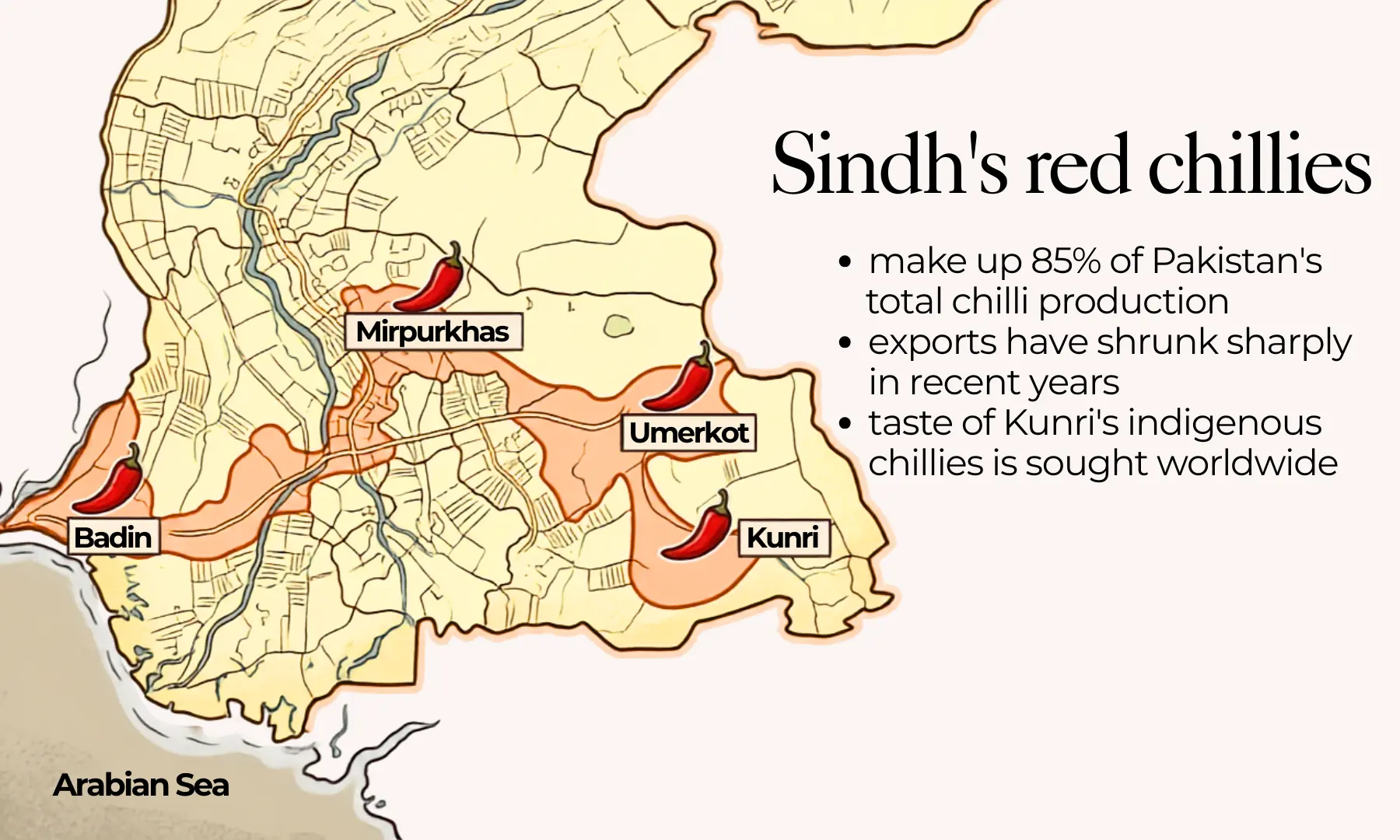
Its aroma is so distinctive that it can be identified from afar by the breath-stopping kick it delivers to the top of the nose. But it has more bark than bite. Abbas Datwesh, a grower, picks a button-shaped one, pops it into his mouth and chews it as proof. “See,” he says, “it’s the flavour—not too spicy, not at all bitter.” This gustatory reputation was Pakistan’s calling card in international spice markets for decades and the reason it rules kitchens across Pakistan.
“This is what the world wants,” says grower and exporter Hamayoon Sattar. Kunri’s Mirch Mandi wholesale market trades over 100,000 tonnes of chillies every year. But Dundicut’s sales are collapsing. Its harvests have more than halved for two reasons: it doesn’t make enough money, and hybrid seeds do. Dundicut/Longi earns Rs100,000 in profit per acre, but the hybrid Sanam seed rakes in eight times that.

No comments yet. Be the first to comment!

Your trusted source for breaking news, in-depth analysis, and comprehensive coverage of today's most important stories.
Get daily updates on breaking news, exclusive interviews, and special features delivered to your inbox.
Have a news tip or want to get in touch with our editorial team? We're here to help.
Plot C3-C Jaypee Wishtown Sector 129 Noida Uttar Pradesh 201304 India