
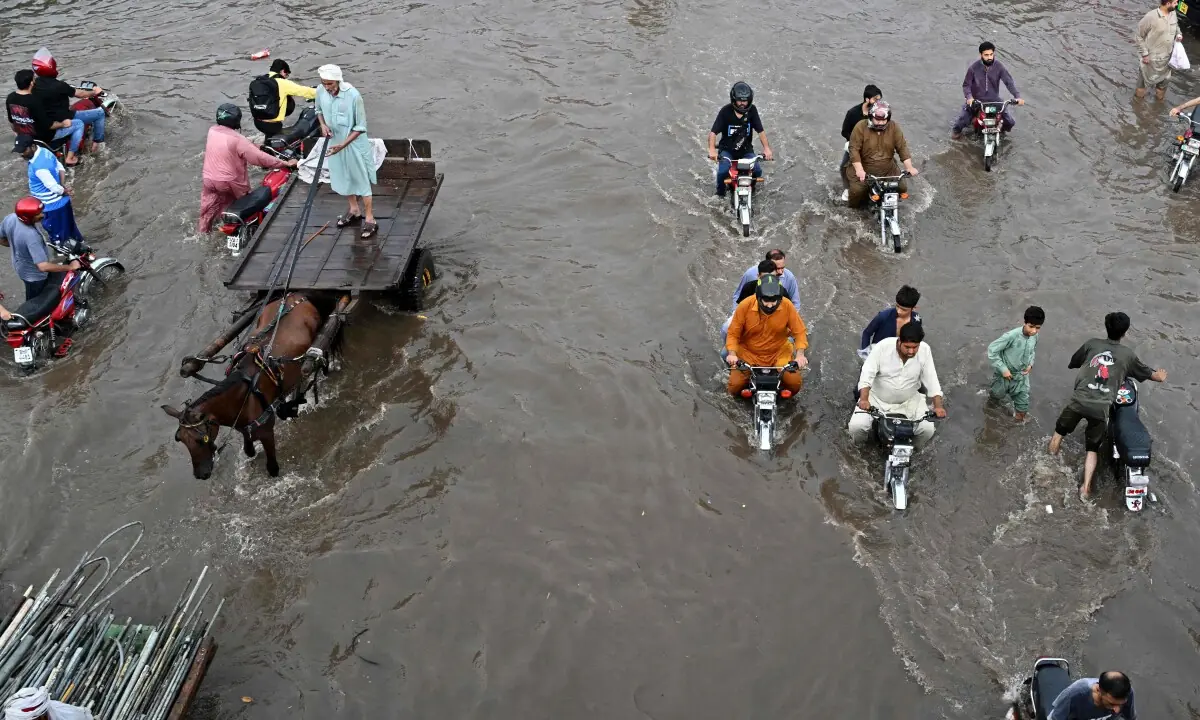
• Flash floods, landslides damage roads, vehicles, crops and houses
• Villages inundated as Punjab records heavy rainfall
• Chenab flows surge at Marala, Khanki, Qadirabad as India released excess water
PESHAWAR/LAHORE: At least 37 people have died in rain-related incidents as the ongoing monsoon spell triggered flash floods and landslides, damaging houses, crops, livestock and roads in Khyber Pakhtunkhwa, Gilgit-Baltistan, Azad Jammu and Kashmir and Punjab.
While people were still grappling with the impact of the catastrophe in many districts, including Gujranwala and Sialkot, which received record 245mm and 139mm rainfall, India increased the release of excess water substantially without officially confirming the data.
The provincial disaster management authority (PDMA) placed Marala and Khanki headworks at medium flood level and Qadirabad at low flood level.
On the other side, the death toll from flash floods and other rain-related incidents rose to 20 in Khyber Pakhtunkhwa and 17 in Punjab, while landslides triggered by rains in KP, GB and AJK damaged roads, crops and houses.
According to the Pakistan Meteorological Department, the current rain spell, which began on July 19, is expected to continue in KP till July 23.
The latest fatalities in KP were reported from North Waziristan, where two men drowned after being swept away by a flash flood in the Tochi River, Rescue 1122 spokesperson Noor Islam said, adding that the bodies were recovered from the river later.
The official warned rains had resulted in exceptionally high water levels in the Tochi River, where flood-like conditions persisted. However, the KP PDMA said water levels and flows in all rivers and streams across the province were currently normal, and all district administrations had been directed to remain on alert.
Earlier, a family of four including two children died when their house roof collapsed in Sararogha tehsil of Upper South Waziristan, Additional Deputy Commissioner Fazal Wadood said.
A report released by the KP PDMA earlier in the day, which did not account for the North Waziristan drownings, said 18 people had died and 19 had been injured in rain-related incidents across the province since Sunday.
Property damaged
The authority said 23 houses had been partially damaged and seven destroyed, while 13 cattle had perished during the four days.
Heavy rains also disrupted routine life in Lower South Waziristan, where landslides blocked the Wana-Gomal Zam Road, one of the most important trade and communication routes in the region.
There were also reports of flash floods damaging agricultural land in several areas. A district official confirmed the road blockage to Dawn on Wednesday following landslides. Residents said large boulders had fallen from mountains at several points along the road, while deep potholes had developed at various locations. They said several culverts, bridges and protection walls had also been damaged.
Rains across Punjab
As intermittent heavy rain lashed several cities in Punjab, with Gujranwala being the worst hit, the death toll jumped to 17.
Of the deaths, 12 were caused by the collapse of buildings or other structures, two by lightning strikes and three from electrocution, the PDMA said.
According to the Water and Sanitation Agency, a record 245mm was recorded in Gujranwala, while Lahore received 123mm of rainfall, Sialkot received 139mm of rainfall and Mandi Bahauddin received 138mm. The PDMA said 117mm rainfall was recorded in Narowal, 85mm in Hafizabad, 95mm in Gujrat, 70mm in Chakwal, 64mm in Okara, 35mm in Jhang, 33mm in Layyah and 32mm in Jhelum.
River flows rise
Water levels in the River Chenab continued to rise, with a moderate flood recorded at Marala Headworks on Wednesday. At Marala Barrage, inflows increased from 84,895 cusecs on Tuesday morning to 132,169 cusecs by Wednesday noon and then to 275,608 cusecs at night. Outflows rose from 62,622 cusecs to 113,169 cusecs and then to 258,608 cusecs, respectively.
The rising trend was also recorded downstream. According to PDMA data released at 9pm on Wednesday, water flow at Qadirabad Barrage increased from 97,653 cusecs to 158,539 cusecs, while Khanki Barrage registered an increase from 113,548 cusecs to 214,330 cusecs. At Trimmu Barrage, inflows rose from 33,601 cusecs to 64,483 cusecs.
Meanwhile, the PDMA rejected reports circulating on social media and some news channels claiming that a 900,000 cusec flood wave was moving through the Chenab River.
In Narowal, erosion continued at two points along the Dek drain, putting nearby villages and agricultural land at risk. Residents said the embankment near Bale Bajwa village suffered erosion. They said a breach could damage several villages, including Chak Isa, Wayan, Shahzada, Mehndipur and Khede.
Residents also reported erosion near Dogri Hindlan village in Pasrur tehsil and called for urgent action by the district administration and irrigation authorities.
Floods, landslides hit GB
In Gilgit-Baltistan, cloudburst-induced floods and landslides caused damage in Losbala village of Astore district, while the Astore Valley Road was closed after erosion and landslides.
According to the Gilgit-Baltistan Disaster Management Authority, flash floods and landslides following a cloudburst damaged homes, agricultural land, electricity supply, water channels, crops, livestock and infrastructure in Astore.
The Communication and Works Department Astore said a severe landslide at Kachek had diverted the Astore River towards the road, causing erosion and damage to the Astore Valley Road, which was closed to traffic until further notice.
Authorities advised passengers and tourists to avoid unnecessary travel, saying emergency measures were under way to restore the road.
Local people said several travellers, including tourists, had been stranded.
The GBDMA said relief operations were continuing in Astore. It said rising water levels in rivers and streams following rapid glacier melt had put roads and bridges at risk in several areas. A bridge on the Shimshal Valley road in Hunza and a suspension bridge in Bagrot were also under threat.
In Gilgit’s Jutal area, rising water in the Hunza-Nagar River placed eight households at risk.
The Met Office has forecast rain and warned of possible glacial lake outburst floods in Gilgit-Baltistan till July 26.
A.K. Wazir in South Waziristan, Haji Pazir Gul in North Waziristan, Imran Gabol in Lahore and Jamil Nagri in Gilgit contributed to this report
Published in Dawn, July 23rd, 2026

No comments yet. Be the first to comment!

Your trusted source for breaking news, in-depth analysis, and comprehensive coverage of today's most important stories.
Get daily updates on breaking news, exclusive interviews, and special features delivered to your inbox.
Have a news tip or want to get in touch with our editorial team? We're here to help.
Plot C3-C Jaypee Wishtown Sector 129 Noida Uttar Pradesh 201304 India