
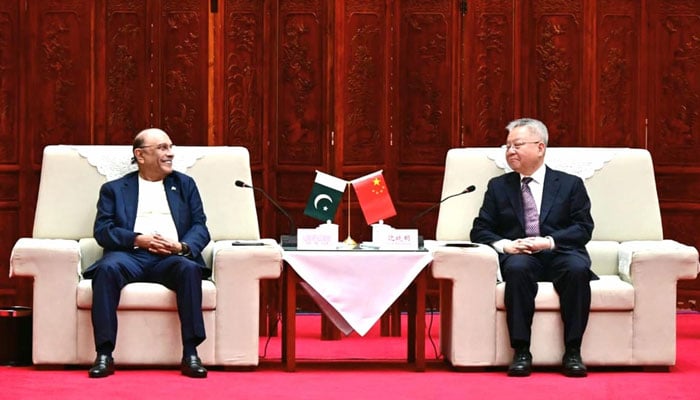
HAINAN, China - President Asif Ali Zardari witnessed the signing of a joint venture and two memorandums of understanding (MoUs) in Hainan province on May 1, 2026, marking a significant expansion of Pakistan-China economic cooperation under the second phase of the China-Pakistan Economic Corridor (CPEC).
The agreements span three critical sectors: livestock and animal health, construction machinery, and healthcare robotics. The signing ceremony underscores Pakistan's commitment to deepening its all-weather strategic partnership with China while attracting advanced technology and investment to support the country's economic development.
Parties: Sindh Livestock Department and Luoyang Modern Biology
Scope of Cooperation:
Production of animal vaccines to protect livestock from diseases
Animal traceability systems to monitor health and movement
Technical collaboration to improve veterinary services
This agreement directly benefits Sindh's massive livestock sector, which is a cornerstone of the province's rural economy. Modern vaccines and traceability systems will help prevent disease outbreaks, increase meat and dairy production, and potentially open export markets for Pakistani livestock products.
Parties: Al Hassan Trade Co. with Sany Heavy Industry and Hainan Jiaolong Industry
Scope of Cooperation:
Joint venture for construction machinery and equipment
Support for CPEC Phase II infrastructure projects
Technology transfer and local assembly opportunities
Sany Heavy Industry is one of China's largest construction equipment manufacturers. This joint venture will ensure that CPEC Phase II projects have reliable access to high-quality machinery while potentially establishing local assembly or maintenance facilities in Pakistan.
Parties: Dr. Ziauddin Hospital (Karachi) and Shenzhen Weibang Healthcare Robotics
Scope of Cooperation:
Introduction of healthcare robotics to Pakistani hospitals
Modernization of surgical and patient care capabilities
Knowledge exchange and technical training
This MoU brings cutting-edge medical technology to Pakistan. Shenzhen Weibang specializes in healthcare robotics, including surgical assistance robots, rehabilitation devices, and hospital automation systems. The partnership will modernize Dr. Ziauddin Hospital's capabilities and could serve as a model for healthcare technology adoption across Pakistan.
President Zardari, who is on a week-long visit to China marking 75 years of Pakistan-China diplomatic relations, expressed satisfaction with the agreements. He noted that these pacts represent practical, people-centric cooperation that will directly improve the lives of ordinary Pakistanis.
The President emphasized that CPEC Phase II is shifting from infrastructure-heavy projects to agriculture, health, technology, and industrial cooperation - areas where the benefits flow directly to citizens.
The agreements come at a critical time for Pakistan's economic recovery. With foreign exchange reserves stabilizing and investor confidence gradually returning, the government has prioritized:
Agricultural modernization: Livestock accounts for nearly 60 percent of Pakistan's agricultural GDP. Modern vaccines and traceability systems can dramatically increase productivity and export potential.
Industrial development: The construction machinery joint venture will support CPEC infrastructure while potentially creating local jobs. Pakistan could eventually become a regional hub for equipment assembly and maintenance.
Healthcare advancement: Healthcare robotics is a multi-billion dollar global industry. Early adoption positions Pakistan's private healthcare sector at the technological frontier.
These agreements reflect the evolving nature of Pakistan-China economic cooperation. While CPEC Phase I (2015-2025) focused on energy and transport infrastructure, Phase II emphasizes:
Agricultural cooperation to achieve food security and boost exports
Special Economic Zones to promote manufacturing and job creation
Information Technology collaboration and knowledge transfer
Healthcare and education partnerships for human development
Green energy and environmental sustainability
The Hainan agreements perfectly align with this vision, bringing Chinese technology and investment into sectors with direct citizen impact.
Officials from both countries praised the agreements as "key steps" for Pakistan's industrial, agricultural, and health sectors.
Sindh Government representatives noted that the livestock MoU will transform animal husbandry in the province, reducing disease prevalence and increasing meat and milk production.
Dr. Ziauddin Hospital officials expressed excitement about introducing robotics to healthcare delivery, noting that Pakistani patients should not have to travel abroad for advanced robotic surgery.
Chinese partners reaffirmed their commitment to technology transfer and long-term cooperation, with Sany Heavy Industry representatives noting that Pakistan's construction sector has immense growth potential.
President Zardari's visit, which runs from April 25 to May 1, 2026, has already seen multiple agreements signed, including:
Seawater desalination plants for Karachi
Agricultural technology transfer
Tea cultivation cooperation
Renewable energy and electric vehicle discussions
The Hainan agreements add livestock, construction machinery, and healthcare robotics to this growing portfolio of cooperation.
As President Zardari concludes his week-long visit, the message from Beijing and Hainan is clear: China remains Pakistan's most reliable partner in economic development. The 75th anniversary of diplomatic relations is not merely a celebration of past friendship but a launchpad for future cooperation.
For Pakistan, these agreements represent jobs, technology, and economic growth. For China, they represent a strategic partnership that stabilizes the region and opens markets for Chinese products and expertise.
The people of Pakistan can expect to see concrete benefits from these pacts in the coming years - healthier livestock, better-equipped hospitals, and CPEC infrastructure built with reliable, modern machinery.


No comments yet. Be the first to comment!

Your trusted source for breaking news, in-depth analysis, and comprehensive coverage of today's most important stories.
Get daily updates on breaking news, exclusive interviews, and special features delivered to your inbox.
Have a news tip or want to get in touch with our editorial team? We're here to help.
Plot C3-C Jaypee Wishtown Sector 129 Noida Uttar Pradesh 201304 India