
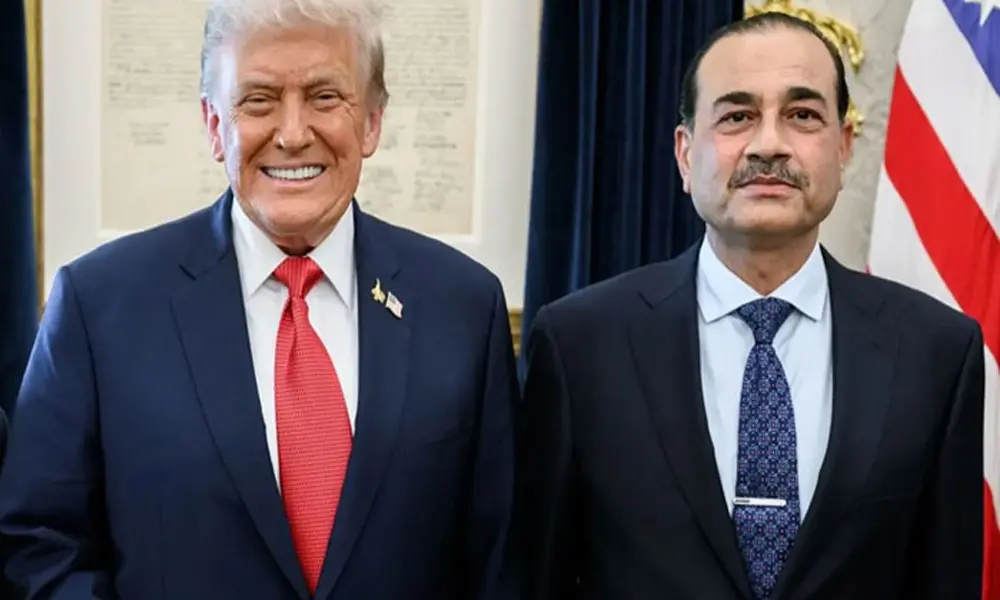
WASHINGTON DC - US President Donald Trump has once again publicly praised Pakistan's military leadership, specifically hailing "The Great Leader Field Marshal Asim Munir" for his instrumental role in facilitating peace negotiations between the United States and Iran.
⚡️🇵🇰🇺🇸
- Zard si Gana (@ZardSi) June 10, 2026
US President Trump once again praised The Great Leader Field Marshal Asim Munir for his efforts to help bring peace between Iran and US.
“I gave them a break at the request of Pakistan. The Field Marshal and the Prime Minister of Pakistan are great. pic.twitter.com/FIwpJPaaaf
Speaking to reporters, Trump credited Pakistan's leadership for securing a ceasefire and advancing diplomatic efforts to end the prolonged conflict in the Middle East, stating that he granted the pause in military operations "at the request of Pakistan" .
'The Field Marshal and the Prime Minister of Pakistan are Great'
In his latest remarks, Trump lauded both Prime Minister Shehbaz Sharif and Field Marshal Munir, describing them as "great" and "outstanding personalities" . The President emphasized that he agreed to the ceasefire as a direct response to Islamabad's diplomatic intervention.
"We really did the ceasefire at the request of other nations," Trump stated while aboard Air Force One. "I wouldn't have really been in favor of it, but we did it as a favor to Pakistan - terrific people, the field marshal and the prime minister" .
Trump has previously referred to Field Marshal Munir as his "favorite field marshal" and an "exceptional man" . The warmth of the relationship was underscored in June 2025 when Trump hosted the Pakistani military chief at the White House for a working lunch - a rare honor typically reserved for heads of state rather than military leaders .
The 'Request of Pakistan' Phenomenon
Trump's recurring phrase - "at the request of Pakistan" - has become a hallmark of the administration's public discourse regarding the Iran conflict. The President has consistently emphasized that key decisions, including the initial ceasefire in early April and subsequent extensions, were granted as accommodations to Pakistani leadership .
In April, Trump announced the extension of a two-week ceasefire, explicitly crediting Pakistan's mediation. He wrote on Truth Social that the pause was granted "based on the request of Pakistan and other countries" . More recently, he acknowledged that Pakistan's Prime Minister and Field Marshal "played an important role in de-escalating the situation" .
Pakistan's Unique Diplomatic Role
The prominent recognition from Washington underscores Pakistan's emergence as an indispensable mediator in one of the world's most volatile conflicts. As the world's only predominantly Muslim nuclear power, Pakistan possesses rare credibility with both Washington and Tehran .
Field Marshal Munir has personally made multiple visits to Tehran as part of the mediation efforts, the most recent on May 21, 2026 . Islamabad also hosted the highest-level direct talks between US and Iranian officials since 1979, with Vice President JD Vance representing the United States .
A Historic Shift in US-Pakistan Relations
Analysts note that Trump's warm relationship with Pakistan's military leadership represents a significant departure from his first term, during which he suspended security assistance to Islamabad and accused the country of harboring militant leaders .
According to a Vox analysis, Pakistan's prominent diplomatic role in the current conflict is "the latest sign of the unexpectedly close relations between the country's government and the second Trump administration" . The US administration has reportedly come to view Islamabad as a "trusted intermediary and diplomatic facilitator" capable of engaging simultaneously with the United States, China, Saudi Arabia, and Iran .
The Stakes of the Negotiations
Despite Trump's warm praise for Pakistani leadership, the underlying negotiations remain delicate. The US president has warned that time is running out for a deal, stating that "Iran should sign the agreement immediately" and warning of renewed military action if Tehran does not comply .
Trump has reiterated that Iran will not be allowed to develop nuclear weapons under any circumstances, while acknowledging that a deal was close before being disrupted by unspecified actors within Iran .
A ceasefire brokered with Pakistan's assistance has held since early April, halting the war that began on February 28, 2026, when US and Israeli forces launched strikes on Iranian military installations. However, a permanent agreement to end the conflict and reopen the Strait of Hormuz has yet to be finalized .
What Comes Next
With Field Marshal Munir having established direct channels to both Washington and Tehran - and with President Trump repeatedly expressing personal confidence in Pakistan's leadership - Islamabad remains uniquely positioned to bridge the remaining gaps between the two adversaries.
As one diplomatic observer put it: "When the President of the United States calls your military leader 'great' and credits him personally for a ceasefire, that is not just diplomacy. That is a strategic partnership."

No comments yet. Be the first to comment!

Your trusted source for breaking news, in-depth analysis, and comprehensive coverage of today's most important stories.
Get daily updates on breaking news, exclusive interviews, and special features delivered to your inbox.
Have a news tip or want to get in touch with our editorial team? We're here to help.
Plot C3-C Jaypee Wishtown Sector 129 Noida Uttar Pradesh 201304 India
