
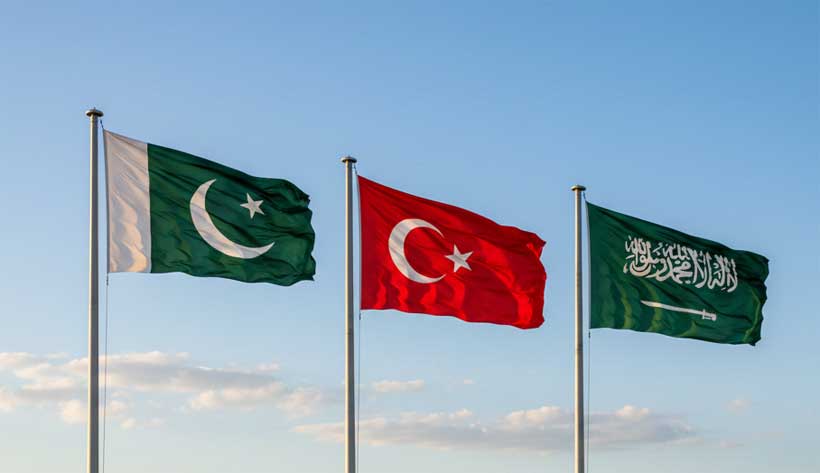
ISLAMABAD / RIYADH / ANKARA - Pakistan, Saudi Arabia, and Türkiye are poised to sign a landmark trilateral intelligence and security agreement during Saudi Crown Prince Mohammed bin Salman's upcoming visit to Türkiye, marking a major step toward what analysts have dubbed a "Muslim NATO."
The agreement would formalize a strategic partnership between three of the most powerful nations in the Islamic world, combining Saudi Arabia's financial muscle, Pakistan's nuclear deterrent, and Türkiye's advanced military-industrial complex and combat experience .
🚨⚡️BREAKING
- Zard si Gana (@ZardSi) June 11, 2026
Pakistan, Saudi Arabia and Türkiye are set to sign a special agreement for a proposed intelligence and security alliance during Crown Prince Mohammed bin Salman’s visit to Türkiye.
A major step toward a “Muslim NATO.” pic.twitter.com/RJIcOXgcH2
From Bilateral to Trilateral Framework
The foundation for this emerging alliance lies in the Strategic Mutual Defence Agreement (SMDA), signed between Pakistan and Saudi Arabia in September 2025 during Prime Minister Shehbaz Sharif's visit to Riyadh . The SMDA contains a collective defense clause closely resembling NATO's Article 5, treating an attack on one signatory as an attack on all .
Turkish officials have been in advanced negotiations to join this framework since early 2026 . In January, Turkish Foreign Minister Hakan Fidan hinted at Ankara's interest, calling for urgent deeper regional cooperation and stating that longstanding regional problems could be resolved if countries trusted one another .
Pakistan's Defence Minister Khawaja Asif confirmed in May that Turkey and Qatar are "likely candidates" for future inclusion in or parallel agreements with the existing SMDA framework . However, some sources have suggested Turkey will not formally join the original SMDA itself, but may enter a parallel tripartite arrangement that maintains the essence of collective security cooperation .
A 'Complementary Power Architecture'
Analysts describe the proposed trilateral framework as a "complementary power architecture" that leverages each nation's unique strategic assets :
Saudi Arabia provides immense financial resources and regional diplomatic weight as the largest economy in the Arab world, underwriting joint projects and defense initiatives .
Pakistan contributes strategic depth through its large military, ballistic missile capabilities, and its status as the only Muslim-majority nuclear weapons state. Reports suggest Pakistan's nuclear capabilities could factor into Saudi defense planning under the existing pact .
Türkiye brings substantial conventional military power, extensive combat experience, and a rapidly expanding defense industry, particularly in drone technology such as the Bayraktar TB2, which played a decisive role in Pakistan's military operations .
"The expanded alliance would make strategic sense as Turkey's interests increasingly overlap with those of Saudi Arabia and Pakistan across South Asia, the Middle East and Africa," Nihat Ali Ozcan, a strategist at Ankara-based think tank TEPAV, told Bloomberg .
Intelligence and Security Cooperation
Beyond conventional defense, the forthcoming agreement is expected to include robust intelligence-sharing mechanisms and counterterrorism coordination. This intelligence and security pillar would formalize cooperation that has already been operational in response to regional threats, including militant networks operating along Pakistan's western border and evolving security challenges in the Middle East.
Implications for Regional Balance
The emergence of this trilateral axis has drawn attention from global powers and regional rivals alike. India, in particular, has expressed concern, viewing the alignment as a direct challenge to its security environment . Turkey's active military support for Pakistan during Operation Sindoor in May 2025 - including the supply of hundreds of drones and trained personnel - demonstrated the operational reality of this deepening partnership .
Israel has also taken note, with some strategic commentators warning that a more cohesive Sunni military grouping involving Turkey and Qatar could constrain Israel's operational freedom .
A New Security Architecture
The agreement, expected to be finalized during Crown Prince Mohammed bin Salman's visit to Türkiye, would mark a formal elevation of ties that have grown increasingly close since the signing of the original SMDA. It signals a broader realignment in which regional powers are seeking to diversify security guarantees amid uncertainty over long-term US commitments .
For Saudi Arabia, Türkiye, and Pakistan, this is more than a symbolic gesture. It is a practical recognition that in an increasingly multipolar world, collective security among like-minded powers is no longer an option - it is a necessity.

No comments yet. Be the first to comment!

Your trusted source for breaking news, in-depth analysis, and comprehensive coverage of today's most important stories.
Get daily updates on breaking news, exclusive interviews, and special features delivered to your inbox.
Have a news tip or want to get in touch with our editorial team? We're here to help.
Plot C3-C Jaypee Wishtown Sector 129 Noida Uttar Pradesh 201304 India
