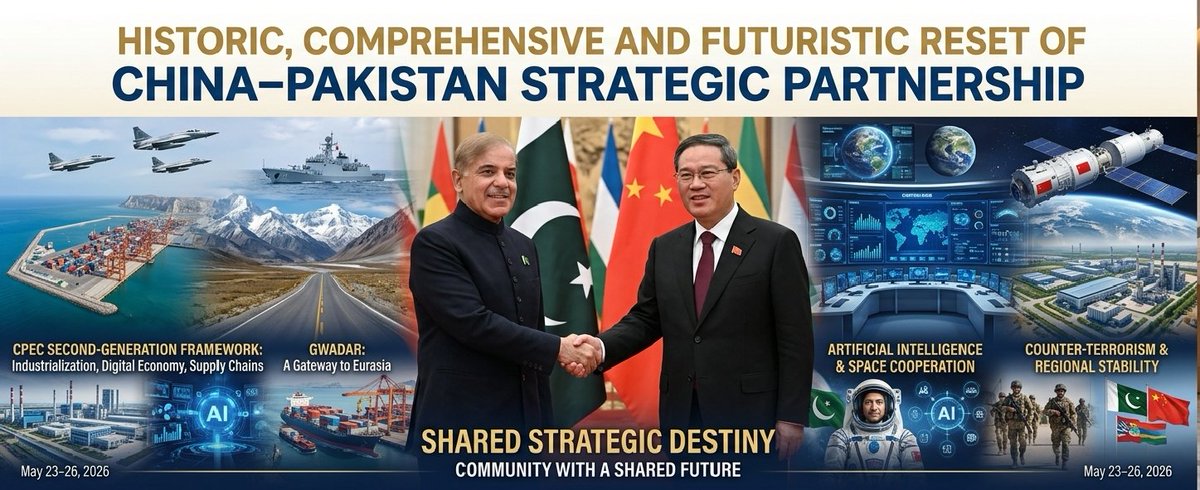
During May 23–26, 2026, Prime Minister Shehbaz Sharif's official visit to China at the invitation of Premier Li Qiang culminated in a historic, comprehensive joint statement described by officials as futuristic and transformative. The document is pitched as a deep consolidation of the Pakistan-China strategic partnership, outlining a long-term roadmap across energy security, trade, technology, and regional cooperation. It emphasizes accelerated infrastructure financing under the Belt and Road framework, expanded energy ties including diversification of supply, and joint ventures in high-tech sectors such as digital connectivity, green energy, and smart-city pilots. For Pakistan, the statement signals potential gains in economic resilience, industrial upgrading, job discovery, and enhanced regional connectivity through new corridors. For China, it reinforces a trusted alliance amid shifting geopolitical currents, with implications for its influence in South Asia and the shaping of regional trade routes. The analysis considers both upside and risk: tangible development and greater regional integration if governance, transparency, and procurement are credible, versus concerns over debt sustainability, project prioritization, and local impact if oversight lags. Opinion: if translated into well-governed, transparent projects, the pact could deliver meaningful development and stability for the region; if mismanaged, it could heighten debt pressures and erode public trust. Overall, the statement signals a forward-looking trajectory in Pakistan-China relations with potential ripple effects across Asia's economic architecture.
Source: Statement from @Rimland_Intel
Public Engagement: 67 views • 1 comments
Published: May 26, 2026, 1:57 am
Editorial Note: This article is based on publicly available information and official statements. We strives for accuracy and fairness in all reporting.