

As NASA’s record-breaking Artemis mission bolsters the US path back to the moon, China’s bid to land astronauts there by 2030 is taking on greater geopolitical significance and putting pressure on Beijing to meet or beat its timetable.
Four US astronauts on the Artemis II mission this week flew past the moon’s shadowed far side, travelling deeper into space than any humans before them and setting the stage for Artemis IV to land on the moon in 2028.
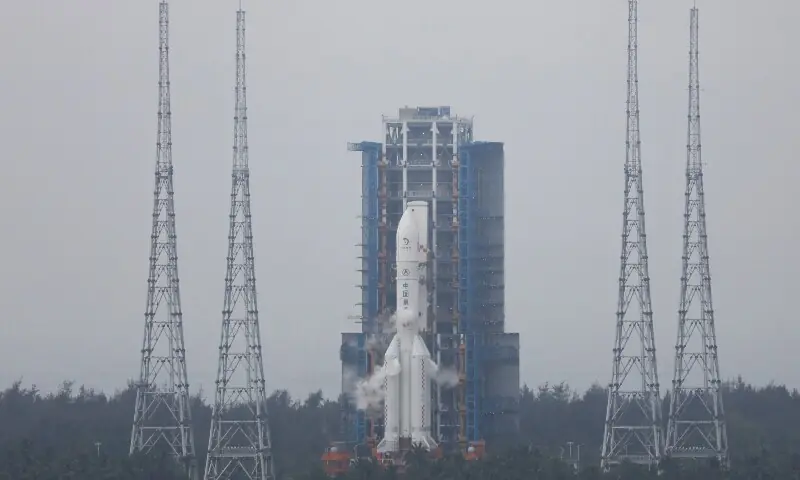
The planned US return after more than half a century is being closely watched in China, which is developing the full architecture for its first crewed landing on the moon, from the Long March-10 rocket to the Mengzhou spacecraft and Lanyue lunar lander.
Beijing has made significant advances in recent years by becoming the first country to return robot-taken samples from both the near and far sides of the moon, and its crewed spaceflight programme has become proficient in operating space stations and handling emergencies in orbit.
“There is no bigger prize for China on the table today than landing people on the moon, this is the essential next step for China on the road to preeminence in space,” said Clayton Swope, deputy director of the Aerospace Security Project at the US-based Center for Strategic and International Studies (CSIS).
Washington and Beijing are also competing in institution-building efforts in preparation for a future when humans have a permanent presence on the moon, with the US-led Artemis Accords on lunar exploration matched up against the Chinese and Russian-led International Lunar Research Station (ILRS).
“The question now is no longer simply who gets there first, but who can stay longer and do more,” Kang Guohua, an aerospace professor at the military-linked Nanjing University of Aeronautics and Astronautics, told China’s state-backed Global Times last week.
A major hurdle for Beijing will be proving an entirely new lunar mission architecture within the next four years, demonstrating all of the hardware being developed for the 2030 mission, from heavy-lift rockets to spacesuits, can work reliably on first use.
China’s manned space agency said in 2023 that the mission would rely on two Long March-10 rockets, one launching a crewed spacecraft and the other a lunar lander. The two vehicles would rendezvous and dock in lunar orbit. Two astronauts would descend to the surface on the lander, collect samples, then return to lunar orbit, redock with the spacecraft and head back to Earth.
“China might avoid directly using language that suggests there is a lunar or space race, but their overall strategic goal is to be the hegemon in space,” said Kathleen Curlee, a research analyst at Georgetown University’s Center for Security and Emerging Technology.
At the same time, China may be moving faster than it admits. Wu Weiren, chief designer of China’s lunar exploration program, told Reuters last year that the 2030 goal was intentionally conservative.
“Eastern peoples always leave a little room when they speak,” he said. “If I can do a 10, I tend to say eight or nine.”

No comments yet. Be the first to comment!

Your trusted source for breaking news, in-depth analysis, and comprehensive coverage of today's most important stories.
Get daily updates on breaking news, exclusive interviews, and special features delivered to your inbox.
Have a news tip or want to get in touch with our editorial team? We're here to help.
Plot C3-C Jaypee Wishtown Sector 129 Noida Uttar Pradesh 201304 India