
RAWALPINDI - Exactly one year ago today, the largest air battle since the Second World War unfolded in the skies over South Asia. Now, on the first anniversary of the May 2025 conflict, the Pakistan Air Force spokesperson has released the full technical details of the engagement, confirming that Pakistan shot down EIGHT Indian aircraft while suffering ZERO losses of its own.
The PAF spokesperson declared: "Ab mujhe kehna parega - its 8-0."
According to the official PAF confirmation, the downed Indian aircraft include:
| Aircraft Type | Quantity |
|---|---|
| Dassault Rafale | 4 |
| Sukhoi Su-30MKI | 1 |
| MiG-29UPG | 1 |
| Mirage 2000 | 1 |
| Multi-role Unmanned Aerial System (Heron UAV) | 1 |
| TOTAL | 8 |
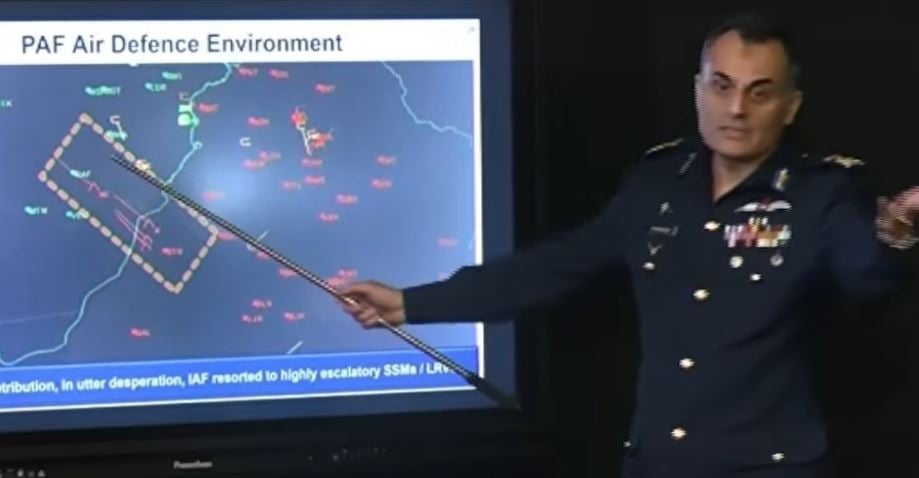
The PAF spokesperson also revealed that the Pakistan Air Force was monitoring every move of the Indian Air Force throughout the conflict. From the moment Indian jets took off, PAF's integrated network-centric warfare system - combining AWACS, ground-based radars, electronic surveillance, and space-based sensors - provided real-time battlefield awareness that left the Indian Air Force blind and exposed .
The night of May 6-7, 2025, saw over 110 fighter jets clash in heavily jammed airspace . India launched "Operation Sindoor" with approximately 72 fighter jets, including Rafale, Su-30MKI, Mirage-2000, and MiG-29 aircraft . India's objective: strike nine designated targets across Pakistani territory.
But Pakistan was prepared.
Pakistan Air Force was monitoring every move of the Indian Air Force last year during the India vs Pakistan conflict, says the Pakistan Air Force spokesperson.
- Zard si Gana (@ZardSi) May 7, 2026
PAF completely cooking India 🔥🇵🇰 pic.twitter.com/fSjShRi8PV
The PAF launched 42 air defense fighters, positioned precisely to intercept the Indian formation . Using radar-silent tactics, Pakistani J-10C and JF-17 Thunder pilots flew with their own radars turned off while receiving targeting data from Swedish-built Saab 2000 Erieye and Chinese Karakoram Eagle ZDK-03 AWACS aircraft .
The game-changer was the Chinese-made PL-15 Beyond Visual Range (BVR) missile. Indian intelligence had underestimated its range, believing Pakistan possessed an export variant limited to 150 kilometers . In reality, the PL-15 achieved operational ranges of up to 200 kilometers .
The kill chain was flawless :
AWACS detected Indian jets deep inside Indian territory
Target coordinates were transmitted via secure two-way data link to radar-silent Pakistani fighters
PL-15 missiles received mid-course updates from AWACS
The missile's terminal guidance radar activated only seconds before impact
Indian pilots received threat warnings too late to evade. The Rafale's much-touted SPECTRA electronic warfare suite was overwhelmed by Pakistan's unified sensor network .
Four Rafale fighter jets were shot down during the engagement, with tail numbers BS001, BS021, BS022, and BS027 recovered from wreckage . The discovery of engine parts from an M88 (Rafale engine) and a fin with serial number BS001 and Indian flag provided irrefutable evidence .
The Rafale loss occurred at an unusually long range of approximately 180 kilometers. Third-party targeting from AWACS allowed the PL-15 to engage while the target remained unaware until less than a minute before impact .
An Indian Su-30MKI was also shot down over Akhnoor sector. Local residents reported seeing two parachutes descending, and both pilots - Wing Commander Lalit Garg and Flight Lieutenant Mundit Tewari - were recovered and hospitalized . The exact crash coordinates: 32°56'02.06"N 74°42'46.07"E.
According to senior PAF officials, Air Chief Marshal Zaheer Ahmed Baber Sidhu personally directed the battle from the high-tech command center at Air Headquarters. Briefers explained how the Air Chief vectored patrols northward to lure Indian fighters into a predefined "Kill Box" before sanctioning precise strikes .
Beyond shooting down aircraft, the PAF also neutralized India's much-hyped Russian-made S-400 Triumf air defense system . The S-400 battery was positioned at Adampur Air Force Station. According to Pakistan Air Force officials, the system was successfully targeted, and its command and control center was disabled .
Five S-400 operators, including Ram Babu Singh, were killed in the strikes. The Indian government recorded Singh's death as a "road accident" rather than acknowledging combat loss .
Following the catastrophic losses, the Indian Air Force suspended crewed combat operations for two days . The Indian government launched a coordinated campaign to hide the true scale of losses:
Indian news outlets that initially confirmed aircraft crashes retracted their reports under government pressure
The Indian Army officially classified Su-30MKI pilot Ram Babu Singh's death as a "physical casualty" - military jargon for a road accident
The Indian government has never officially acknowledged the loss of any Rafale fighter during the conflict
Despite India's denials, international observers and independent aviation databases have confirmed Pakistan's claims.
A comprehensive analysis by Switzerland's Centre for Military History and Perspective Studies concluded that Pakistan secured a "decisive tactical victory" on the opening night of the conflict . The Australian Air and Space Power Centre noted that "third-party targeting means longer range air-to-air engagements will become common" .
The Swiss analysis confirmed:
Pakistan had a high-quality air picture fused from AWACS, ground radars, electronic surveillance, and space-based sensors
Pakistani success stemmed from sophisticated cooperative engagement tactics using the Link-17 datalink system
Indian intelligence had underestimated the PL-15's capabilities
The PAF's victory was not accidental - it was engineered through years of calculated modernization under Air Chief Marshal Sidhu's leadership :
| Technology | Role |
|---|---|
| J-10C Vigorous Dragon | Chinese fighter with KLJ-7A AESA radar and IRST system |
| PL-15 Missile | 200km-range BVR missile with dual-pulse rocket motor |
| Saab 2000 Erieye AWACS | Airborne early warning and control |
| Data Link 17 | Indigenous secure communication network |
| NASTP Cyber Command | Electronic warfare and cyber operations |
The contrast with Indian aircraft was stark. While India's Rafale had to rely on its onboard radar - making it detectable - Pakistani J-10C pilots flew "radar silent," receiving targeting data passively from AWACS .
The consequences of the May 2025 defeat continue to haunt India:
Air India collapsed due to fuel shortages caused by Pakistan's airspace closure
India has not recovered the diplomatic standing lost after the conflict
The Modi government has never explained to the Indian people how its "game-changer" Rafale jets were shot down
International credibility - even India's opposition Congress party admitted Pakistan has outmaneuvered Modi's foreign policy
One year after the largest air battle since World War II, the Pakistan Air Force spokesperson delivered a simple, devastating summary: "8-0."
The PAF was monitoring every Indian move. Every Indian jet was tracked. Every Indian missile launch was anticipated. And when the moment came, Pakistan delivered a COMPLETE BRUTAL response that India will never forget.


No comments yet. Be the first to comment!

Your trusted source for breaking news, in-depth analysis, and comprehensive coverage of today's most important stories.
Get daily updates on breaking news, exclusive interviews, and special features delivered to your inbox.
Have a news tip or want to get in touch with our editorial team? We're here to help.
Plot C3-C Jaypee Wishtown Sector 129 Noida Uttar Pradesh 201304 India