
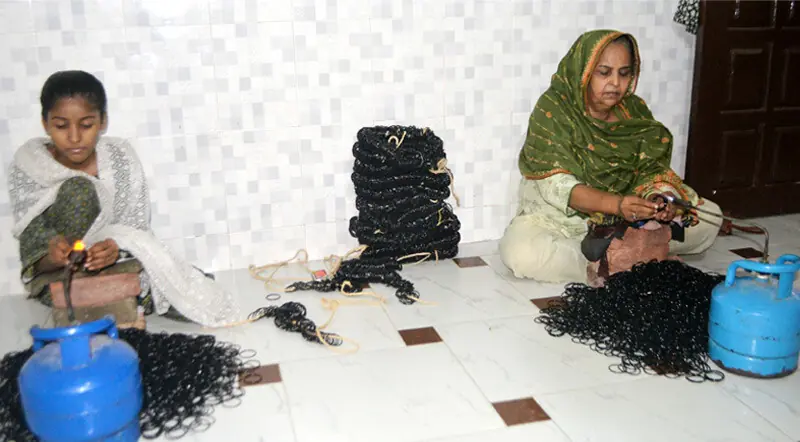
HYDERABAD: Bangle factory owners are facing production losses due to the unavailability of liquefied petroleum gas (LPG) at affordable prices, while the government has long restricted natural gas supply, even for domestic consumers.
Sindh’s traditional bangle industry is largely based in Hyderabad, and many home-based workers are associated with it to earn their livelihood. Either LPG remains unavailable or is being sold at exorbitant rates in the market.
LPG unavailability was primarily due to a human tragedy that struck a middle-class neighbourhood in Paretabad on May 30, 2024, resulting in 27 deaths, including 19 children. Following the tragedy, the administration launched a crackdown on illegal LPG sales, which significantly reduced supply.
“We often have to shut the factory because glass bangles pile up for value addition,” said Glass Bangle Manufacturers Association President Saleem Khan. “Since women are not able to complete the remaining part of raw bangles, the stocks produced in factories remained unutilised. He added that factories also receive zero gas supply during peak hours.
Key processes done by home-based workers remain incomplete
The glass bangles undergo various manufacturing processes before they reach the market for sale. Female home-based workers handle multiple jobs to provide a finished product in the market. These stages are called ‘saddaee’ and ‘jooraee’. Both of these processes were performed at home using gas, either natural gas or LPG. ‘Jooraee’ is a process in which two ends of a bangle are connected while on a flame. ‘Sadai’ is done to smooth the bangle’s surface by placing it on a large tray and gently touching the flame.
Most of these processes are carried out in slum areas of the city, where women, young girls, and even children work to supplement their families’ income. Neighbourhoods like Unit-5, 10, and 12 in Latifabad, Quaidabad, Liaquat Colony, and Gujarat Para are best known for bangle work.
Until two decades ago, these women were paid Rs7 per bunch or a ‘tora’ of unfinished bangles. Now they are paid Rs27 per bunch, according to their union leader, Jamila Abdul Latif. “The workers are unable to perform the job because LPG is unavailable or is being sold at exorbitant rates,” she said.
Hyderabad Small Chamber President Saleem Memon claimed that against a regulated price of Rs309 per kilo, LPG was being sold for Rs450 to Rs500. He said it was sheer exploitation of consumers and, in the absence of natural gas from the government, not only domestic consumers but other sectors were also facing serious problems.
Mr Saleem said that only about 25pc of bangle supplies are reaching the market due to the present situation. “Even if natural gas is supplied to factories, the processes done at homes remain incomplete, and then the production losses start accumulating.”
Jamila was of the view that, as the natural gas supply was already restricted, workers turned to procuring LPG from far-flung areas, which added to their overhead costs, making it unviable for them to earn their livelihood.
Published in Dawn, June 28th, 2026

No comments yet. Be the first to comment!

Your trusted source for breaking news, in-depth analysis, and comprehensive coverage of today's most important stories.
Get daily updates on breaking news, exclusive interviews, and special features delivered to your inbox.
Have a news tip or want to get in touch with our editorial team? We're here to help.
Plot C3-C Jaypee Wishtown Sector 129 Noida Uttar Pradesh 201304 India