
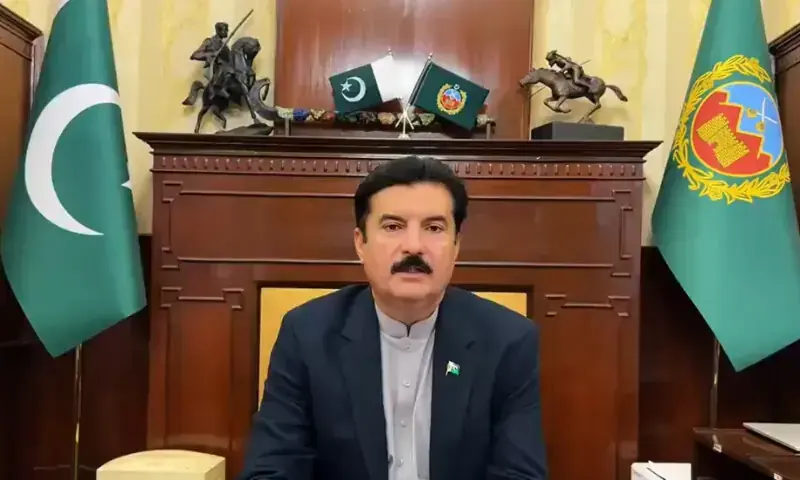
Khyber Pakhtunkhwa Governor Faisal Karim Kundi on Friday urged the National Assembly speaker and the Senate chairman to convene a meeting for deciding on a single bill for lawmakers’ privileges.
His remarks come after the KP Assembly passed the KP Provincial Assembly (Powers, Immunities and Privileges) Act, 2026 on April 30. The law expanded provincial assembly members’ powers and immunities, including the issuance of lifetime official passports to them and their spouses.
Kundi had assented to the law, alongside others, on May 6. However, following backlash, KP Chief Minister Sohail Afridi this week ordered a review of the new law’s provisions.
In a post on the social media platform X, Kundi called on National Assembly Speaker Ayaz Sadiq and Senate Chairman Yousuf Raza Gilani to “immediately convene a meeting of the speakers of all four provincial assemblies and agree on a single, harmonised bill governing the salaries, privileges and entitlements of legislators across Pakistan”.
“No province should legislate extraordinary privileges for itself while expecting the people to embrace austerity,” he said, adding that salaries, security, official passports, allowances and “every other entitlement” should be “uniform across the federation, ensuring one standard for all”.
“A harmonised national framework is the only way to ensure fairness, accountability and public confidence,” he said.
The post came shortly after he appeared to distance himself from KP’s new law, saying that his observations were “on record” and that “public money belongs to the people”.
In a separate post on X, Kundi said his observations had been “on record since May” and that he had made it clear that “no law should become a means of expanding privileges when the people of Pakistan, especially the people of KP, were being asked to endure austerity and economic hardship”.
He said he had urged that the law be implemented “in the true spirit of fiscal discipline and prudent use of public resources”, adding that “a government that speaks of financial constraints cannot, in the same breath, legislate greater privileges for those in power”.
“My position was clear then, and it remains unchanged today: public money belongs to the people, not to the perks of those who govern them,” Kundi said.
In a copy of his observations published with the post, he recommended that the provincial assembly’s finance committee implement the spirit of the prime minister’s 14-point austerity measures, including expenditure cuts, fuel rationing and the elimination of unnecessary privileges.
He also suggested that the committee reconsider the law to operationalise those principles “in true letter and spirit”.
The privileges law expands provincial assembly members’ powers and immunities, including the issuance of lifetime official passports to them and their spouses, blanket immunity from preventive detention, and entitlement to licences for up to eight non-prohibited-bore weapons.
Through the KP Provincial Assembly (Powers, Immunities and Privileges) Act, 2026, the government repealed the 1988 law on the matter. Although most provisions of the repealed law were retained in the new legislation, certain changes were made to expand the privileges of assembly members.
The 1988 law provided that members could not be preventively detained during the period commencing 14 days before the start of an assembly session and ending 14 days after its conclusion. It also barred preventive detention during the period commencing seven days before the meeting of a committee of which the member was a part and ending seven days after the meeting concluded.

No comments yet. Be the first to comment!

Your trusted source for breaking news, in-depth analysis, and comprehensive coverage of today's most important stories.
Get daily updates on breaking news, exclusive interviews, and special features delivered to your inbox.
Have a news tip or want to get in touch with our editorial team? We're here to help.
Plot C3-C Jaypee Wishtown Sector 129 Noida Uttar Pradesh 201304 India