
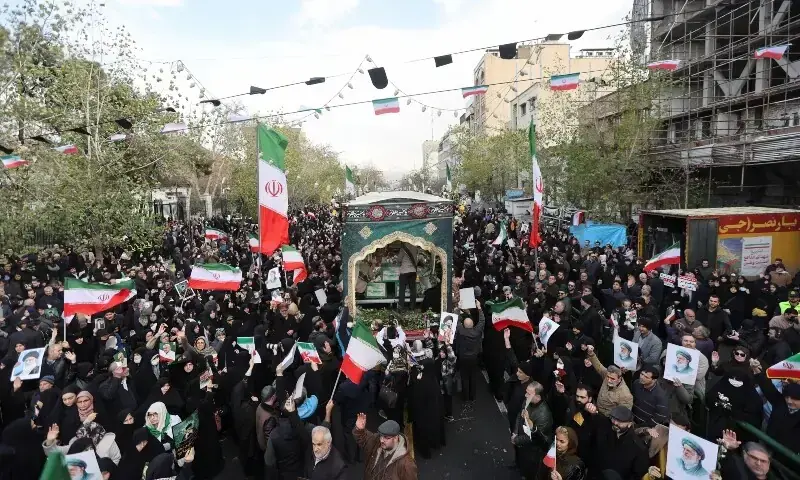
Protests in Iran have subsided after a crackdown by security forces amid an internet blackout, monitors said Friday, a week after the start of the largest demonstrations in years challenging the country’s government.
Reza Pahlavi, the US-based son of Iran’s late shah, however, said he was confident the Islamic republic would fall and called for intervention, though the threat of new military action by the United States against Iran has appeared to have receded for the time being.
In posts to social media on Friday, Pahlavi announced a fresh coordinated demonstration, calling for Iranians to “raise your voices in anger and protest with our national slogans” on the weekend.
Protests sparked by economic grievances started with a shutdown in the Tehran bazaar on December 28 but turned into a mass movement demanding the removal of the clerical system that has ruled Iran since the 1979 revolution.
People started pouring into the streets in big cities from January 8 but authorities immediately enforced a shutdown of the internet that has lasted over a week and activists say is aimed at masking the scale of the crackdown.
The “brutal” repression has “likely suppressed the protest movement for now”, said the US-based Institute for the Study of War, which has monitored the protest activity.
But it added: “The regime’s widespread mobilisation of security forces is unsustainable, however, which makes it possible that protests could resume.”
Pahlavi also told a news conference in Washington on Friday that “The Islamic republic will fall – not if, but when.” “I will return to Iran,” he said.
Monitor Netblocks said that the “total internet blackout” in Iran had now lasted over 180 hours, longer than a similar measure that was imposed during 2019 protests.
Amnesty International said this was being backed up by the use of heavily armed patrols and checkpoints to crush “the nationwide popular uprising in Iran” with security forces visible in the streets.
Trump, who backed and joined Israel’s 12-day war against Iran in June, had not ruled out new military action against Tehran and made clear he was keeping a close eye on if any protesters were executed.
But a senior Saudi official told AFP on Thursday that Saudi Arabia, Qatar and Oman led “a long, frantic, diplomatic last-minute effort to convince President Trump to give Iran a chance to show good intention”.
While Washington appeared to have stepped back, the White House said Thursday that “all options remain on the table for the president”.
Attention had focused on the fate of Erfan Soltani, a 26-year-old protestor who rights activists and Washington said was set to be executed as early as Wednesday.
The Iranian judiciary confirmed Soltani was under arrest but said he had not been sentenced to death and his charges meant he did not risk capital punishment.
Rights groups have estimated up to 20,000 people have been arrested.
Security officials cited by the Tasnim news agency on Friday said around 3,000 people were arrested.
The US Treasury on Thursday announced new sanctions targeting Iranian officials including Ali Larijani, secretary of Iran’s Supreme Council for National Security.
Russian President Vladimir Putin meanwhile held telephone talks with Iranian President Masoud Pezeshkian in what the Kremlin described as “efforts to facilitate de-escalation”.
Despite the internet shutdown, new videos from the height of the protests, with locations verified by AFP, showed bodies lined up in the Kahrizak morgue south of Tehran, as distraught relatives searched for loved ones.
At the UN Security Council in New York, Iranian-American journalist Masih Alinejad, invited to address the body by Washington, said “all Iranians are united” against the clerical system in Iran.
Iran’s representative at the meeting, Gholamhossein Darzi, accused Washington of “exploitation of peaceful protests for geopolitical purposes. “

No comments yet. Be the first to comment!

Your trusted source for breaking news, in-depth analysis, and comprehensive coverage of today's most important stories.
Get daily updates on breaking news, exclusive interviews, and special features delivered to your inbox.
Have a news tip or want to get in touch with our editorial team? We're here to help.
Plot C3-C Jaypee Wishtown Sector 129 Noida Uttar Pradesh 201304 India