
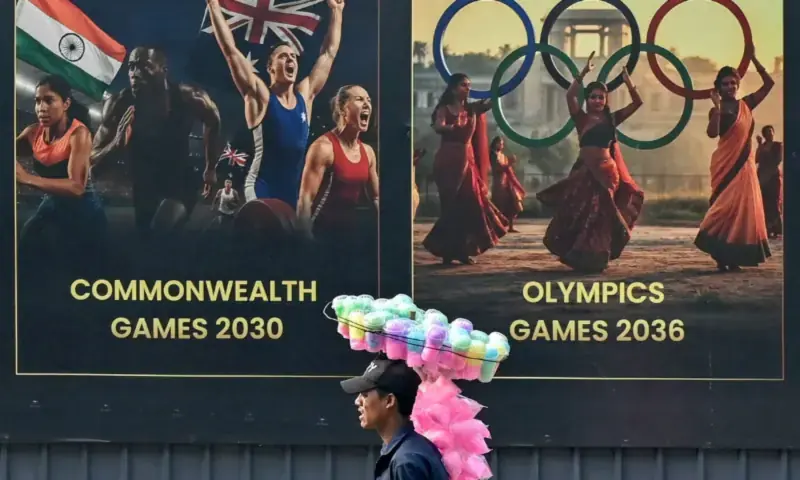
Organisers are confident they can avoid the calamities of last time when India hosts the Commonwealth Games but there are many challenges for a country that also has Olympic ambitions.
Ahmedabad, in Indian Prime Minister Narendra Modi’s home state of Gujarat, was confirmed on Wednesday as the venue for the 2030 Commonwealth Games.
It is seen in India as a stepping stone towards the goal of hosting the 2036 Olympics and authorities hope it will establish the world’s most populous nation as a sporting destination.
A successful Commonwealth Games will also help erase the memories of the 2010 Commonwealth Games in New Delhi, which were marred by accusations of corruption and construction delays.
Ahmedabad already boasts the world’s largest cricket stadium, a 130,000-seat arena named after Modi, which most likely will stage the opening and closing ceremonies.
But beyond that, massive investment in roads, subway lines and sporting facilities are needed to reshape the city of more than seven million people.
Barely five years until the competition is a comparatively short timeframe to get it all done.
Ashwani Kumar, a senior Gujarat official who looks after sports, said Ahmedabad’s existing venues were capable of hosting the Games “withh some modifications”.
New arenas will also be built by “late 2028 or early 2029”.
“We are very confident and we have done good homework as a team,” Kumar told reporters, adding that a budget had been worked out already, without giving figures.
Aside from competition venues, India will need to boost infrastructure for the thousands of athletes, spectators and officials flooding into the city.
Hotels are expected to add thousands of new rooms while the local airport will start construction on a new terminal next year.
“Five years is enough for building our capacity,” said Narendra Somani, president of the Hotels and Restaurants’ Association of Gujarat.
“Also, we expect the government to come up with some industry-friendly policies that would boost the outlook further.” Somani admitted personnel challenges.
“We have a shortage of skilled workers in the hotel industry in Gujarat. We will have to hire workers from other states like Assam and Punjab,” he told AFP on Friday.
The spectre of the 2010 Commonwealth Games looms large.
At the time the Games were meant to showcase India’s status as an emerging global power but headlines were instead about delays, shoddy construction and budget overruns.
English and Australian swimmers blamed Delhi’s swimming pool for contracting a stomach virus while some athletes complained of finding a cobra in the Games village accommodation.
India’s national auditor accused the Delhi government of wasteful spending to the tune of at least $29 million during its “ill-conceived and ill-planned” programme to beautify the city in the run-up to the Games.
A report by the Comptroller and Auditor General also listed several examples of alleged rigged bidding for lucrative contracts to supply timekeeping equipment, lighting fixtures for the glitzy opening ceremony and catering services.
The auditors blamed the organising committee for hyping up projected revenues from the Games to an astronomical 17.8 billion rupees.
“In reality the total committed revenues amounted to just 6.8 billion rupees,” the report said.
The Gujarat government official Kumar admitted that there were “some challenges” in 2010, but said this time was different.
“We all are well prepared. We are very confident that we will deliver the Games which would be remembered in years to come,” said Kumar.
But he also added a note of caution: “We don’t want to overcommit on anything, and would rather learn from the past editions of the Games elsewhere in the world.”

No comments yet. Be the first to comment!

Your trusted source for breaking news, in-depth analysis, and comprehensive coverage of today's most important stories.
Get daily updates on breaking news, exclusive interviews, and special features delivered to your inbox.
Have a news tip or want to get in touch with our editorial team? We're here to help.
Plot C3-C Jaypee Wishtown Sector 129 Noida Uttar Pradesh 201304 India