
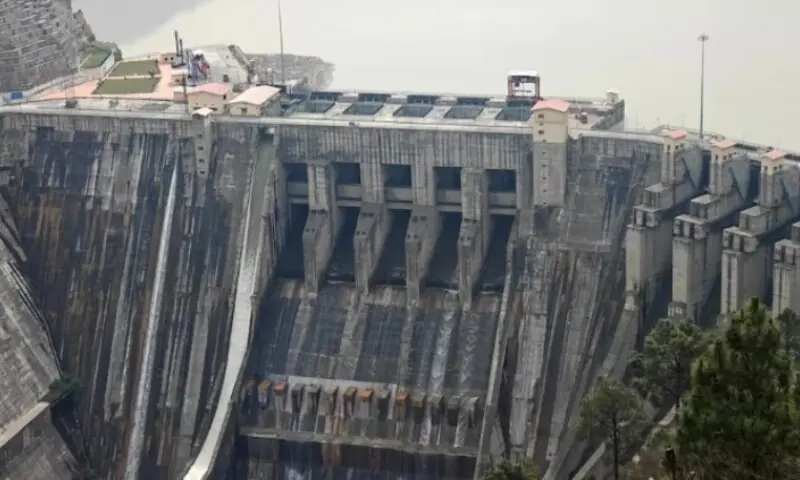
NEW DELHI - India is working to ensure "not a single drop of water" will flow into neighboring Pakistan, Water Minister CR Patil has declared, confirming that New Delhi is actively pursuing plans to permanently cut downstream flows under "directives" from Prime Minister Narendra Modi .
Speaking to India's ANI news agency, Patil stated with certainty that "not a single drop of water will go (to Pakistan) in the coming years," emphasizing that India is "actively working on it" following Modi's directives . The announcement follows India's unilateral suspension of the 1960 Indus Waters Treaty (IWT) in April 2025 after the Pahalgam attack, a decision Islamabad has repeatedly denounced as illegal and without precedent under international water law .
Patil's statement reveals that India has moved beyond rhetoric to implementation. The Water Minister disclosed that Union Home Minister Amit Shah has been tasked by Modi to oversee the water-blockade initiative . Short, medium, and long-term plans are being developed to dam or divert water that, under the Treaty, has historically flowed to Pakistan, with an official stating "It is certain, not a single drop of water will go (to Pakistan) in the coming years" .
However, experts note that India currently lacks the infrastructure-particularly adequate storage facilities on the Jhelum and Chenab rivers-to substantially alter flows in the short term . Any project to achieve Patil's stated goal would take several years to complete and likely not begin before mid-2027, according to an official in Indian-held Kashmir .
Nevertheless, experts analyzing India's shift believe the IWT suspension and associated threats are "unlikely to be reversed," representing a calculated shift toward permanent recalibration rather than temporary leverage . The political will to pursue this course could dramatically accelerate timelines for new infrastructure construction across the Western rivers, even if those timelines remain measured in years rather than months .
The Indus Waters Treaty, signed in 1960 and brokered by the World Bank, has survived full-scale wars, military standoffs, and decades of hostility. It allocates the three Eastern rivers-Ravi, Beas, and Sutlej-to India, while granting Pakistan unrestricted use of the Western rivers-the Indus, Jhelum, and Chenab .
India's suspension of the treaty finds no support in the treaty text. Article XII(3) bars unilateral withdrawal or suspension, requiring express mutual consent for any modification . Pakistan has repeatedly reminded the UN Security Council that India's actions "undermine the letter and spirit of the Treaty, threaten ecosystems, disrupt data-sharing, and endanger the lives of millions who depend on the Indus river system" .
From Islamabad's perspective, any attempt to physically block or divert flows would cross a clear redline. Pakistan has previously declared that any attempt to stop or divert water allocated to Pakistan under the IWT will be considered an "act of war" . The stakes could not be higher: the Indus River system is a lifeline for over 240 million people in Pakistan, supporting agriculture that accounts for a significant portion of the country's economy and food security .
Pakistan has taken the fight to the UN Security Council, urging international intervention to compel India's return to compliance . Ambassador Asim Iftikhar Ahmad has described India's unilateral action as a "textbook example" of deliberate weaponization of shared natural resources, warning that India's continued unilateral suspension of the treaty carries "grave peace and security, and humanitarian consequences" for South Asia .
The 2025 Court of Arbitration award upheld the continuing validity of the treaty and its dispute-resolution mechanisms, affirming that all issues must be resolved within its legal framework . Yet India shows no sign of retreating. The water blockade threat exists alongside India's ongoing refusal to share hydrological data, a longstanding treaty obligation that has been suspended since April 2025 . This lack of data and warning-exemplified by India's surprise water release from the Baglihar and Salal dams on May 5-creates risks of both humanitarian and military escalation .
While Islamabad has consistently advocated for diplomatic and legal resolution, the state reserves the right to respond if water flows are physically blocked. Pakistan believes there is no mechanism to unilaterally withdraw from the treaty, and considers any attempt to change the flow of cross-border waterways as an "act of war" .
If India proceeds with infrastructure projects capable of permanently diverting or storing water from the Western rivers, Pakistan could face an existential crisis-its agriculture, economy, and population dependent on predictable flows. In such a scenario, military options, including targeted strikes on Indian water-control infrastructure, are not off the table. However, Pakistan's preference remains clear: dialogue, adherence to international law, and restoration of the treaty framework.
President Asif Ali Zardari recently declared on the first anniversary of the May 2025 military operation that Islamabad would defend its water rights with "the same resolve it has shown in defense of its territory" . But he also reiterated that Pakistan "seeks no conflict," preferring resolution through established legal channels and diplomatic engagement .
India's water minister has now publicly declared the goal: zero water for Pakistan. While physical infrastructure to achieve this will take years to materialize, the political declaration itself represents an unprecedented rupture in one of the few remaining cooperative frameworks between the two nuclear-armed rivals.
The Indus Waters Treaty, once hailed as a model of transboundary water cooperation, now lies suspended by India's political will. Pakistan insists the treaty remains legally in force. The international community, so far, has offered little more than words .
But one redline remains clear: if India moves from declaration to physical blockade, Pakistan has stated it will not stand idle. The water flow may take years to stop. But the countdown to confrontation has already begun.


No comments yet. Be the first to comment!

Your trusted source for breaking news, in-depth analysis, and comprehensive coverage of today's most important stories.
Get daily updates on breaking news, exclusive interviews, and special features delivered to your inbox.
Have a news tip or want to get in touch with our editorial team? We're here to help.
Plot C3-C Jaypee Wishtown Sector 129 Noida Uttar Pradesh 201304 India