
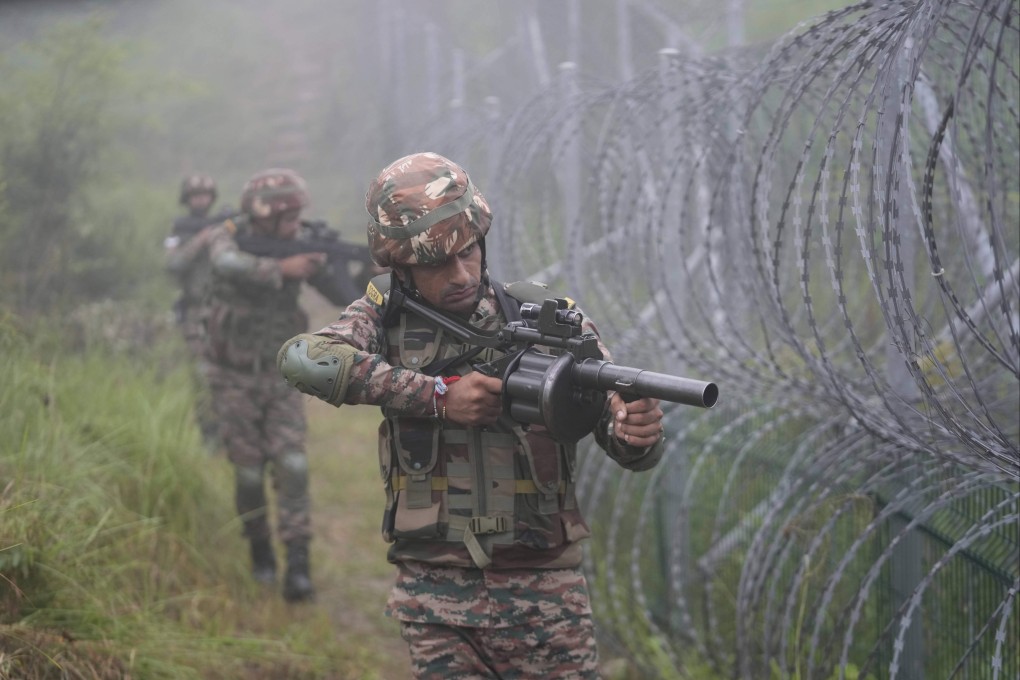
ISLAMABAD - Reports emerging from across the eastern frontier indicate that India is relocating key military assets to the Pakistan border as the first anniversary of last year's four-day war approaches, raising concerns in Islamabad that New Delhi may be planning a provocative action to regain political momentum following its strategic setbacks in 2025.
Intelligence sources and defense analysts have confirmed unusual troop movements and repositioning of armored divisions, artillery batteries, and air defense systems along the Line of Control and the working boundary in Punjab and Sindh sectors. The redeployment comes as India's political establishment faces mounting internal pressure following a year of military humiliation and domestic unrest.
🚨UPDATE: large scale movement of Indian Armed forces toward the Pakistani border, with significant reinforcements and military assets being transported via train. pic.twitter.com/wgvaVi0dgM
- ︎ ︎ ︎ ︎︎ ︎ ︎ ︎︎ ︎ ︎ ︎︎ ︎ ︎ ︎ (@IntelShieldpk) April 30, 2026
The movement of Indian military assets coincides with the approaching anniversary of the four-day war that saw the Pakistan Air Force destroy seven Indian fighter jets, including four Rafale aircraft, and neutralize key components of India's Russian-made S-400 air defense system. The conflict, which ended with a decisive Pakistani victory and zero Pakistani aircraft losses, shook the foundations of India's military establishment.
Indian military analysts and political commentators have openly acknowledged that the May 2025 engagement was a catastrophic defeat for the Indian Armed Forces. The destruction of India's most advanced fighter jets and the exposure of vulnerabilities in its premier air defense system have haunted New Delhi for twelve months.
Credible Indian journalists and strategic affairs commentators are now warning that the Narendra Modi government may be planning a false flag operation similar to the 2019 Pulwama attack to manufacture a casus belli for renewed confrontation with Pakistan.
According to multiple reports circulating in Indian media circles, New Delhi is considering staging an incident that can be blamed on Pakistan-based militants, thereby creating domestic political momentum and diverting attention from India's economic struggles, agricultural protests, and the ruling BJP's increasingly authoritarian governance.
The Palghar analogy is particularly troubling. In April 2020, India witnessed a brutal lynching of two Hindu sadhus and a driver in Palghar, Maharashtra, an incident that was initially blamed on "Pakistan-backed elements" before investigations revealed it was entirely a homegrown mob attack. Analysts fear a similar narrative may be constructed ahead of the war anniversary.
Pakistan's military and civilian leadership have taken note of the Indian military movements and have issued a clear, unambiguous warning to New Delhi: any unprovoked aggression will be met with a decisive and overwhelming response.
A senior military official speaking on condition of anonymity stated:
"Pakistan does not seek war. We have never been the aggressor in any conflict with India. However, any Indian adventure, whether a false flag operation or overt military strike, will be answered in a manner that India will regret for generations. Our forces are fully prepared and have been placed on appropriate alert levels."
Prime Minister Shehbaz Sharif's office has reportedly convened an emergency meeting of the National Security Committee to review the situation and ensure all branches of the armed forces are coordinated in their response posture.
Pakistan's military readiness has been tested and proven in the crucible of last year's conflict. The Pakistan Air Force's air defense network, the Army's integrated battle management systems, and the Navy's coastal defense capabilities all performed exceptionally during the four-day war.
Key advantages Pakistan maintains include:
Air Superiority: JF-17 Thunder and J-10C fighters, now battle-proven against Indian Rafales
Air Defense: Comprehensive multi-layered systems capable of neutralizing Indian aerial threats
Strategic Depth: Operational experience and terrain familiarity along the entire border
Intelligence Capabilities: Enhanced early warning and real-time battlefield awareness
Field Marshal Asim Munir, Chief of Army Staff, has reportedly visited forward positions along the eastern border to personally assess troop readiness and morale. His message to the rank and file has been consistent: the nation's security is in capable hands.
In a parallel development that underscores the deteriorating internal situation in India, social media platforms are seeing a surge of Indian civilians sharing military convoy and troop movement videos. Security analysts note that this phenomenon appears to be driven by two factors:
First, Indian citizens, particularly in opposition-held states, are documenting military movements as a form of protest against what they describe as the Modi government's increasing authoritarianism and religious persecution of minorities. Videos of army convoys heading toward the Pakistan border are being shared alongside condemnation of BJP policies.
Second, the videos reflect a growing anxiety within Indian civil society that their government may be manufacturing a war to distract from domestic crises. By sharing military movements, Indian citizens appear to be signaling their awareness of-and opposition to-potential government adventurism.
Reports from Indian social media suggest that Muslim communities in Uttar Pradesh, Gujarat, and Rajasthan are particularly alarmed, viewing a potential conflict with Pakistan as a mechanism to further suppress minority rights under the cover of wartime national security measures.
The Bharatiya Janata Party is facing significant internal and external challenges that analysts believe may drive it toward external conflict:
Economic Stagnation: Growth remains sluggish, unemployment high, and foreign investment declining
Agricultural Unrest: Farmers continue to protest lack of price support and recurring crop failures
Religious Tensions: Anti-Muslim violence and rhetoric have intensified, alienating significant populations
Opposition Unity: A resurgent opposition alliance has begun to challenge BJP's electoral dominance
Historically, regimes facing domestic crises have resorted to external conflicts to rally nationalist sentiment and suppress dissent. Pakistan is acutely aware of this pattern and has prepared accordingly.
The United States, China, and the United Nations have all issued calls for restraint amid the rising tensions. Washington is particularly concerned about the possibility of a nuclear-armed confrontation in South Asia, which would have catastrophic global economic consequences given the region's location along critical shipping lanes.
Chinese officials have reportedly reached out to both Islamabad and New Delhi to urge dialogue and de-escalation, though Beijing's influence over India is limited given the ongoing border disputes between the two Asian giants.
Pakistan's Foreign Office has initiated a diplomatic offensive, reaching out to friendly nations and international organizations to share intelligence regarding potential Indian false flag operations. Islamabad has requested that the international community pressure New Delhi to refrain from reckless military adventurism and instead focus on resolving disputes through dialogue.
Foreign Minister Ishaq Dar is expected to brief the United Nations Security Council on the situation, presenting evidence of Indian troop movements and warning of the consequences of another Indian miscalculation.
Pakistan's message to India is clear and has been delivered through multiple channels: do not mistake Pakistan's desire for peace as a sign of weakness. The armed forces are fully prepared, the nation is united, and any aggression-whether open military attack or covert false flag provocation-will be met with a response that protects Pakistan's sovereignty and territorial integrity.
The people of Pakistan have stood with their armed forces through every challenge and will do so again. As the first anniversary of the four-day war approaches, the nation remains vigilant, strong, and ready to defend every inch of its sacred soil.


No comments yet. Be the first to comment!

Your trusted source for breaking news, in-depth analysis, and comprehensive coverage of today's most important stories.
Get daily updates on breaking news, exclusive interviews, and special features delivered to your inbox.
Have a news tip or want to get in touch with our editorial team? We're here to help.
Plot C3-C Jaypee Wishtown Sector 129 Noida Uttar Pradesh 201304 India