
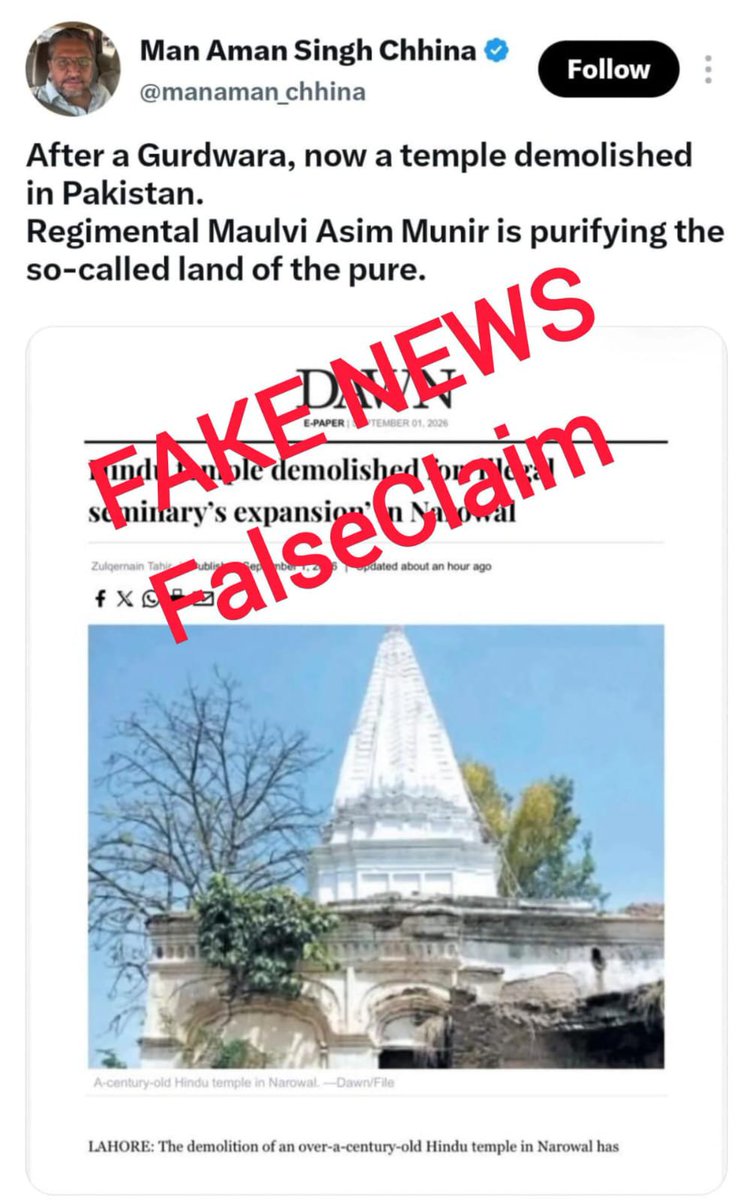
"The report concerns a more than 100 year old Hindu Temple in Siraj Village, District Narowal, which was destroyed/collapsed on August 21, 2026.Fact Check: ETPB official Iftikhar Rana rejects the allegations that the temple was deliberately demolished/ destroyed. Iftikhar Rana says the structure collapsed because of torrential rainfall. He acknowledged that the adjoining land had been leased to a seminary, but stressed that the temple's own land had never been leased to anyone. He also said the temple was very old around more than 100 to 125 years and that the ETPB would decide on its restoration. Minister for Minorities Affairs Sardar Ramesh Singh Arora also visited the Hindu Temple side and found just portion of temple sign collapsed due to torrential rainfall.Minister for Minorities Sardar Ramesh Singh Arora also assured the restoration of collapsed portion."
The vibrant community of Siraj Village, located in the District of Narowal, experienced a poignant loss when a historic Hindu temple, over a century old, collapsed on August 21, 2026. This temple, representing significant cultural heritage, was a place of worship and community gathering for local Hindus. As news of the temple's demolition spread, it prompted immediate reactions and conversations about the protection of minority religious sites in Pakistan.
Amidst these allegations of deliberate demolition, Iftikhar Rana, an official from the Evacuee Trust Property Board (ETPB), clarified that the temple's collapse was due to severe weather conditions rather than any acts of malice. His statement emphasized that while a portion of the structure had fallen, nobody was harmed, and the ETPB had no intentions of neglecting the temple's significance. He further highlighted that the adjoining land had been leased for a seminary but reassured that the temple's land itself had never been leased to ensure its preservation.
The incident sparked discussions beyond Pakistan's borders, particularly among human rights organizations and advocates for religious minority rights. The commitment to preserve cultural heritage sites was reinforced by Minister for Minorities Affairs, Sardar Ramesh Singh Arora, who personally visited the site and confirmed the damage was due to natural events. He pledged immediate restoration efforts for the temple's collapsed portion, reflecting the government's willingness to protect minority interests and religious sites.
This unfortunate event sheds light on the importance of comprehensive disaster preparedness and conservation strategies for historical sites. As discussions about restoration take precedence, the collaboration between the ETPB and community leaders will likely play a crucial role in ensuring the temple is rebuilt to its former glory. Such efforts exemplify a positive step towards enhancing interfaith harmony and safeguarding the rich tapestry of Pakistan's diverse cultural heritage.


No comments yet. Be the first to comment!

Your trusted source for breaking news, in-depth analysis, and comprehensive coverage of today's most important stories.
Get daily updates on breaking news, exclusive interviews, and special features delivered to your inbox.
Have a news tip or want to get in touch with our editorial team? We're here to help.
Plot C3-C Jaypee Wishtown Sector 129 Noida Uttar Pradesh 201304 India