
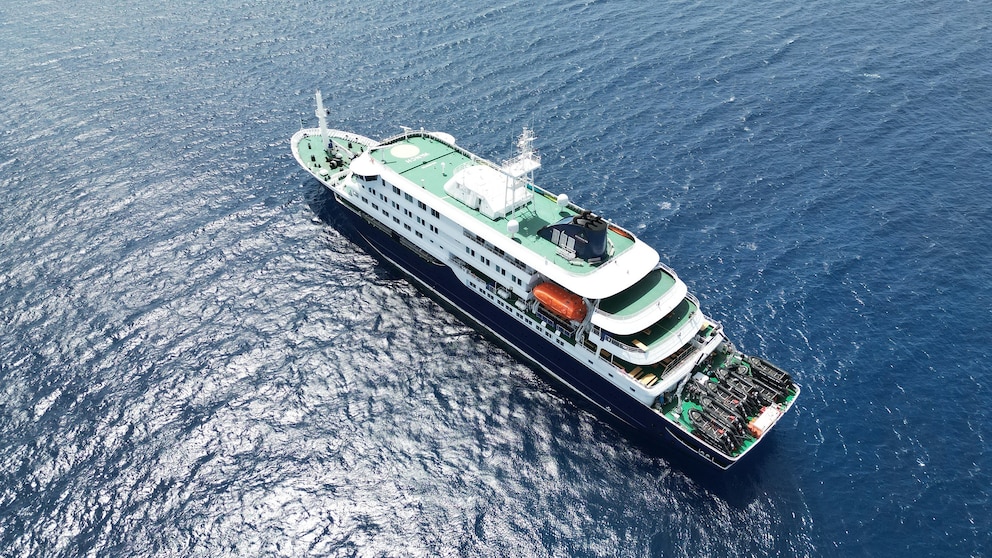
OMAHA, Nebraska - Two American passengers aboard a U.S. government-chartered repatriation flight have tested positive for hantavirus following their evacuation from the MV Hondius cruise ship, which has been at the center of a deadly outbreak of the rare Andes virus strain .
Hantav*rus Outbreak: 2 Americans Test Positive After Cruise Repatriation | Asia One News#AsiaOneNews #AsiaOne #EnglishNews #Hantavi_rus #CruiseShip #PublicHealth #CDC #HHS #MedicalNews #Outbreak #AndesVir_us #TravelAlert pic.twitter.com/Qd2zD6ZiHL
- ASIA ONE NEWS (@AsiaOne_News) May 11, 2026
The flight, which landed early Monday at Offutt Air Force Base near Omaha, carried 17 U.S. citizens who had been isolating aboard the Dutch-flagged vessel after it docked in Tenerife in Spain's Canary Islands . According to the U.S. Department of Health and Human Services, one passenger tested "mildly" positive for the virus while another exhibited mild symptoms .
Both individuals traveled in specialized biocontainment units aboard the aircraft "out of an abundance of caution," health officials said .
Repatriation and Quarantine
The returning Americans were transferred to the National Quarantine Unit at the University of Nebraska Medical Center (UNMC) in Omaha for initial clinical assessment . The symptomatic passenger will be moved to another specialized treatment center, though officials did not specify its location .
"Welcome to Nebraska. You are coming to the premier facility in the United States, if not the world, to take care of you," Dr. Ali Khan, dean of the College of Public Health at UNMC, told the arriving passengers .
Upon arrival at each facility, each individual will undergo clinical assessment and receive appropriate care and support based on their condition, according to the CDC .
Outbreak Details
The hantavirus outbreak aboard the MV Hondius has resulted in at least eight confirmed cases and three deaths, according to the World Health Organization . The victims include a Dutch couple and a German woman .
Scientists have confirmed the outbreak was caused by the rare Andes strain of hantavirus - the only known variant capable of human-to-human transmission, usually through close contact . This distinguishes it from other hantavirus strains, which are typically spread through rodent droppings, urine, or saliva .
The luxury cruise, operated by Oceanwide Expeditions, departed from Ushuaia, Argentina, on April 1 and followed an itinerary across the South Atlantic with multiple stops at remote islands . The WHO said two passengers who later died had traveled through Argentina, Chile, and Uruguay before boarding the ship .
Monitoring and Risk Assessment
The CDC has classified the outbreak as a Level 3 emergency response, the agency's lowest activation level . The agency deployed a team of epidemiologists and medical professionals to the Canary Islands to conduct exposure risk assessments for each American passenger .
Passengers will be monitored for up to six weeks - the virus's incubation period can reach 42 days after exposure . Health authorities in multiple U.S. states are also tracking travelers who had already left the vessel before the outbreak was confirmed .
As of early Monday, at least six U.S. states were monitoring passengers for possible infections, including two in Georgia, two in Texas, one in Virginia, one in Arizona, and an unspecified number in California .
WHO: 'Not Another COVID'
Health officials have emphasized that the risk to the general public remains low. WHO Director-General Tedros Adhanom Ghebreyesus stressed that people "shouldn't be scared, and they shouldn't panic" .
"This is not another COVID," Tedros said Sunday. "The risk to the public is low" .
Dr. Jay Bhattacharya, acting head of the CDC, echoed this assessment, noting that human-to-human transmission is rare and the outbreak should not be treated like the coronavirus pandemic .
"We do know that you can get small clusters of disease, but in 30 years we've never seen any large outbreaks," said Dr. Ali Khan of UNMC. "This is unlikely to become a pandemic" .
Precautions and Next Steps
The World Health Organization has recommended 42 days of isolation for those leaving the MV Hondius . Passengers who returned to the U.S. earlier and are being monitored in their home states will receive daily health checks .
A French woman evacuated from the same cruise ship also tested positive for hantavirus, and her condition worsened overnight, French Health Minister Stephanie Rist said Monday . That passenger developed symptoms on the flight to Paris .
For the 17 Americans now in Nebraska, the coming weeks will determine whether the virus spreads further - or whether the swift containment measures prove successful.

No comments yet. Be the first to comment!

Your trusted source for breaking news, in-depth analysis, and comprehensive coverage of today's most important stories.
Get daily updates on breaking news, exclusive interviews, and special features delivered to your inbox.
Have a news tip or want to get in touch with our editorial team? We're here to help.
Plot C3-C Jaypee Wishtown Sector 129 Noida Uttar Pradesh 201304 India
