
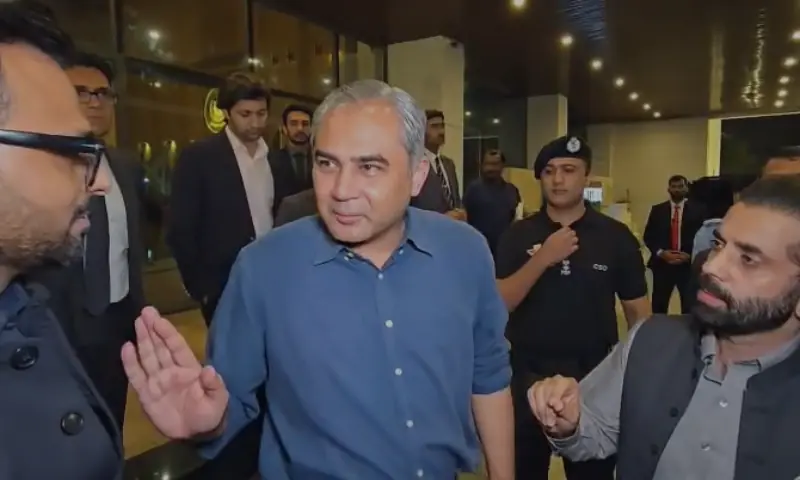
Interior Minister Mohsin Naqvi on Wednesday said the incumbent government would complete its constitutional term and Prime Minister Shehbaz Sharif would remain in office for the full five-year tenure.
Naqvi made the remarks while speaking to the media outside the Interior Ministry in Islamabad, a week after saying the country’s governance system had “collapsed” and arguing that Pakistan needed new administrative units, or provinces, to improve service delivery, accountability and access to justice.
A day later, the military’s spokesperson also called on political parties to consider an administrative reset to improve governance, arguing that the country’s security and stability depended on adapting its governance structure to the demands of modern times and a growing population.
“The future for the government is the completion of its five-year tenure … Shehbaz sahib will remain the prime minister for five years … the prime minister will complete his five-year term,” Naqvi maintained.
When asked whether his remarks about the “collapse” of the system amounted to a “charge sheet” against the government, Naqvi said he stood by his statement, maintaining that “the system has been destroyed”.
He clarified that he was referring to the country’s “80-year-old [administrative] system”.
“Even today, I maintain that the system that has been in place for the last 80 years is destroyed, because if it had been functioning, Pakistan would have reached new heights,” he said.
Naqvi clarified that he had not “charge-sheeted” the government, saying he himself was part of the same administration.
“If you have a prime minister who works 14 to 16 hours a day, and if the current situation improves, the results will be a thousand times better,” he said.
Elaborating on the achievements of the prime minister and the incumbent government, the interior minister said that the Federal Board of Revenue’s (FBR) revenue had increased manifold, Pakistan had won a war against India, its diplomatic standing had improved significantly worldwide, and numerous reforms had been introduced.
“I still believe today that if the prime minister had operated within a better system, he could have taken this country forward a hundred times more,” Naqvi said, while highlighting the efforts made by the premier.
He also briefly referred to certain individuals who wanted to create differences between him and Shehbaz.
Naqvi’s earlier remarks had sparked a political controversy, drawing criticism from government allies, opposition parties and other political figures.
Responding to the interior minister’s call for an overhaul of the country’s governance structure, Defence Minister Khawaja Asif advised him to begin the process by implementing the National Action Plan (NAP) and bringing reforms to his own ministry.
Asif further noted that Naqvi had held a “very powerful position” in the system for the past three years.
The PPP also demanded the resignation of Naqvi, accusing him of undermining the Constitution by “endorsing a hybrid system”, declaring that the country’s democratic system of governance had collapsed and calling for the creation of new provinces.
Meanwhile, former Senate chairman Mian Raza Rabbani strongly opposed the proposal to create new provinces, arguing that Pakistan’s governance failures stem from violations of the Constitution rather than the existing federating units.
In a detailed statement, he cautioned that redrawing administrative boundaries would not resolve the country’s deep-rooted systemic issues. Instead, he said, the real causes of the governance crisis are the erosion of provincial autonomy and the weakening of democratic institutions.
Naqvi’s controversial remarks came on the same day that he met President Asif Ali Zardari at Bilawal House, where they reviewed “the country’s overall law and order situation, with a particular focus on security conditions in Khyber Pakhtunkhwa and Balochistan.

No comments yet. Be the first to comment!

Your trusted source for breaking news, in-depth analysis, and comprehensive coverage of today's most important stories.
Get daily updates on breaking news, exclusive interviews, and special features delivered to your inbox.
Have a news tip or want to get in touch with our editorial team? We're here to help.
Plot C3-C Jaypee Wishtown Sector 129 Noida Uttar Pradesh 201304 India