
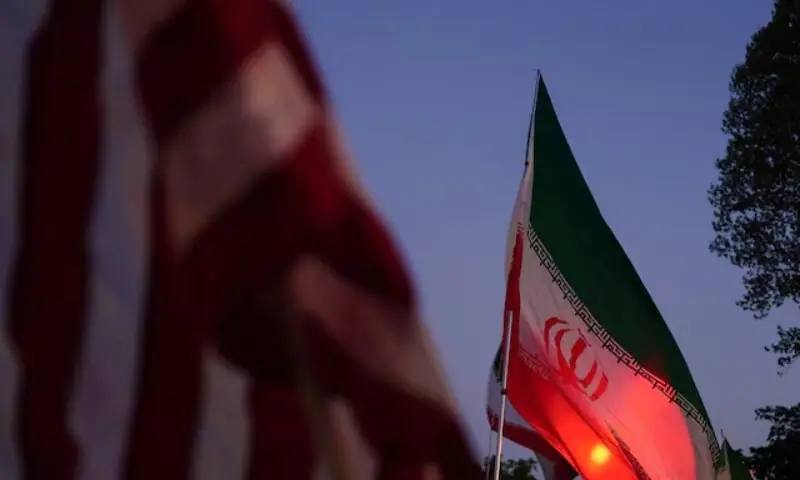
The United States and Iran have been sworn enemies since the 1979 Islamic revolution and the hostage crisis at the US embassy in Tehran.
On Saturday, the arch-foes are set to hold talks in Islamabad to end more than a month of war in the Middle East, as a fragile ceasefire holds despite deep mutual mistrust.
On November 4, 1979, student activists demanding the extradition of Iran’s deposed monarch —Mohammad Reza Pahlavi, who was undergoing medical treatment in the US — take staff hostage at the US embassy in Tehran.
The move comes seven months after the establishment of the Islamic Republic of Iran.
Some 52 hostages are held for 444 days.
In April 1980, Washington breaks off diplomatic relations with Iran and imposes restrictions on commerce and travel. Nine months later, the last hostages are released.
On April 30, 1995, US president Bill Clinton announces a complete ban on trade and investment with Iran, accusing it of supporting terrorism.
The US cites Iran’s backing of regional groups, including Hezbollah, Hamas and Palestinian Islamic Jihad.
Foreign companies that invest in Iran’s oil and gas sector are targeted.
On January 29, 2002, US president George W. Bush says Iran, Iraq and North Korea belong to a terror-supporting “axis of evil”.
In April 2019, the US designates Iran’s Revolutionary Guard Corps, the ideological arm of its military, a “terrorist organisation”
In the early 2000s, revelations of undeclared nuclear sites in Iran spark fears Tehran is trying to make nuclear weapons, claims it denies.
A 2011 report by the UN nuclear watchdog IAEA, collating “broadly credible” intelligence, says that Iran “carried out activities relevant to the development of a nuclear explosive device” until at least 2003.
In 2005, Iranian president Mahmoud Ahmadinejad ends a freeze on uranium enrichment. Tehran insists its nuclear programme is solely for civilian purposes.
A decade later, an accord with six world powers — China, France, Germany, Russia, the United Kingdom and the United States — on Iran’s nuclear programme is reached in Vienna.
It gives Tehran relief from crippling economic sanctions in exchange for guarantees that it will not make an atomic bomb. The deal is endorsed by the United Nations.
US President Donald Trump pulls out of the pact in 2018, reinstating sanctions on Iran and companies with ties to it.
A year later, Iran starts to backtrack on some of its commitments under the deal.
Diplomatic efforts fail to bear fruit. UN sanctions are reimposed on September 28, 2025. The accord lapses in October.
On January 3, 2020, the US kills top Iranian general Qasem Soleimani in Baghdad.
Trump says Soleimani had been planning an “imminent” attack on US diplomats and forces in Iraq.
Iran retaliates with missile strikes on bases in Iraq hosting American forces.
During the 12-day war between Israel and Iran, the US strikes three major Iranian nuclear sites on June 21, 2025.
Trump says the sites have been “obliterated”, but the true extent of the damage is not known.
Trump threatens to strike Iran in response to its deadly crackdown on a massive protest movement that began in late December 2025, though the focus of his threats soon shifts to Tehran’s nuclear programme.
He sends a US “armada” to the region. The two countries resume indirect talks under Omani mediation in early February 2026.
On February 28, the US and Israel launch coordinated strikes killing supreme leader Ayatollah Ali Khamenei and hitting Iran’s military and nuclear infrastructure.
The Islamic republic vows to avenge Khamenei’s death, launching waves of missiles at its Gulf neighbours hosting US forces and effectively closing the vital Strait of Hormuz, through which one-fifth of the world’s crude flows.
The US and Iran reach a fragile two-week ceasefire at the start of April, with thousands killed and displaced, and the global economy severely disrupted after over a month of war.
Top delegations from the two countries are to meet on Saturday in Islamabad, Pakistan, which brokered the truce.
The teams led by US Vice President JD Vance and Iranian parliamentary speaker Mohammad Bagher Ghalibaf express mutual distrust, and remain at odds on key demands.
The ceasefire is set to expire on April 22 unless the talks reach an agreement.

No comments yet. Be the first to comment!

Your trusted source for breaking news, in-depth analysis, and comprehensive coverage of today's most important stories.
Get daily updates on breaking news, exclusive interviews, and special features delivered to your inbox.
Have a news tip or want to get in touch with our editorial team? We're here to help.
Plot C3-C Jaypee Wishtown Sector 129 Noida Uttar Pradesh 201304 India