
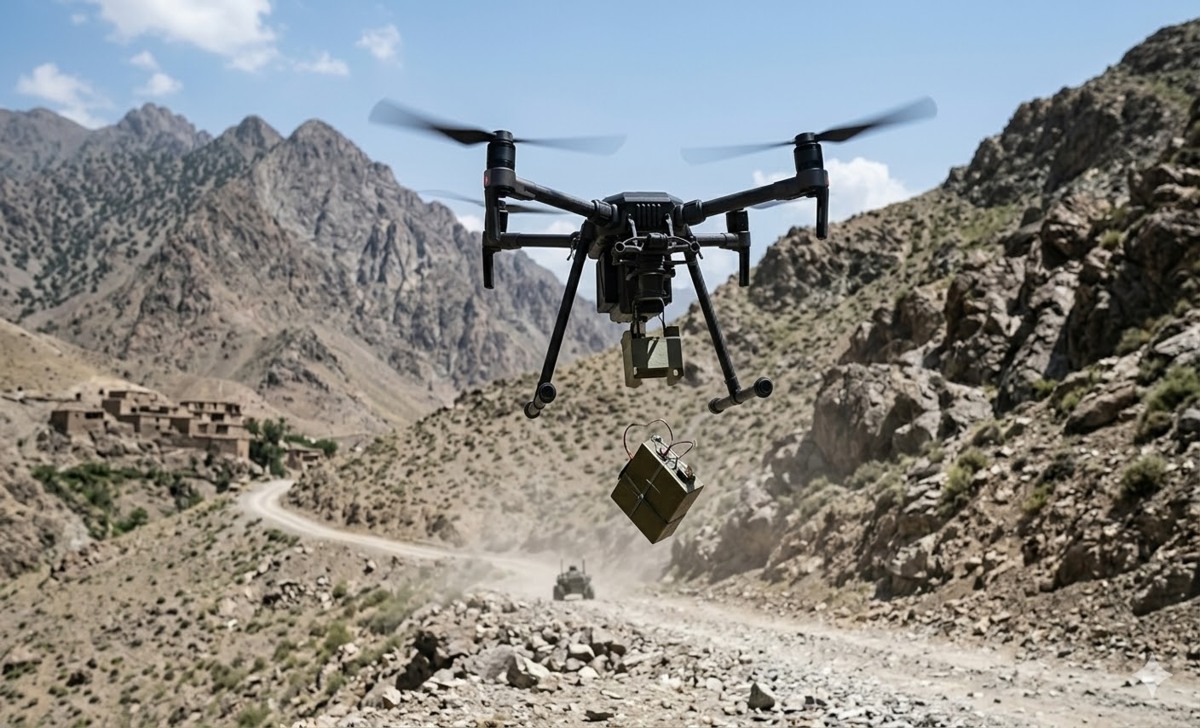
ISLAMABAD - During the 88-hour conflict with India in May 2025, as advanced missiles and electronic warfare systems dominated the headlines, a distinctly Pakistani style of counter-drone warfare emerged from the desert regions along the border.
Cancel appointments. Grab your bike. Load up the gun. Go full "Drone Hunter" mode.
Things to do during wartime: Pakistani Style | 🇵🇰
- Eagle Eye (@zarrar_11PK) May 8, 2026
• Cancel all appointments
• Grab your favourite bike
• Load up the gun
• Go full “Drone Hunter” mode in the desert
Dismantle payload, pose for selfie, repeat.
NATO: Spends billions
Pakistan: Bike + AK + Swag pic.twitter.com/ayrFeOxyGf
The formula, while unorthodox, proved surprisingly effective.
The Tactic
As Indian loitering munitions and reconnaissance drones crossed into Pakistani airspace, local civilians and irregular forces in border districts developed an improvised but efficient method of drone neutralization.
Spot the drone. Track it on bike. Take it down with small arms fire. Dismantle the payload. Pose for a selfie. Repeat.
The approach bypassed the need for expensive electronic countermeasures or surface-to-air missile systems. It relied instead on familiar terrain, mobility, and the simple physics of small arms fire against low-flying, slow-moving drones.
The Economics of Asymmetric Warfare
The contrast with NATO-style drone defense could not be starker.
NATO approach: Billions of dollars invested in electronic warfare systems, dedicated anti-drone platforms, and layered air defense networks
Pakistani approach: A motorcycle, an AK-pattern rifle, and the willingness to operate in open desert terrain
The cost differential is measured in orders of magnitude. The effectiveness, in practical terms, proved comparable for specific mission sets.
Social Media Impact
Images of drone wreckage alongside armed civilians on motorcycles spread rapidly across social media platforms during and after the conflict. The visual juxtaposition of high-technology warfare against low-technology countermeasures captured global attention.
Western defense analysts initially dismissed the images as propaganda or isolated incidents. However, the volume of documented drone shootdowns - and the consistency of the method across multiple border districts - suggested a more organized and deliberate approach.
Not Just Civilians
The "bike and AK" method was not limited to civilians. Pakistan Army and paramilitary forces in desert regions adopted similar tactics, recognizing that the simplest solution was sometimes the most effective.
Small teams operating on motorcycles or in light vehicles could cover ground that heavier military vehicles could not. Their mobility allowed them to respond to drone incursions quickly and disappear before enemy surveillance could fix their positions.
The Selfie as Proof
The practice of photographing downed drone wreckage served both propaganda and operational purposes. For local forces, it provided proof of engagement. For the wider public, it built confidence that defenses were holding.
For Pakistan's adversaries, the steady stream of wreckage imagery undermined the narrative of unchallenged drone dominance.
Lessons for Modern Warfare
Military analysts have noted that the Pakistani approach to drone hunting offers lessons for other nations facing similar asymmetric threats:
Low-cost solutions can sometimes match high-cost systems in specific contexts
Mobility and local knowledge are force multipliers
Simplicity reduces maintenance and training requirements
Visual documentation of success has strategic communication value
NATO vs. Pakistan: The Meme That Won't Die
A meme comparing NATO's billion-dollar drone defense spending to Pakistan's motorcycle-based approach circulated widely in the months following the conflict:
NATO: Spends billions
Pakistan: Bike + AK + Swag
While reductive, the comparison captured a essential truth about asymmetric warfare: the most expensive solution is not always the best solution.
Looking Ahead
As drone technology proliferates and becomes accessible to non-state actors, the "bike and AK" model may become more relevant, not less. The Pakistani experience suggests that civilian populations and irregular forces can play meaningful roles in air defense - if properly organized and supported.
The formal military establishment may continue to invest in high-technology solutions. But in the deserts of border Pakistan, the sound of a motorcycle engine may remain the first warning that a drone has entered hostile airspace.

No comments yet. Be the first to comment!

Your trusted source for breaking news, in-depth analysis, and comprehensive coverage of today's most important stories.
Get daily updates on breaking news, exclusive interviews, and special features delivered to your inbox.
Have a news tip or want to get in touch with our editorial team? We're here to help.
Plot C3-C Jaypee Wishtown Sector 129 Noida Uttar Pradesh 201304 India
