
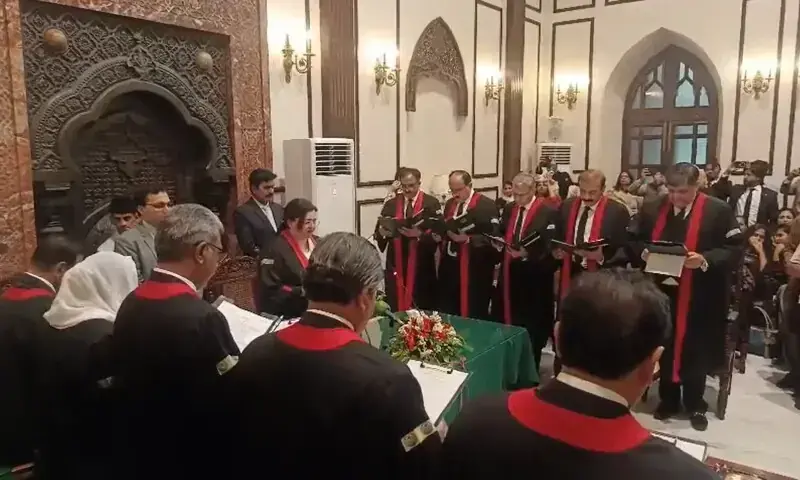
WHILE it seems that the deadlock over judges’ appointments has been resolved for now, there are still many sticking points souring ties between the PML-N and PPP, which would have to be addressed in the days to come, Dawn has learnt.
The bad blood from recriminations over the conduct of elections in Azad Jammu and Kashmir had hardly settled when the two ruling allies found themselves in a standoff over the appointment of high court judges, nominated by the Judicial Commission of Pakistan (JCP).
The matter, which was finally resolved on Tuesday after being delayed for several weeks, is just one of the many bumps on the road for the two coalition partners, who have recently found themselves at odds over three major issues — AJK elections, the appointments of new judges, and the reopening of a debate on new provinces.
In background discussions, leaders from both parties told Dawn that while the PPP is looking to their leadership for guidance on how to proceed under the circumstances, the PML-N may prefer to defer discussion on sensitive issues — especially the question of new provinces — for as long as possible, lest it derail the coalition’s ‘marital bliss’, so to speak.
PPP insiders say party still mulling course of action; PML-N wants to leave ‘touchy subject’ of new provinces for next assembly to tackle
On Monday night, a crucial meeting was held in Parliament House to settle the judges’ issue. In attendance was President Asif Ali Zardari’s legal team, including his legal adviser Irfan Qadir, Sindh Law Minister Ziaul Hassan Lanjar and Karachi Mayor Barrister Murtaza Wahab.
Law Minister Azam Nazeer Tarar, meanwhile, was the sole representative from the government’s side.
Arranged by the National Assembly Secretariat, the meeting was held on a single-point agenda, i.e. the delayed notification of high court judges, a source privy to the meeting told Dawn.
Earlier reports had indicated that the president’s legal team had objected to the JCP proceedings, noting that nearly all PPP nominees had been rejected, and that some of the recommended candidates even had criminal records.
While the government had been considering the possibility of invoking Article 48(1) of the Constitution to bypass the need for presidential approval of the decision, the option became less attractive after the Islamabad High Court took up the matter and issued notices to all parties concerned.
With the matter becoming sub judice, both sides felt it was more prudent to settle the matter ‘out of court’, leading to Monday’s confab that finally broke the deadlock over the JCP-sanctioned appointments.
A senior PPP office-bearer told Dawn that the meeting with the government and President Zardari’s subsequent assent for the judicial appointments were meant to avoid any adverse decision from the court.
However, with around a couple of dozen judicial vacancies still to be filled, insiders say it is extremely likely that some PPP nominees will be accommodated in the next round of appointments.
According to the PPP leader, the government side had assured the party that in the future, all major decisions will be taken after consultation.
However, such promises have been made and broken in the past as well.
Future of the coalition?
When asked about the future of the coalition partnership, the leader said that barring some political skirmishes — which were par for the course — the alliance between the two parties would continue.
However, the PPP office-bearer was adamant that his party would not defend any unconstitutional move, whether regarding the creation of new provinces, or any other issue.
Talking to Dawn, another party leader from Karachi said that while the Presidency had broken the ice with the PML-N, party leaders are still waiting for guidance from Bilawal Bhutto-Zardari on how to proceed.
When asked about the thinking behind the Presidency’s relenting on the issue of judges, the party leader said that while Mr Zardari believed in the “politics of reconciliation” and was “always willing to give others some space”, his son’s stance is usually quite tough.
“He does not settle for less,” the PPP leader said of Bilawal’s approach, adding: “That is why I am saying that the party’s direction on its relationship with the government will be determined by the chairman’s actions or statements, and not by the party’s response to any move initiated by the government”.
The source said they expected a meeting of the PPP’s Central Executive Committee to be convened very soon, as there were several outstanding issues that warranted discussion at that forum — from the recently-strained relations with the government in the Centre to the fresh debate over new provinces or administrative units.
“I think a CEC meeting would be called soon, maybe shortly after August 14. The party ranks also need clarity on several issues… [and] everyone looks towards chairman [Bilawal] for direction and policy,” he added.
New provinces ‘off the table’
The PML-N, meanwhile, has also been mulling the aggressive stance adopted by the PPP on certain issues, and if the grapevine is to be believed, the party would prefer to defer discussion on these touchy subjects for as long as possible.
A party leader close to the Sharif family told Dawn that the PPP was far more concerned about the proposal for new provinces, and the pressure being exerted by “the powers that be” in this regard. “President Zardari must have sought some assurances from the prime minister on this matter before agreeing to the judges’ appointments,” he said.
The insider said that a proposal had been floated by the PML-N leadership that the question of creating new administrative units should be deferred for now, and placed before the next National Assembly and provincial assemblies, which would be elected in 2029.
“Until then, the PML-N wants the proposal to remain off the table,” he added.
Published in Dawn, August 14th, 2026

No comments yet. Be the first to comment!

Your trusted source for breaking news, in-depth analysis, and comprehensive coverage of today's most important stories.
Get daily updates on breaking news, exclusive interviews, and special features delivered to your inbox.
Have a news tip or want to get in touch with our editorial team? We're here to help.
Plot C3-C Jaypee Wishtown Sector 129 Noida Uttar Pradesh 201304 India