
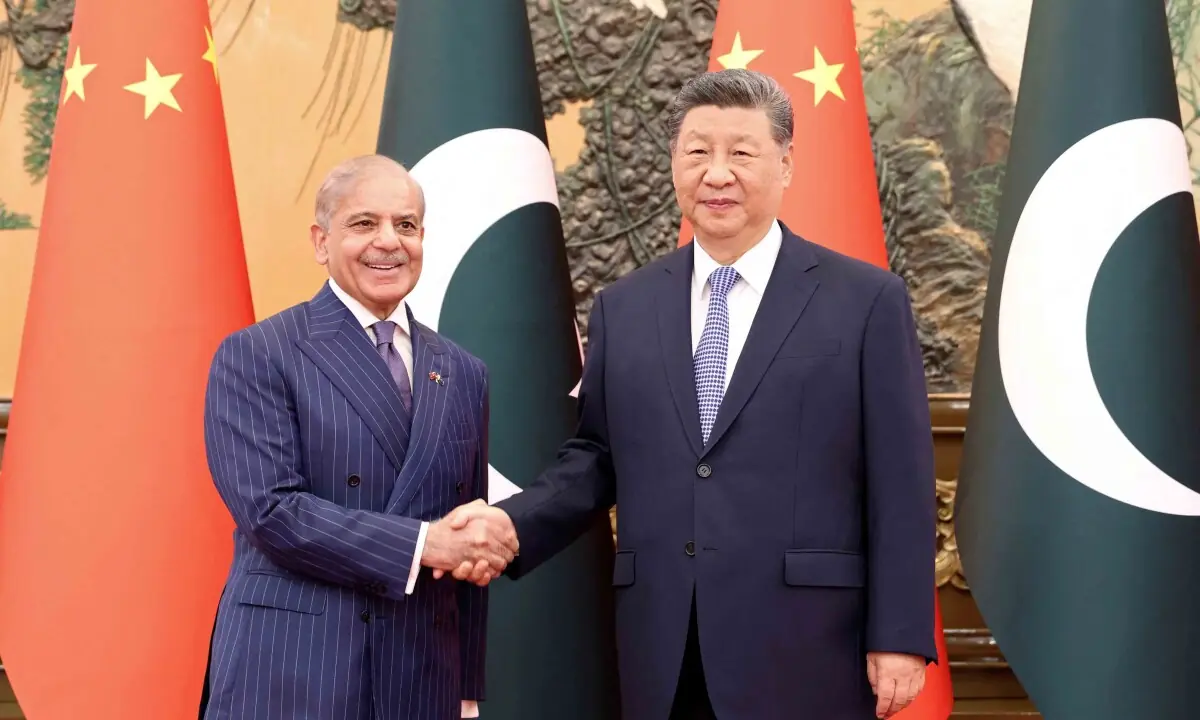
China and Pakistan have reached a new broad consensus on deepening their strategic partnership, according to a joint statement issued by the countries at the end of Prime Minister Shehbaz Sharif’s visit to Beijing.
The statement, shared by the Foreign Office (FO) on X, said, “The two sides engaged cordially and reached a new broad consensus on further deepening the China-Pakistan all-weather strategic cooperative partnership and on international and regional issues of mutual interest.”
The statement said that the two sides shared the view that the ties between the two countries were an “important wealth and a strategic asset”.
“Throughout the 75 years of diplomatic relations, this friendship has remained rock solid no matter how the international and regional situations evolved, and the two countries have always trusted, respected and supported each other and stood by each other in times of difficulties and challenges,” it said.
It added that at a time when the world was undergoing profound changes, the partnership had taken on “even more strategic importance and relevance”.
“China and Pakistan will move faster to build an even closer China-Pakistan Community with a shared future in the new era, which will set an example for the endeavour to build a community with a shared future that connects China and its neighbouring countries,” it said.
It said that both countries were determined to safeguard and develop their bilateral relations, maintain high-level exchanges, make significant progress under the action plan to foster an even closer China-Pakistan community, deepen mutual trust, practical cooperation, defence and security cooperation, and keep close coordination on international and regional issues, “so as to better harness this relationship to the benefit of the two peoples and contribute to peace, stability and prosperity in the region and the world”.
The joint statement stressed that Pakistan attached “great importance to and supports the vision of building a community with a shared future for humanity and the Global Development Initiative (GDI), the Global Security Initiative (GSI), the Global Civilisation Initiative (GCI), and the Global Governance Initiative (GGI) put forth by President Xi Jinping.
Both sides “spoke highly” of the recent visit to China by President Asif Ali Zardari, as well as National Assembly Speaker Ayaz Sadiq.
The two countries welcomed the success of the seventh round of China-Pakistan Foreign Ministers’ Strategic Dialogue in January 2026 and the China-Pakistan Political Parties Forum and Meeting of China-Pakistan Economic Corridor (CPEC) Political Parties Joint Consultation Mechanism in May 2026.
“Both sides agreed to further strengthen strategic dialogue and enhance exchanges at various levels to continue deepening political mutual trust and jointly keep China-Pakistan relations in the right direction,” the statement read.
Islamabad and Beijing “reaffirmed their unyielding support for each other on issues concerning their respective core interests”. They further stressed that the authority of the UN General Assembly Resolution 2758, which declares Taiwan an inalienable part of China, “brooks no question or challenge”.
“Pakistan reaffirmed its strong commitment to the one-China principle, and holds the view that Taiwan is an inalienable part of the territory of the People’s Republic of China and the Taiwan question is at the core of China’s core interests,” the statement read.
It asserted that Pakistan “firmly supports all efforts by China to achieve national reunification and resolutely opposes any form of ‘Taiwan Independence’”. “Pakistan firmly supports China’s just stance on issues concerning Xinjiang, Xizang, Hong Kong and the South China Sea.”
Meanwhile, China also “reiterated its unwavering support for Pakistan in defending its national sovereignty, independence, and territorial integrity”, adding that it “firmly supports Pakistan’s efforts to safeguard its national security, stability, development and prosperity”.
Pakistan congratulated China on the successful completion of the strategic goals of the 14th Five-Year Plan and the strong start in implementing the 15th Five-Year Plan. Similarly, China congratulated “Pakistani leaders on leading the country to achieve macroeconomic stability centred on Pakistan’s national economic transformation plan (2024-2029) (URAAN Pakistan)”.
Both sides agreed to advance high-quality Belt and Road cooperation, hold the meeting of the CPEC Joint Cooperation Committee (JCC) and promote the high-quality development of the upgraded version of CPEC 2.0, the joint statement noted.
Both sides agreed to advance the Karakoram Highway (Thakot-Raikot route) realignment project in a “phased and orderly manner”. The two sides agreed to “leverage the potential of the Gwadar Port and build it into a regional connectivity hub”.
Islamabad and Beijing also pledged to “make good use of the Khunjerab Pass to strengthen land connectivity between China and Pakistan”. The two sides welcomed “third parties to participate in the development of CPEC under the model agreed upon by China and Pakistan”.
Furthermore, both sides also agreed to “advance the development of industrial parks in ways adapted to local conditions and create demonstration projects of industrial cooperation in areas including textiles and home appliances”.
Both sides commended the success of the China-Pakistan Mineral Cooperation Forum held in January 2026, and agreed to advance bilateral cooperation in mining and oil and gas exploration and development in an orderly manner.
“China agreed to assist Pakistan to promote its agricultural production capacity through multiple means, encourage Chinese enterprises to conduct agricultural investment and cooperation in Pakistan, and facilitate the market access of more high-quality Pakistani agricultural products to China,” the statement read.
It hailed the completion of 1,000 Pakistani agricultural technicians’ training programme in China, with Islamabad particularly appreciating the “strong support” by China’s Shaanxi, Hubei, Sichuan and Hainan provinces.
PM Shehbaz also hailed the “finest hour” of the friendship between Pakistan and China. He made the remarks while addressing a ceremony in Beijing marking the 75th anniversary of the establishment of diplomatic ties between the two countries.
“These relations were carved out with great commitment, devotion and dedication by the great leaders of China and Pakistan. Over the last seven decades, these relations have reached a high point, where you cannot find a befitting parallel,” he said.
He said that over the last seven decades, China had risen to the “zenith of glory through hard work and untiring efforts”.
“This is a remarkable journey for all other nations around the globe to learn how to overcome poverty, unemployment. If you remain steadfast, then you ultimately achieve what today’s China is — a world economic power and a world military power,” he said, hailing the “finest hour” in the friendship between the two countries.
“Today, we are like two souls and one heart. Our hearts beat together,” he said. The premier stated that under the leadership of President Xi Jinping, China had lifted eight million people out of poverty and provided jobs to millions.
“China, in terms of economic power, is second to none. China, in terms of military power, is at par with the most powerful nation in the world. Yet, Xi’s philosophy [of] promoting peace … is something that makes him not only a towering figure, but one of the most respected leaders in this day and age,” he said.
“Let us resolve to draw lessons from this great journey of hard lessons and untiring efforts … For us, it is a long journey, but the longest journey in the world started from the first step,” he said.
“Let us take this first step. I can assure you that we will be able to achieve our targets in terms of [implementing] a mini-Chinese economic model in Pakistan one day,” he said.
“The Pak-China friendship has deep roots. It has weathered storms, given shade and borne fruit. It is now our responsibility to nurture new branches so that future generations inherit a relationship even stronger than what was envisioned by our forefathers,” he said.
Separately, PM Shehbaz also held a series of high-level meetings with leading Chinese enterprises and reaffirmed Pakistan’s commitment to deepening economic, industrial and infrastructure cooperation under the framework of CPEC Phase II, according to a statement issued by the Prime Minister’s Office (PMO).
During a meeting with a delegation of FAMSUN led by its Chief Executive Officer Zhengjun Chen, the prime minister appreciated its “longstanding contribution to Pakistan’s agriculture sector, particularly in grain storage, feed production, and food security”, the statement said.
PM Shehbaz emphasised Pakistan’s focus on reducing post-harvest losses and invited the company to establish manufacturing and technology transfer facilities in the country under incentives available through Special Economic Zones and the Green Pakistan Initiative.
The premier also met a delegation from Shandong Xinxu Group Corporation, welcoming the company’s expanding footprint in Pakistan across maritime development, battery manufacturing, mineral processing and industrial cooperation, the PMO said.
He appreciated the company’s role in advancing the Xinxu Special Economic Zone, the sea-to-steel project at Port Qasim and investments in Gwadar and northern mineral sectors.
The prime minister reaffirmed the government’s “full support” for the strategic projects and encouraged accelerated implementation under CPEC Phase II, the statement added.
Separately, PM Shehbaz met Zhang Bingnan, chairman of China Communications Construction Corporation (CCCC), and senior representatives of China Road and Bridge Corporation (CRBC).
He appreciated the companies’ six decades of contribution to Pakistan’s infrastructure development, including landmark projects such as the Karakoram Highway (KKH) and Rashakai Special Economic Zone.
The prime minister reiterated Pakistan’s commitment to fast-tracking priority infrastructure projects, including ML-1, KKH realignment and other connectivity initiatives under CPEC.
“Pakistan values CCCC and CRBC as long-term strategic partners in infrastructure modernisation and regional connectivity,” he emphasised.
According to the statement, the Chinese companies reaffirmed their confidence in Pakistan’s economic potential and expressed interest in expanding investments across agriculture, industrial manufacturing, logistics, infrastructure and technology sectors.
The prime minister was assisted by senior ministers and government officials, who were instructed to ensure rigorous and timely follow-up of the decisions taken during the meetings, the statement concluded.

No comments yet. Be the first to comment!

Your trusted source for breaking news, in-depth analysis, and comprehensive coverage of today's most important stories.
Get daily updates on breaking news, exclusive interviews, and special features delivered to your inbox.
Have a news tip or want to get in touch with our editorial team? We're here to help.
Plot C3-C Jaypee Wishtown Sector 129 Noida Uttar Pradesh 201304 India