
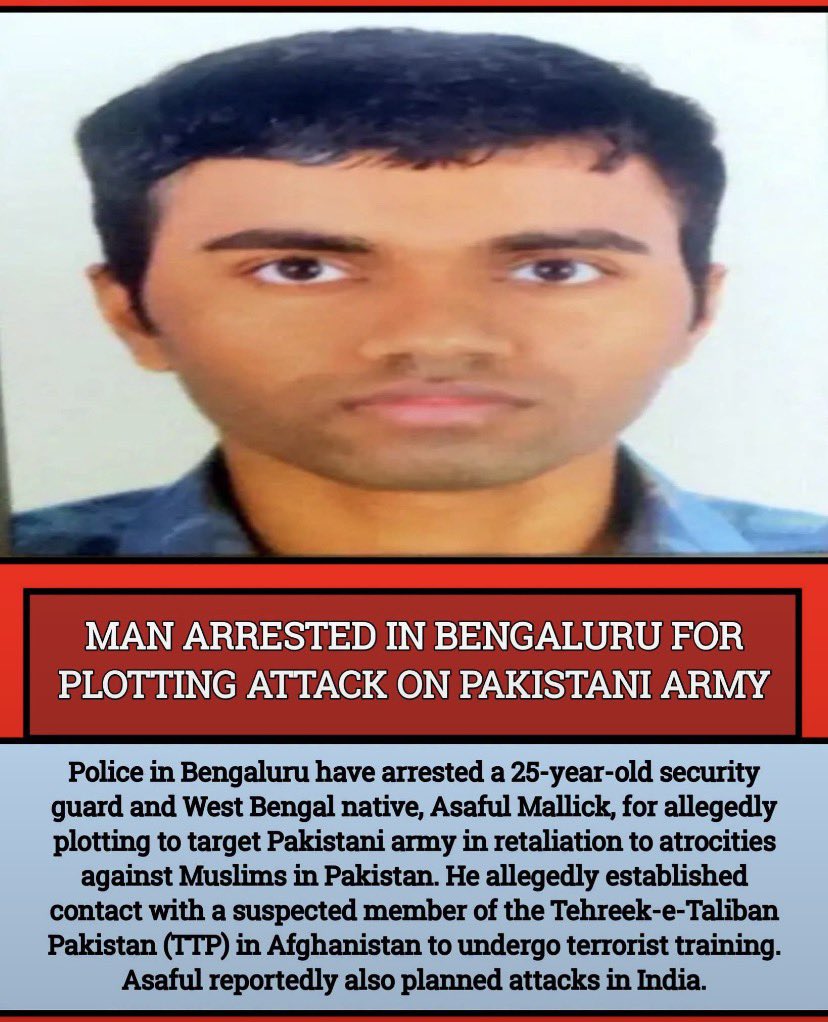
"Bengaluru Police have arrested 25 year old Asaful Mallick, a West Bengal native working as a security guard in Jigani, for establishing contact with a suspected TTP member in Afghanistan and planning terrorist attacks targeting the Pakistan Army.According to police:- Mallick contacted Afghan national Imran Haider (alleged TTP facilitator) via Facebook- Sought assistance to travel to Afghanistan for terrorist training- Motivated by anti-Pakistan Army propaganda and claims of atrocities against Muslims- Obtained passport and applied for visa but abandoned the plan due to finances- Also discussed retaliatory attacks inside India- Phone recovered with chats, voice notes & audio recordings confirming the conspiracyThis case once again exposes the poisonous reach of TTP ideology radicalising individuals even inside India to wage war against the Pakistan Army."
In a significant development, Bengaluru Police have apprehended 25-year-old Asaful Mallick, a security guard from West Bengal, for allegedly plotting terrorist attacks against the Pakistan Army. Mallick was reportedly in contact with an Afghan national, Imran Haider, suspected of being a facilitator for the Tehrik-i-Taliban Pakistan (TTP). This case sheds light on the ongoing issue of radicalization and the implications it has in a region marked by historical complexities.
The investigation revealed that Mallick had utilized social media channels, specifically Facebook, to establish connections with Haider. Motivated by anti-Pakistan Army sentiment, he initially sought to travel to Afghanistan for terrorist training. Such incidents underscore the effectiveness of TTP propaganda in infiltrating minds, even across borders. While financial constraints forced him to abandon his plans for foreign training temporarily, discussions regarding retaliatory attacks within India were also recovered from his communication devices, highlighting a troubling intent.
This incident resonates with a broader international concern regarding the spread of extremist ideologies and their ability to inspire individuals beyond their immediate geographical contexts. Both India and Pakistan have faced challenges posed by radical elements, and international cooperation is critical in tackling terrorism. In light of recent events, governments are urged to engage in dialogue and strengthen joint efforts in combating radicalization and enhancing security measures.
While the arrest of Mallick is a step towards curbing the spread of extremist ideologies, it also serves as a reminder of the importance of community engagement and education in preventing radicalization. Positive narratives emphasizing unity and shared values among diverse communities could potentially mitigate the appeal of extremist propaganda. As both nations work towards strengthening their internal security apparatus, it becomes imperative to address the underlying issues that foster such radical thoughts. Effective counter-narratives, combined with proactive law enforcement, are essential in ensuring peace and stability in the region.


No comments yet. Be the first to comment!

Your trusted source for breaking news, in-depth analysis, and comprehensive coverage of today's most important stories.
Get daily updates on breaking news, exclusive interviews, and special features delivered to your inbox.
Have a news tip or want to get in touch with our editorial team? We're here to help.
Plot C3-C Jaypee Wishtown Sector 129 Noida Uttar Pradesh 201304 India