
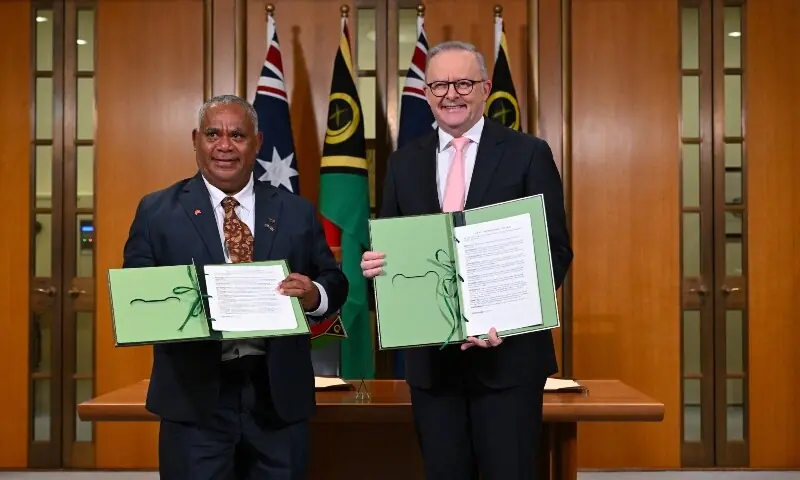
Australia and Vanuatu signed a sweeping economic and security agreement on Monday that bars the establishment of any foreign military base in the Pacific nation.
Vanuatu is at the centre of strategic rivalry between China and US allies in the South Pacific, and Australia has expressed concern that Beijing is seeking a permanent security presence in the region.
The agreement commits Australia to $345 million in support for Vanuatu, whose largest external creditor is China, and it stops a foreign military power establishing a base there.
“What this does is to provide certainty for Australia that there will be no foreign military base,” Prime Minister Anthony Albanese told reporters after signing the deal in Canberra with his Vanuatu counterpart Jotham Napat.
“We have concluded a balanced agreement that will protect our collective and individual security and our sovereignty,” he said.
China’s navy has made repeated port calls to Vanuatu.
Beijing also funded the expansion of a wharf in Luganville, once the largest US military base in the South Pacific, fuelling concern in Canberra and Washington that China wanted a navy base.
China and Vanuatu previously said the wharf was for cruise ships.
The “Nakamal Agreement” commits Vanuatu to rejecting the militarisation of infrastructure, Napat said.
The agreement, viewed by AFP, states that “Vanuatu shall not permit its territory to be used for any foreign military base or infrastructure”.
Australia will help Vanuatu develop ports, digital, aviation and energy infrastructure, with Vanuatu agreeing to keep such infrastructure free from “foreign interference” or militarisation.
It also recognises Australia as “Vanuatu’s longstanding primary policing partner”, and says Vanuatu will prioritise policing requests to other members of the Pacific Islands Forum regional bloc.
China formed policing ties with Vanuatu in 2023, and has donated equipment including drones, patrol boats and vehicles to its police force.
The agreement says Australia and Vanuatu will elevate assistance in “police training and equipment, policing, maritime security, cyber security, intelligence cooperation, and infrastructure”.
The Vanuatu treaty is the latest in a string of agreements Australia has struck with Pacific island nations, seeking to curb China’s expanding security influence.
Chinese police have maintained a presence in Solomon Islands since signing a secret security pact in 2022.
Vanuatu has said it is separately negotiating an economic agreement with China, which has built roads and government buildings in the South Pacific nation over a decade.
The Nakamal Agreement does not stop Vanuatu partnering with China on infrastructure, but says the Pacific nation will consult Australia when it engages a third-party.
A former Australian diplomat in the Pacific, James Batley, said the contest for influence between Beijing and Canberra would continue.
“Vanuatu’s long tradition of non-alignment means that it won’t simply abandon its relationship with China. Nor will China abandon its attempts to undermine Australia’s interests in Vanuatu,” he told AFP.
Anna Naupa, a Pacific security researcher with the Australian National University, said the signing was a “significant milestone” after a prolonged period of uncertainty since the agreement went unsigned during Albanese’s visit to Vanuatu last year.
Vanuatu has sought better access for its citizens to Australia for travel and work, and agreed to differentiate foreign-born Vanuatu citizens who gained a passport through a controversial investment scheme.
Workers from Vanuatu made a significant contribution to Australia’s horticultural sector, Naupa told AFP.

No comments yet. Be the first to comment!

Your trusted source for breaking news, in-depth analysis, and comprehensive coverage of today's most important stories.
Get daily updates on breaking news, exclusive interviews, and special features delivered to your inbox.
Have a news tip or want to get in touch with our editorial team? We're here to help.
Plot C3-C Jaypee Wishtown Sector 129 Noida Uttar Pradesh 201304 India