
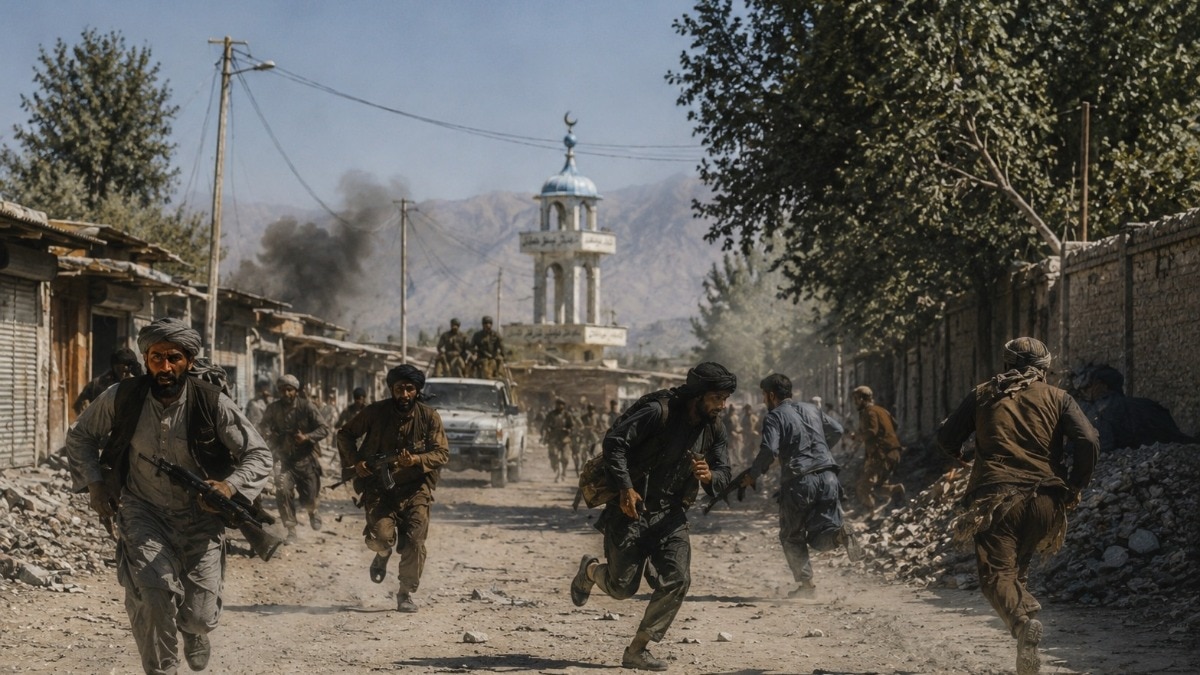
ISLAMABAD - Fighting between Taliban forces and armed opposition groups has intensified in Afghanistan's northeastern Badakhshan province, with clashes entering a second week as multiple resistance factions claim significant successes against Taliban positions.
⚡️🇦🇫 Freedom Fighters Defeating the Afghan Taliban!
- Zard si Gana (@ZardSi) July 27, 2026
Afghan Taliban flags are being torn down across Badakhshan as Freedom Fighters continue liberating occupied areas.
The end of Taliban regime is nearpic.twitter.com/nBrvK1cFtE
The Afghanistan Freedom Front (AFF) and the Homeland Soldiers Front (HSF), also known as Sepahiyan-e-Mehan, have been conducting coordinated operations across several districts, challenging Taliban control in one of the most sustained episodes of armed resistance since the group returned to power in 2021 .
Clashes in the strategically significant Zebak district have intensified, with the Afghanistan Freedom Front claiming to have shot down two Taliban military drones operating in the area . According to the group, the drones were conducting operations inside territories controlled by the Freedom Front, which successfully foiled a Taliban advance .
The group further claimed that Taliban forces suffered both human and military losses during intense clashes, and that resistance fighters prevented Taliban reinforcement helicopters from landing by opening heavy fire, forcing the aircraft to retreat .
Fighting has continued for several hours overnight in different parts of Zebak, which has emerged as the center of recent violence . Residents report that heightened military activity has turned parts of the district into a heavily militarized area .
Earlier this month, the newly formed Homeland Soldiers Front claimed a significant victory, briefly seizing control of the Yaftal-e Payin district center . According to local sources, between 20 and 25 armed fighters stormed government facilities before dawn, taking control of the district administration building, police headquarters, and intelligence office .
Videos shared on social media appeared to show armed men raising the group's flag over the government compound and firing celebratory gunshots . The group claimed its fighters disarmed Taliban personnel stationed at the district center and seized a large cache of weapons and military equipment before withdrawing .
The operation was reportedly led by Qayum Malang, a former Afghan Republic-era commando from the same district who had previously joined a commando unit of the National Resistance Front . This marks the first time the Taliban has lost temporary control of a district since its return to power .
The Afghanistan Freedom Front also claimed responsibility for a rocket attack on a Taliban military convoy traveling from Kabul to Badakhshan, reportedly killing seven personnel and seriously injuring over six others . The attack occurred in the Doshi district of Baghlan province as the convoy was transporting reinforcements and military equipment to Badakhshan .
The group said four Taliban commanders were killed in clashes over the past two days . Eleven Taliban fighters, including the four commanders, have been killed in attacks carried out by the Freedom Front in Baghlan and Badakhshan provinces .
The Taliban's 219th Omar-e-Salis Division confirmed fighting in Zebak district, saying border forces had killed five attackers who allegedly entered from Pakistan's Chitral region . However, independent verification of either side's casualty claims remains unavailable .
Fasihuddin Fitrat, the Taliban's chief of army staff, has traveled to Zebak as fighting continues . Taliban officials have sought to downplay the significance of the clashes, with Information Minister Shir Ahmad Haqqani dismissing reports as "rumors" intended to mislead the public .
"The fighting is based on rumors and false narratives, and they are trying to mislead the public," Haqqani said, describing opposition fighters as "killers, bandits, oppressors, and servants of others" .
Taliban spokesman Zabihullah Mujahid acknowledged recent fighting but said such incidents occur in every country and had been exaggerated for propaganda purposes . The Taliban governor of Badakhshan has urged armed opposition groups to lay down their arms and resolve grievances through dialogue .
Daoud Naji, head of the Afghanistan Freedom Front's political committee, has described the fight against the Taliban as entering a new phase, stating that the "decisive battle for liberation" would end with freedom for the Afghan people .
Former Afghan Vice President Amrullah Saleh has asserted that the Taliban regime is not a legitimate government and that political and armed resistance against it would become more organized, ultimately leading to the end of Taliban rule .
Security analysts note that Badakhshan's mountainous terrain, borders with China, Pakistan, and Tajikistan, and its long history of resistance make it well suited for guerrilla warfare . The recent attacks suggest a strengthening and increasingly decentralized anti-Taliban resistance, with localized armed groups expanding beyond traditional resistance strongholds .
The Taliban concentrated on Hazarajat and Tajik population provinces, but waves of resistance may also arise from Nuristan and Kunar provinces . Internal divisions within the Taliban over control of mining resources and administrative appointments have further complicated the security situation .

No comments yet. Be the first to comment!

Your trusted source for breaking news, in-depth analysis, and comprehensive coverage of today's most important stories.
Get daily updates on breaking news, exclusive interviews, and special features delivered to your inbox.
Have a news tip or want to get in touch with our editorial team? We're here to help.
Plot C3-C Jaypee Wishtown Sector 129 Noida Uttar Pradesh 201304 India
