
TWENTY-eight years after the nuclear tests at Chagai, the strategic environment in South Asia has shifted dramatically.
The assumptions that shaped Pakistan’s deterrence posture in 1998, and the paradigm shift from ‘Credible Minimum Deterrence’ to ‘Full-Spectrum Deterrence’, were rooted in visions of a conventional invasion, mass mobilisation and large-scale armoured thrusts across the border.
In contrast, the modern battlefield looks very different today. The war in Ukraine, the Azerbaijan-Armenia conflict, the Iran-US/Israel war and — most importantly for Pakistan — the May 2025 India-Pakistan conflict, have demonstrated how precision missiles, armed drones, electronic warfare, satellite enabled surveillance and integrated air defence systems are reshaping escalation dynamics.
Speaking over the weekend at the Shangri-La Dialogue in Singapore, Lt Gen Nauman Zakaria — commander of the 1 Corps who was introduced at the conference as the commander of the newly-raised Army Rocket Force Command — warned that emerging technologies were creating “new vulnerabilities… risk of miscalculation… [and a] compression of decision making timelines” that have altered “the nature of interstate conflict and strategic deterrence”.
Raising of new rocket force signals a significant strategic shift, as precision weapons compress decision timelines and blur the line between conventional and nuclear signalling in South Asia
This echoes what many view as the most important lesson from the May 2025 conflict: it was not that nuclear weapons failed; rather that they worked, but only in a limited sense.
They prevented full-scale war, but did not stop sustained military confrontation involving missiles, drones, air operations, electronic disruption and naval signalling under the nuclear shadow.
Reflecting on the May 2025 conflict, Lt Gen Zakaria said Pakistan’s response had “effectively debunked the notion of space for war in South Asia”.
Historically, Pakistan’s deterrence posture has adapted to shifts in Indian military doctrine. ‘Credible Minimum Deterrence’ gave way to ‘Full-Spectrum Deterrence’ after India developed the ‘Cold Start’ concept, prompting Islamabad to lower the nuclear threshold through systems such as Nasr.
But while Pakistan adjusted to the threat of limited ground incursions, India moved towards precision strikes, drones and standoff capabilities, as seen in Balakot in 2019, and the May 2025 conflict.
Subsequent events showed that even the “quid-pro-quo plus” approach adopted after 2016, which sought to impose higher costs on Indian military action, has not fully denied New Delhi room for limited operations below the level of full scale war.
To put it simply, India continues to look for ways to apply military pressure without triggering the nuclear escalation ladder.
Here, Pakistan now faces an important doctrinal question. While nuclear weapons remain the ultimate guarantor against existential threats, they are no longer the only instruments available for imposing costs or shaping an adversary’s behaviour during a crisis.
Pakistani strategists appear to recognise this shift. Prof Dr Adil Sultan, who is dean at the Faculty of Aerospace and Strategic Studies at Air University, argued that the impact of emerging technologies and the lessons of the May 2025 conflict highlight the need to “reconceptualise” existing notions of strategic stability.
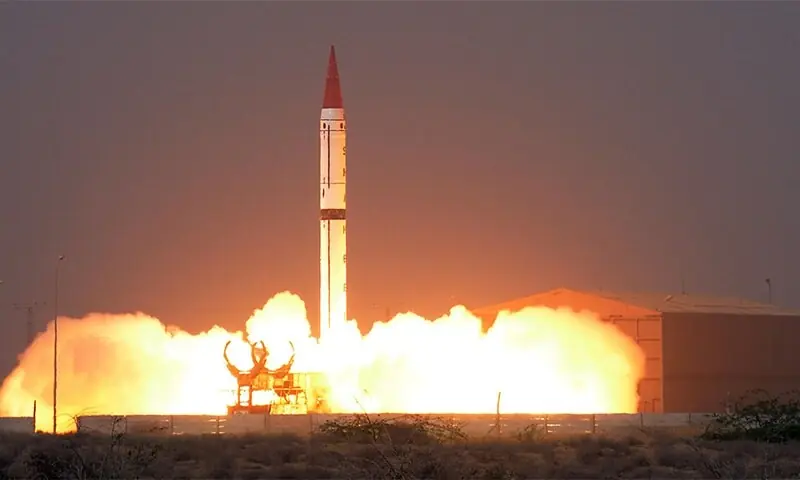
The creation of the Army Rocket Force Command is perhaps the clearest indication that Rawalpindi is building a stronger conventional deterrent layer.
Lt Gen Zakaria has been emphatic that the force is “a strictly conventional force” with a command structure entirely separate from Pakistan’s nuclear forces.
Moreover, the modernisation of systems like the Fatah missile series — whose fourth iteration was test-fired a fortnight ago — and efforts to improve precision strike capabilities clearly show that conventional missile forces are now being viewed not merely as battlefield assets, but rather strategic instruments in and of themselves.
Dr Rabia Akhtar, a visiting fellow of the Harvard Kennedy School-based Project on Managing the Atom, sees the creation of the National Strategic Command and Rocket Force Command as recognition that “conventional deterrence is becoming increasingly important” and could provide decision makers “a wider range of conventional response options” before reaching the nuclear threshold.
The reasoning is straightforward. If precision conventional systems can deliver calibrated but meaningful military effects, they reduce the requirement for early nuclear signalling and raise the practical threshold for nuclear use.
It also means doctrines framed around tactical nuclear use for battlefield denial may no longer correspond fully to the realities of the evolving battlespace.
Pakistan, therefore, may need to reconsider whether the existing formulation of ‘Full-Spectrum Deterrence’, or for that matter, the “quid-pro-quo plus” approach still reflects the strategic environment of 2026 or whether parts of it belong more to the threat perceptions of the mid-2000s.
Ambassador Zamir Akram, an adviser to the Strategic Plans Division, noted: “Space for conventional warfare has increased and raised the nuclear threshold”.
Yet, he also cautioned that new technologies have created greater “entanglement of conventional and strategic weapons”, making escalation faster and harder to control.
The argument that conventional deterrence needs to be given greater importance does not suggest abandoning nuclear deterrence or pursuing unrealistic conventional parity with India.
Indeed, Pakistan’s nuclear capability remains indispensable as the ultimate safeguard against existential coercion, but there is a growing case for recalibrating the relationship between nuclear and conventional deterrence.
One reason is the growing danger of ambiguity in a battlefield increasingly shaped by speed, automation and dual capable systems. Modern warfare compresses timelines, blurs signalling and increases the risk of misreading intentions. Pakistan’s traditional policy of strategic ambiguity served an important purpose when the objective was to create uncertainty in the adversary’s calculations.
Syed Ali Zia Jaffery, deputy director at the University of Lahore’s Centre for Security, Strategy and Policy Research, argued that while “calculated strategic ambiguity is still a critical part of deterrence”, there is also a need for “more emphasis” on strengthening conventional deterrence.
“It would act as a clear signal that Pakistan will counter India’s efforts to create a new normal in South Asia. While nuclear deterrence has delivered what it is expected and designed to do, the past two crises underscore the significance of the other planks of deterrence,” Jaffery maintained.
The May 2025 conflict demonstrated that limited war under the nuclear shadow is now a practical reality rather than a theoretical possibility.
One implication is that Pakistan may require a more carefully layered deterrence architecture in which strong conventional capabilities form the first line of deterrence, while nuclear forces remain the ultimate backstop against existential threats.
Published in Dawn, June 1st, 2026

No comments yet. Be the first to comment!

Your trusted source for breaking news, in-depth analysis, and comprehensive coverage of today's most important stories.
Get daily updates on breaking news, exclusive interviews, and special features delivered to your inbox.
Have a news tip or want to get in touch with our editorial team? We're here to help.
Plot C3-C Jaypee Wishtown Sector 129 Noida Uttar Pradesh 201304 India