
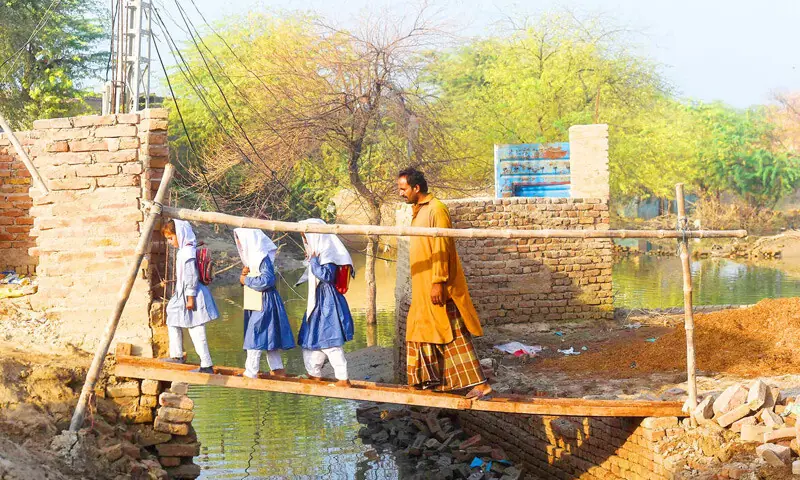
Khanzadi Kapri has lived through this three times.
In 2011, when the floods came to her village in Mirpurkhas, the schools went underwater. Her education was disrupted, saved only because her father, a teacher, turned their home into a classroom. Her siblings studied at the kitchen table while the rest of the village waited for the water to subside.
In 2022, the floods came back. Then again, in 2024. Each time, Kapri watched the same thing happen. Girls would return to school when the waters receded. They would sit in classrooms with no roofs, with broken furniture, with teachers who showed up on some days and not on others.
“There were hundreds, perhaps thousands of girls who completed grade five but never enrolled in grade six,” Kapri recounts. “Climate-related disasters do not just interrupt education temporarily. For many girls, they permanently change the course of their lives.” Kapri has witnessed this herself and has been trying to do something about it. She is now the founder of Aurat Sujag, a grassroots feminist initiative working on gender equality and climate justice in rural Sindh.
However, while it is a primary concern, the problem extends far beyond the rebuilding of the material infrastructure after the havoc caused by flooding. For instance, the girls’ school in Kapri’s village was supposedly ‘rebuilt’ and had a new flag hoisted outside it by late 2023, as if to signal that this institution exists, that it is counted, that it appears on a government spreadsheet somewhere as a functioning educational facility. It had walls, it had, nominally, a teacher assigned to it. It had been rebuilt, or partially rebuilt, with the kind of speed that post-disaster funding cycles demand.
What it did not have, for months at a stretch, was any teacher physically present there, or a roof over the rear classroom. Or girls above the age of 12 sitting inside it. But according to the data, the school existed. And according to the data, the girls had come back.
Four years after Pakistan was wrecked by catastrophic, record-breaking floods, some of the girls’ schools that were destroyed by the flooding have been ‘rebuilt’ on paper. Yet, across rural Sindh, damaged classrooms, a dearth of functioning toilets, absent teachers and silent dropouts reveal how girls continue to fall through the cracks of a post-flood recovery measured by numbers rather than lives
THE IMPACT OF THE FLOODS ON GIRLS’ EDUCATION
The 2022 monsoon floods were the worst in Pakistan’s recorded history. One-third of the country was submerged. Sindh was the most devastated province, as communities were swept away, roads destroyed, crops lost and schools, thousands of them, reduced to ruins or left standing as shells. The United Nations Children’s Fund (Unicef) reported at the time that the floods had put millions of children out of school overnight.
Then came the recovery narrative, as international donors pledged funds. According to a 2024 Global Partnership for Education document, 1,667 temporary learning centres were established across Sindh, 1,432 with Unicef support. The Sindh government reviewed district-level damage data and reconstruction began.
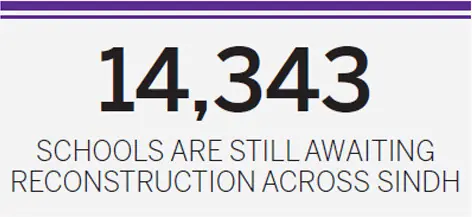
But, as of early 2026, 14,343 schools across Sindh, out of more than 19,500 damaged in 2022, are still awaiting reconstruction — as was disclosed following a meeting this March between Sindh Chief Minister Syed Murad Ali Shah, Sindh Education Minister Syed Sardar Shah and Secretary School Education Zahid Abbasi, among others.
Pakistan’s education spending dropped to approximately 0.8 percent of the gross domestic product (GDP) in the fiscal year 2024-2025, a record low, according to the Pakistan Economic Survey 2025-26. This number is far below the United Nations Educational, Scientific and Cultural Organisation (Unesco) benchmark of four-six percent, and far below what is needed to rebuild what the floods erased in rural Sindh.
The Sindh budget presented for the 2026-27 fiscal year does little to close that gap. Overall education spending has climbed, on paper, to over Rs600 billion, but the money tied specifically to fixing what the floods destroyed remains a footnote: just over Rs234 million earmarked for restoring flood-damaged schools, against more than 14,000 buildings still in ruin. The province’s development allocation for education was cut by roughly a third this cycle, even as officials described the year as one of record investment.
In Sindh, 7.4 million children, roughly 44 percent of the province’s five-16 age group, are out of school. This is the current number and not some post-flood statistic. According to Unicef Pakistan, the number of out-of-school girls in Sindh exceeds the number of out-of-school boys, reflecting what researchers carefully call “enduring structural and socio-cultural barriers”, a phrase that means: girls are easier to keep home when there is a reason to keep them home.
Boys face their own version of this. In flood-affected communities across Khairpur and Dadu, boys are pulled from classrooms for agricultural labour, brick kiln work, or seasonal migration, when family income collapses. Riaz H. Manglo, founder of TaleemDaan, a grassroots education initiative working in District Khairpur, has watched boys disappear from school, drawn into the fields during harvest, or sent to cities to find work.
“The question should not only be how many children are enrolled,” he says, “but how many are attending regularly, learning effectively and completing their education.”
The crisis is not only a girls’ crisis, but the barriers girls face are layered in ways they are not for boys. Looking beyond even the damage and disruption caused by the floods, the continuation of girls’ education in the region is compounded by safety, mobility, marriage compulsions and a social calculus that often comes at the cost of girls’ education.
THE GHOST ‘RECOVERY’ AFTER THE FLOODS
There is a particular kind of data failure that happens after disasters since organisations need to show ‘results’. Donors need to see that their money ‘worked’. Governments need to demonstrate ‘progress’. And so enrolment figures are collected, temporary learning centres are counted, schools with roofs and flags are marked as ‘functioning’. What the data rarely captures is whether that building had been rebuilt in a properly functioning manner, if at all, and whether the girl who walked back into the school in January 2023 was still sitting in it by June.
Manglo has watched this happen in Khairpur for three years. He visits schools that look fine on a register and look completely different in person.
“School records often show encouraging enrolment figures,” he reveals, “but when you visit schools and observe classrooms, the actual attendance is much lower.” He has tracked a pattern that repeats across the district. Enrolment in the early years, grade one, is relatively high. Then, grade-by-grade, the numbers thin. By grade five, the classroom is half-empty.
Sharjeel Ahmed, a development professional who has worked with flood-affected communities in District Dadu, describes how the disappearance happens not in one moment but in many small ones. He says, “Sometimes girls stop attending for a few days, then a few weeks, and eventually disappear from the education system altogether. This is why looking only at enrolment numbers can be misleading.”
Kapri does not soften her assessment of the gap between what is reported and what she sees. “Yes, some schools may have reopened. Yes, enrolment numbers may show improvement. But these numbers do not tell us how many girls are attending regularly, how many quietly dropped out after enrolling, how many were married before completing school.”
The Annual Status of Education Report Pakistan’s (ASER’s) annual education reports for Sindh have consistently shown that learning outcomes in rural Sindh are among the lowest in the country, independent of floods. The deeper reality is that the floods did not create this crisis, but they deepened a pre-existing one and then allowed the recovery narrative to obscure both.
Pakistan has 26.2 million children out of school nationwide, including 13.4 million girls, according to the federal government’s own Girls’ Education Statistics and Trends Report 2023-24. Sindh alone accounts for 7.4 million of the national total. These are not children who were never enrolled. Many of them were enrolled, some of them went back after the floods and then they disappeared again, in ways that the enrolment data is not designed to detect.
Furthermore, there is also a dimension to this story that appears in almost no official report, no donor assessment, no recovery statistic. When a school has no functioning toilet at the primary school level, a girl can still manage. She is young and she often leaves early to go home. But an adolescent girl who has reached puberty and has no private, hygienic space at school faces a choice the data never records: her dignity or her education. In many cases, the former is chosen.
Roshni Anwar, founder of HerSpace (an organisation that works at the intersection of gender equality and climate action in Pakistan) and a climate justice expert, has seen this first-hand in the field and through conversations that official recovery visits do not tend to have. During her work in Mirpurkhas after the 2022 floods, Amwar says she met women and girls whose villages, homes and schools remained submerged for months. They described how difficult it was to access washrooms, maintain hygiene and find a moment of privacy in a landscape where every boundary had dissolved. “Women had to lift their clothes above their knees and walk through floodwater just to find a place for privacy,” Anwar says. “Many told me they felt ashamed and humiliated.”
This is not a minor discomfort. For adolescent girls managing their periods with no clean water, no toilets, no privacy and no sanitary products, the very act of going to school becomes not just difficult but humiliating. Studies across South Asia consistently show that the absence of menstrual hygiene facilities is one of the leading causes of girls dropping out at puberty, yet it is treated, in most post-flood recovery frameworks, as an afterthought.
“We talk about infrastructure, relief packages and statistics in the aftermath of floods,” Anwar says. “But we rarely talk about women’s privacy, safe sanitation, gendered experiences of displacement, emotional and psychological trauma, the silent dropout crisis.”
Dignity, she says, must be a core part of any genuine recovery — both within the school and beyond.

No comments yet. Be the first to comment!

Your trusted source for breaking news, in-depth analysis, and comprehensive coverage of today's most important stories.
Get daily updates on breaking news, exclusive interviews, and special features delivered to your inbox.
Have a news tip or want to get in touch with our editorial team? We're here to help.
Plot C3-C Jaypee Wishtown Sector 129 Noida Uttar Pradesh 201304 India