
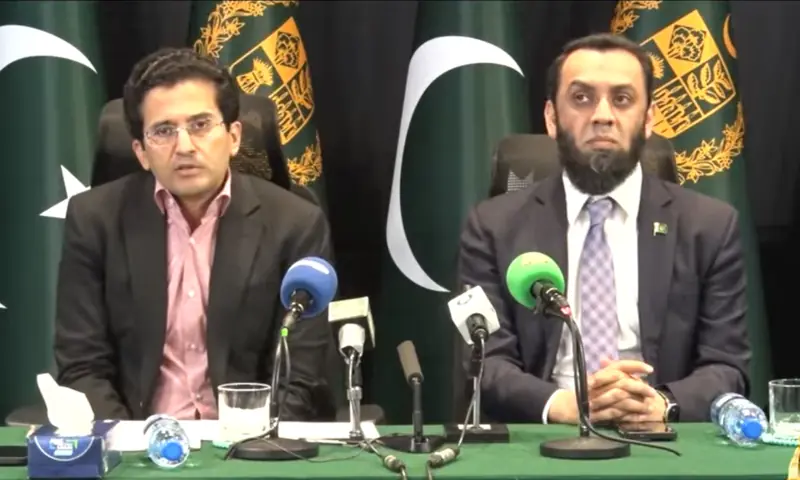
Petroleum Minister Ali Pervaiz Malik on Friday said that fuel prices would be fixed daily due to fluctuations in international market prices following renewed hostilities between Iran and the US.
Addressing a press conference alongside Information Minister Attaullah Tarar, Malik thanked the nation on behalf of the government, who he said have “patiently tried to bear the burden of this war”.
He noted that despite the efforts of Chief of Defence Forces (CDF) and Chief of Army Staff Field Marshal Asim Munir and Prime Minister Shehbaz Sharif, the US-Iran war seemed to be escalating in the region.
“The Cabinet and prime minister have decided … Ogra will be given the responsibility to daily decide the fuel prices based on the international market,” the petroleum minister said.
He added that Ogra would “not just publish the fuel rates on its website that are used to determine prices, but also publish the factors leading to the price that we see in each petrol pump”.
Malik stated that although the decision would surely add a burden on citizens, they would see how it was necessary for the state. He said that the decision was part of the government’s decision to make the system more transparent, so that people could understand why increasing fuel prices were inevitable.
He also noted that there had been “a lot of discussion” on the government’s levies and the prime minister’s promise that any price reductions would directly benefit the nation.
“The government is still determined to deliver on its promise,” he said.
He said that the price of diesel dropped from Rs520 to the range of Rs300 today, and similarly a huge price reduction of Rs70-80 was seen for petrol when it happened in the international markets.
On the topic of levies, he noted that the petrol levy and the carbon support levy on petrol and diesel were still low today.
The minister also said that the government was working on transparency and reducing the burden of indirect taxation.
According to him, the daily price announcements will be decided according to a seven-day weekly average in the international market. He added that in another step towards deregulation, it would be ensured that the prices in the country were adjusted according to the international market without asking him, the information minister “or anyone else”.
Malik highlighted that PM Shehbaz had created a committee under the petroleum minister’s leadership, which had already held four meetings.
“In the next 15-20 days, we will decide on post-war energy pricing and energy security architecture, based on which the next generations will assess this government,” he said.
He also raised the question of why Pakistan continued to fulfill its energy requirements through imports, stating that a study commission had been undertaken to make educated decisions through internationally-renowned consultants on whether the government had the resources to keep strategic petroleum reserves.
Other questions, he noted, included how much money the government could commit to this venture over the next few years, and how it could motivate large-scale traders in international markets and companies in “brotherly and neighbouring” countries to keep their reserves with Pakistan and provide them to other markets from here.
This summary will be presented next week in the Cabinet, he said.
Malik also highlighted steps taken by the government to increase energy extraction. He noted that after the prime minister’s recent visit to Turkiye, Turkish Petroleum would be arriving to extract oil and gas in the country in October after 20 years.
“We will move towards betterment so that people will remember this government in good words,” the minister said. “If there are any burdens … we will get through these times using schemes like austerity measures.”
Information Minister Attaullah Tarar also addressed the press conference, stating that the increase in oil prices in international markets was linked to the worsening regional situation and that Pakistan’s efforts to resolve the situation had been “appreciated by the entire world”.
During oil shortages at the peak of tensions, he noted that “many developed countries in the world saw people lining up for fuel and they couldn’t get it. At that time, the prime minister had prearranged additional oil reserves beforehand.”
“Many countries opted for rationing, but in Pakistan, there was no rationing or shortage,” Tarar said.
More to follow

No comments yet. Be the first to comment!

Your trusted source for breaking news, in-depth analysis, and comprehensive coverage of today's most important stories.
Get daily updates on breaking news, exclusive interviews, and special features delivered to your inbox.
Have a news tip or want to get in touch with our editorial team? We're here to help.
Plot C3-C Jaypee Wishtown Sector 129 Noida Uttar Pradesh 201304 India