
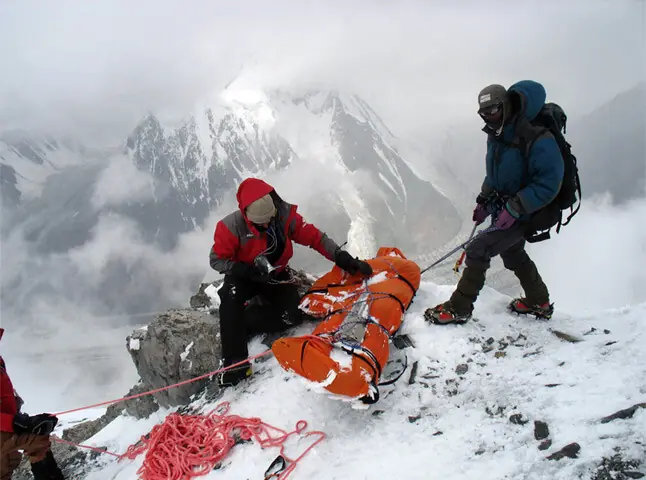
RECOVERING THE UNRECOVERABLE
Kronthaler’s expedition demonstrated that recoveries were possible. Nearly two decades later, Pakistani climbers have begun carrying that work forward themselves.
Abid Sadpara comes from mountaineering royalty. He is the son of famed climber Hasan Sadpara, the first Pakistani to achieve the combined distinction of summiting Mt Everest and all five of Pakistan’s 8,000-metre peaks: K2, Nanga Parbat, Gasherbrum I, Broad Peak and Gasherbrum II.
In 2023, Abid was approached for the retrieval of the body of an Afghan climber, Akbar Ali Sakhi, who had passed away in 2022 on K2, at an altitude of 7,200 metres. At first, Karakoram Expeditions (KE), Sakhi’s tour operator, told his widow Karima Sakhi that they would recover his body, but they later refused, saying that it was impossible to bring it down from that altitude.
For many families, a burial matters as much as the climb itself. Without a body, grief often remains suspended indefinitely. Karima was determined to recover her husband’s body and give him a proper burial close to his favourite trail in Kabul. After contacting several tour operators, she was connected to Abid, who agreed to attempt a recovery mission.
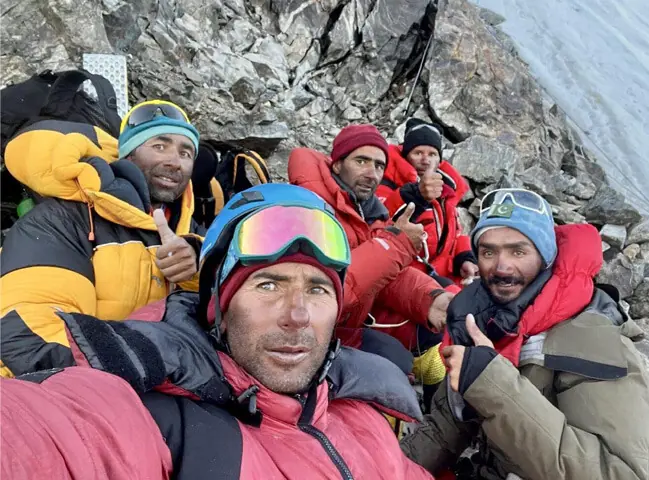
“The first step was assembling a team of experienced mountaineers, which included Murad Sadpara, Sadiq Sadpara, Ali Musa Sadpara, Ali Shigri, Abideen Shigri, Sajjad Sadpara and Ismail Sadpara,” Abid explains to Eos. “The team then went to train at Khosar Gang (6,040m), a ‘technical’ climb in the Shigar Valley and a popular peak for those wishing to train themselves before going on to K2.”
After reaching K2 basecamp, they began the process of acclimatisation, climbing higher every day and setting up camp so that their bodies could get used to the height. Sakhi’s body was on Camp 3, just above the Black Pyramid, over 1,500 feet of exposed rock and ice, and it was necessary that their bodies be primed to conduct both the physical and technical aspects of recovery.
It also required getting all the other climbers for that day to understand that there was a recovery mission being attempted.
“We requested everyone below us that, for the next two days, they had to restrict their movement for any summit push. Once we could get everyone to agree that they would not be making a summit push, our team could finally go and recover Sakhi,” says Abid.
Abid’s team attempted the mission late at night. “People climb in very early hours of the morning at around 3am to 4am. Since we were conducting a recovery mission and needed there to be almost no one trying to climb up, we decided on beginning our recovery mission at night time.”
They had to chisel around the body to make Sakhi unstuck. “Around 8pm [after they secured Sakhi’s body], it took them seven hours [to get down] till Camp 2 at the [House’s] Chimney, where they rested for a day and then abseiled down to base camp, where a helicopter was waiting for them and the body,” recalls Abid.
“When we brought his body down to CMH [Combined Military Hospital] Skardu and it began to thaw, it was so well preserved in the ice that it was almost like he had died only a week ago,” Abid continues.
After Sakhi’s body was brought to Skardu, according to Abid, it was handed over to the Pakistan Army, who then took the responsibility of transporting him first to Islamabad and, later, to Kabul.
INSIDE THE DEATH ZONE
One of the most controversial incidents on K2 illustrates why body recovery has become such an emotional issue.
In July 2023, dozens of mountaineers who were attempting to summit K2 walked over Muhammad Hassan Shigri as he lay dying in the snow, trying to ask for help while his body went numb. The chilling footage of the scene sparked outrage in the mountaineering community and public alike, who questioned why no one helped him down to a lower altitude.
“At those altitudes, it’s important to realise that people are in an altered mental state,” says Abid Sadpara. “When you are summiting a peak, you don’t stop to help those around you. You only think about survival for yourself.”
UAE-based Pakistani mountaineer Naila Kiani agrees. However, she contends that, in Shigri’s case, the summit push should have been delayed. “With the help of four to five climbers, Shigri could have been brought down to Camp 4 [from the Bottleneck] and provided oxygen. He could have been saved,” she tells Eos via WhatsApp.
The next year, Kiani was on a K2 clean-up mission — which involves systematically removing refuse from high altitudes and fragile ecosystems. This entails collecting empty oxygen cylinders, ropes, hooks, tools and even bodies.
After contact with Hassan Shigri’s widow and children, Kiani organised a mission to bring back Shigri’s body for a proper burial. Murad Sadpara, also on the Ali Akbar Sakhi recovery team, became a part of the mission.
Hassan Shigri’s body was on the Bottleneck — regarded as the most dangerous part of the K2 ascent — a narrow corridor between a serac (an unstable block of ice) and a steep drop.
Ali Muhammad Sadpara, who was on a summit push for K2, also ended up joining the recovery mission. “I met Murad [Sadpara] and Naila on the way to the summit, where Murad asked if I could also be a part of the team to recover Shigri’s body,” Ali Muhammad Sadpara tells Eos.
“We had left Camp 4 at 9pm for our summit push, reaching the peak at 6:30am. While on my way to summit K2, I could see Shigri’s feet sticking out from under the snow,” narrates Ali Muhammad. “On my way back [from the peak], I crossed the body again and then met up with Murad and Dilawar [Sadpara], and decided to go back up 100 metres with them to recover the body. By this time, Zakir and Akbar Hussein [other members of the mission] had also arrived and the five of us then used ice-axes to break the ice around Shigri’s body.”
The team then tied his body with rope and anchored it down, first to Camp 4 and then Camp 3, in around seven hours. According to Ali Muhammad Sadpara, since the clean-up mission was operational with its ropes and fixtures on the mountain, this step became easier than what it typically would have been like.
THE COST OF RECOVERY
Recovery missions also raise another question: who pays?
Hassan Shigri’s death shows the precarious economic situation in which Pakistani climbers and porters find themselves in. While climbing at high altitudes is an expensive pursuit, poorly paid porters in Pakistan have to train themselves with meagre resources to take on the world’s highest peaks.
“Pakistani porters are paid between five to seven lakh rupees [Rs500,000 to Rs700,000] for an expedition that can last for more than a month,” continues Abid. If they use oxygen, the four to six canisters required for a summit can cost up to Rs400,000. “A porter then needs to decide whether to use oxygen or cut down on the money he brings back to his children,” explains Abid.
Abid received Rs6 million — approximately USD21,000 — for the whole team and equipment needed to recover Akbar Ali Sakhi’s body, which is much less than what expeditions to climb K2 would cost if undertaken by a foreign mission. In 2024, American publication Outside Magazine reported that bringing down a body from Everest costs $75,000 — nearly Rs21 million.
Until 2014, there were just 10 Pakistani mountaineers who had summited K2, Pakistan’s highest peak. Today, over 54 Pakistani climbers have reached the peak of the Savage Mountain.
According to Ayaz Shigri, General Secretary of the Alpine Club of Pakistan, social media has fundamentally changed how porters and climbers from Pakistan are perceived.
“The reality is that, before, international climbers would not let their high altitude porters summit with them,” Ayaz tells Eos on the phone. But now, with social media and the availability of video cameras, instances of climbers preventing their porters from summiting have become harder to suppress. “This has resulted in such instances going down,” suggests Ayaz.
Uproar over Hassan Shigri’s death was also possible because of the video that was shared on social media, which prompted recovery efforts.
THE BODIES THAT REMAIN
Poor record-keeping has meant that the exact number of bodies left on Pakistan’s mountains is difficult to ascertain. Unless regular clean-up missions take place, most of them will never be recovered.
In February 2021, Ali Sadpara, John Snorri, and Juan Pablo Mohr were killed during an attempt to summit K2 in the winter. An attempt by Ali Sadpara’s son, Sajid Sadpara, in July of that year was unable to bring their bodies down, but Sajid marked their graves. As the trio attempted the “last first” — which specifically refers to achieving the first successful winter summit of K2 — bringing their bodies down from their resting place atop the Killer Mountain will be a feat in itself.
Until Pakistan develops a permanent high-altitude rescue and recovery service, every recovery will depend on volunteers willing to risk their own lives to bring someone else home. For now, there are no takers for the dead, and for the dozens who are still on the country’s highest mountains, that call may never come.
The writer is Managing Editor of Folio Books
Published in Dawn, EOS, July 5th, 2026

No comments yet. Be the first to comment!

Your trusted source for breaking news, in-depth analysis, and comprehensive coverage of today's most important stories.
Get daily updates on breaking news, exclusive interviews, and special features delivered to your inbox.
Have a news tip or want to get in touch with our editorial team? We're here to help.
Plot C3-C Jaypee Wishtown Sector 129 Noida Uttar Pradesh 201304 India