
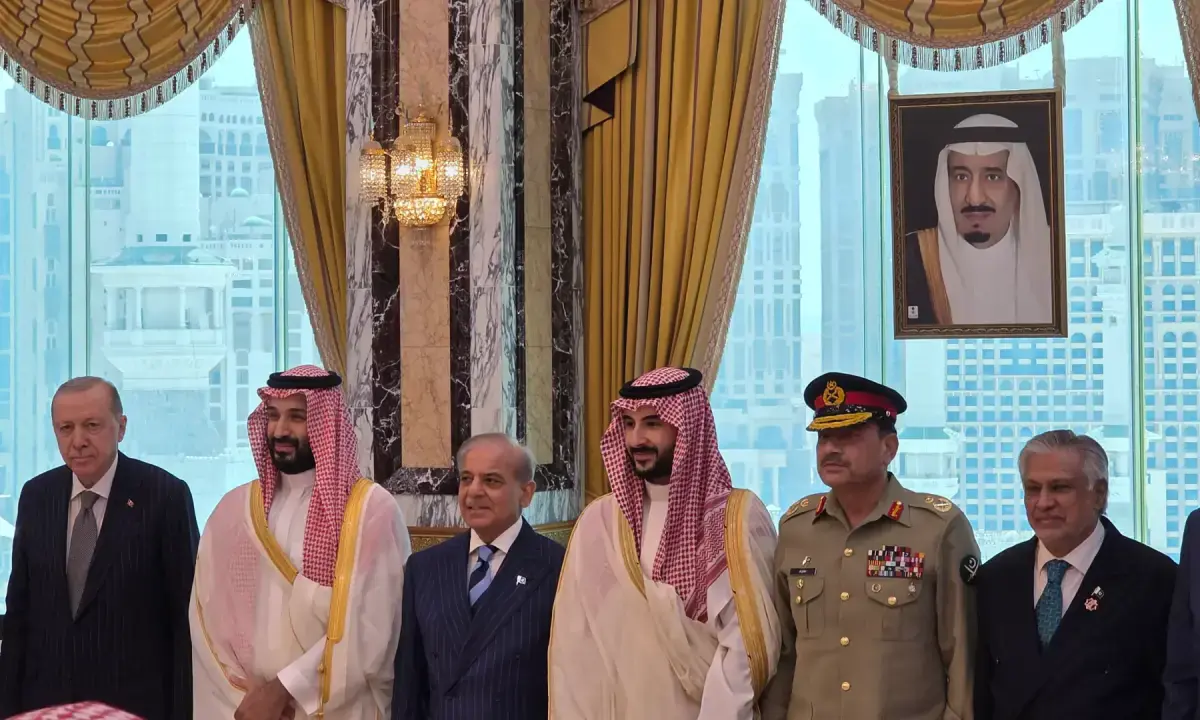
Pakistan, Saudi Arabia and Turkiye on Friday signed a joint defence pact in Makkah that empowers member states to treat an attack against one of them as an attack against all of them.
Pakistan, Saudi Arabia and Turkiye on Friday signed the Makkah Joint Defence Agreement aimed at strengthening “collective deterrence against any act of aggression”, the Foreign Office (FO) said.
Prime Minister Shehbaz Sharif, Saudi Crown Prince and PM Mohammed bin Salman, and Türkiye’s President Recep Tayyip Erdogan signed the pact after the “Makkah Al-Mukarramah Summit for Joint Defence” was held at the Al-Safa Palace.
The agreement reflects the three countries’ “shared commitment to further strengthening their collective security and to promoting peace, security, and stability in the region and beyond, in pursuit of a secure and prosperous future”, the FO said.
“The agreement is intended to strengthen collective deterrence against any act of aggression, and stipulates that any armed attack against any one of the three states shall be regarded as an attack against them all.”
The pact also “provides for the enhancement of all aspects of defence cooperation” among the three countries, the FO statement added.
The agreement is “guided by the longstanding historical ties among the three states, based on the enduring bonds of brotherhood and Islamic solidarity that unite them, and building upon their shared strategic interests and longstanding defence cooperation”.
During the Makkah Al-Mukarramah Summit for Joint Defence, the “distinguished relations” between the three countries were reviewed, “along with a number of issues of mutual interest”, the FO noted.
Crown Prince Salman received PM Shehbaz and President Erdogan at the Al-Safa Palace.
The prime minister arrived in Saudi Arabia on a three-day visit on Thursday, while the Turkish president undertook a one-day visit today, Anadolu Agency reported.
Erdogan landed at King Abdulaziz International Airport in Jeddah, from where he departed for Makkah by road, the Turkish news outlet reported.
The agreement ties together Pakistan, the only nuclear-armed Muslim country; Saudi Arabia, the home to Islam’s holiest sites and one of the world’s top oil exporters; and Turkiye, Nato’s second-largest military.
It comes in the backdrop of the US-Israel war on Iran, the tensions from which have expanded to the Middle East and the Gulf region in recent weeks.
The regional conflagration has rained missile fire onto Gulf oil exporters. Iran has targeted Gulf countries in what it says is retaliation for attacks carried out against it using US military bases in the region.
Pakistan and Saudi Arabia had signed the “Strategic Mutual Defence Agreement” in Riyadh last September, pledging that any attack on either nation would be treated as an act of aggression against both.
Earlier in the day, PM Shehbaz, accompanied by Chief of Defence Forces and Chief of the Army Staff Field Marshal Asim Munir, met with the Saudi crown prince at the Al-Safa Palace, the Prime Minister’s Office (PMO) said.
According to the PMO, Deputy Prime Minister and Foreign Minister Ishaq Dar and Defence Minister Khawaja Asif were also present on the occasion.
PM Shehbaz had landed in Jeddah on Thursday, where he was received by Makkah’s Deputy Governor Prince Saud bin Mishal bin Abdulaziz.
CDF Munir later joined the Pakistani delegation, which also included Information Minister Attaullah Tarar and Special Assistant to PM Tariq Fatemi.
On Friday morning, the delegation visited the Holy Kaaba and performed Umrah, the PMO said. PM Shehbaz was also set to visit Masjid-i-Nabvi (PBUH) in Madina.
According to an earlier statement by the FO, discussions between the two sides were to “focus on consolidating the Pakistan-Saudi bilateral relations as well as exchange of views on regional and international developments of mutual interests”.
The FO had noted that although the visit was taking place amid heightened tensions in the Gulf, it carries “significance beyond the immediate crises and short-term considerations”.
It said the visit will “further strengthen bilateral relations, deepen strategic cooperation, enhance coordination on regional and international issues of mutual interest, and reinforce multilateral cooperation”.
“The visit marks Pakistan’s long-standing partnership with the Kingdom of Saudi Arabia anchored in decades of mutual trust, cooperation and brotherhood,” the FO had emphasised.
More to follow

No comments yet. Be the first to comment!

Your trusted source for breaking news, in-depth analysis, and comprehensive coverage of today's most important stories.
Get daily updates on breaking news, exclusive interviews, and special features delivered to your inbox.
Have a news tip or want to get in touch with our editorial team? We're here to help.
Plot C3-C Jaypee Wishtown Sector 129 Noida Uttar Pradesh 201304 India