
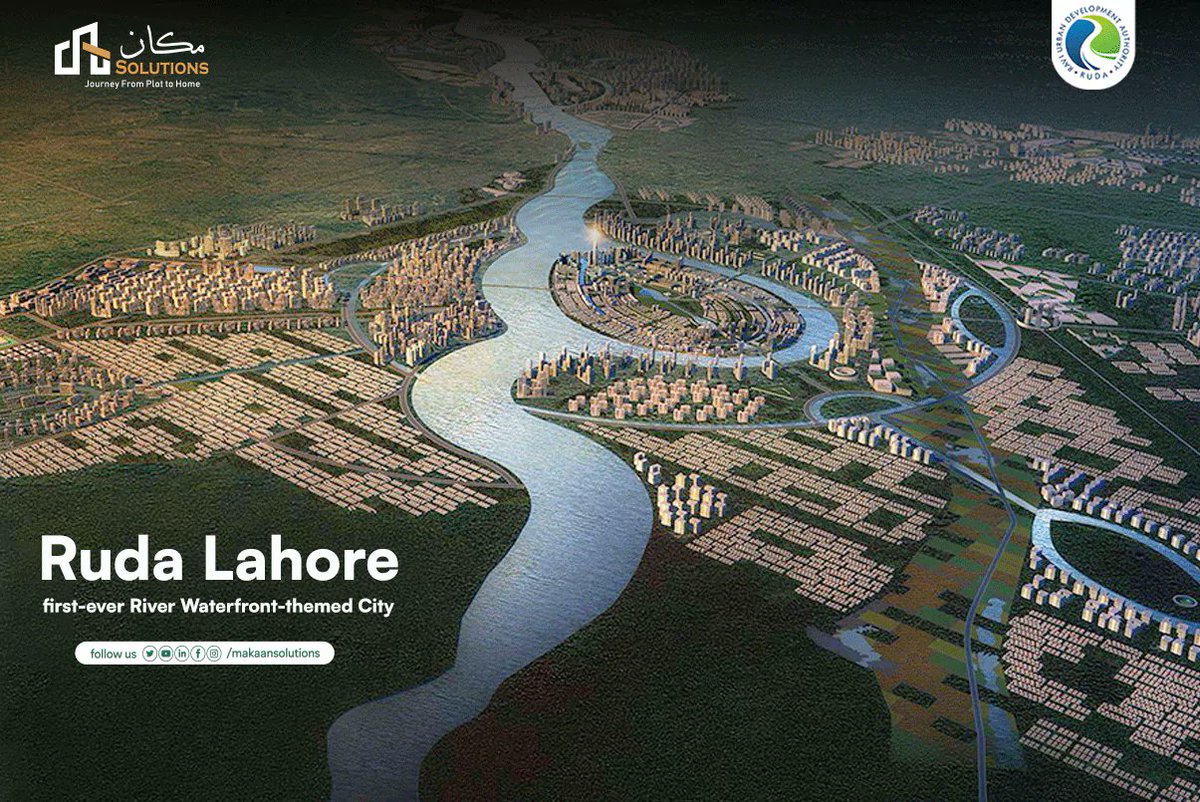
"Flowing into the future ... RUDAThe Ravi Urban Development Authority (RUDA) project in Lahore is a mega scale riverfront master plan spanning 1 Lakh acres along a 46 km stretch of the River Ravi. Designed to house up to 10 million people, it aims to fix overpopulation , water scarcity, and pollution.It will feature Specialized sectors including the Financial District (The SOUQ District), Medical City, Sports City, and residential enclaves. Phase one of Chahar Bagh is nearing completion.70% of its area will be reserved for the plantation of 6million trees.A lake, anurban forest, threebarrages and sixwater treatment plantswill be built in the first phase.Project was launched in august 2020 with public private partnership model to house upto 100 housing colonies at the total cost of 30 billion $ and to be completed in three phases. Due to economic crisis and court orders, it was slowed down but gradually picking up steam RUDA has sought to permanently address flood risks by developing a 1 km wide and 6 metre deep river creek, capable of carrying flood flows of up to 600,000 cusecs with a 10pc freeboard.What do you think, how this eco-metropolis would affect the urban planning across Pakistan. Can environmental and indus water treaty in abeyance concerns impact floods and livelihood of people "
The Ravi Urban Development Authority (RUDA) project is a significant undertaking designed to tackle pressing urban challenges in Lahore, Pakistan. Spanning over 1 Lakh acres along a 46 km stretch of the River Ravi, this riverfront master plan aims to provide housing for up to 10 million people. With the city's struggle against overpopulation, water scarcity, and pollution, RUDA represents a proactive approach to urban planning.
Launched in August 2020, the project is based on a public-private partnership model, with an estimated total cost of $30 billion. Spread over three phases, the first phaseChahar Baghis nearing completion and has earmarked 70% of its area for the plantation of about 6 million trees. This focus on greenery, along with the establishment of a lake, an urban forest, and other eco-friendly infrastructures, sets the groundwork for a sustainable urban environment. Additionally, the project aims to implement vital water management systems through six water treatment plants and a network of three barrages, working to mitigate water pollution and flooding effectively.
The international community has observed the RUDA project with a mix of optimism and skepticism. While environmental activists commend the tree-planting initiatives and sustainable urban planning, concerns about the project's financing and bureaucratic hurdles have emerged. The project aims to address flood risks with a 1 km-wide and 6-meter-deep river creek designed to manage flood flows of up to 600,000 cusecs. However, obstacles such as economic crises and legal challenges have temporarily slowed progress. As the project gradually gains momentum, its success could provide a model for urban development in the region, attracting international investments and fostering economic growth.
RUDA has the potential to redefine urban architecture and environmental management in Pakistan. Its successful completion could stimulate urban planning initiatives across the country, offering valuable lessons in sustainable development. However, the implementation of effective environmental and industrial water management strategies will remain essential, especially in light of treaty concerns that may affect water quality and availability for local communities. As the project moves forward, a collaborative approach involving local authorities, environmental groups, and residents will be crucial in ensuring long-lasting benefits that enhance the livelihoods of those living along the River Ravi.


No comments yet. Be the first to comment!

Your trusted source for breaking news, in-depth analysis, and comprehensive coverage of today's most important stories.
Get daily updates on breaking news, exclusive interviews, and special features delivered to your inbox.
Have a news tip or want to get in touch with our editorial team? We're here to help.
Plot C3-C Jaypee Wishtown Sector 129 Noida Uttar Pradesh 201304 India