
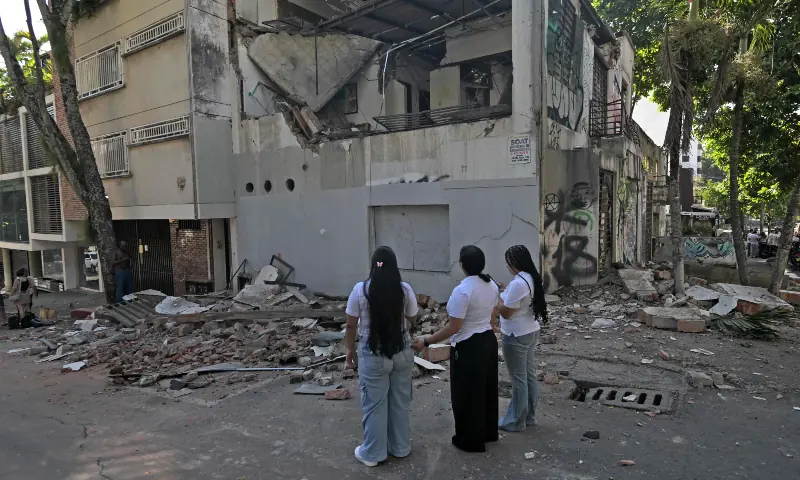
At least 77 people were killed after a powerful earthquake struck western Colombia early on Monday, knocking down buildings across several cities and leaving others trapped in the rubble.
The quake struck just days after Abelardo De La Espriella was sworn in as president, thrusting the new administration into its first major crisis, with memories still fresh of devastating twin earthquakes in neighboring Venezuela in June.
The Colombian geological service and its American counterpart, the US Geological Survey, put the magnitude at 7.4. Colombia had initially put it at 6.6.
The quake, according to USGS, struck at a depth of 107km near San Jose del Palmar, in Choco, a sparsely populated province on Colombia’s Pacific Coast, but was felt in major cities nationwide.
“Significant casualties and damage are likely and the disaster is potentially widespread,” the agency warned.
The highest reported death toll was in the western province of Risaralda in Colombia’s coffee-growing region, where Governor Juan Diego Patino, speaking by phone to Caracol Television, reported 42 fatalities.
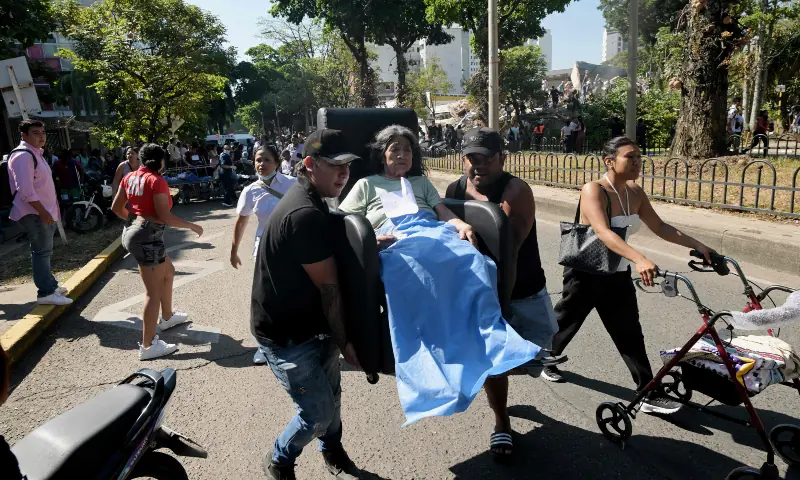
In the province’s capital of Pereira, social media images showed a building with a cracked facade crash to the ground, sending up a dark cloud of dust and debris as onlookers on the street darted away. The impact also toppled one of the towers atop a Gothic-style cathedral in Manizales, and forced nurses in Cali to wheel patients outside in hospital beds, social media and television images showed.
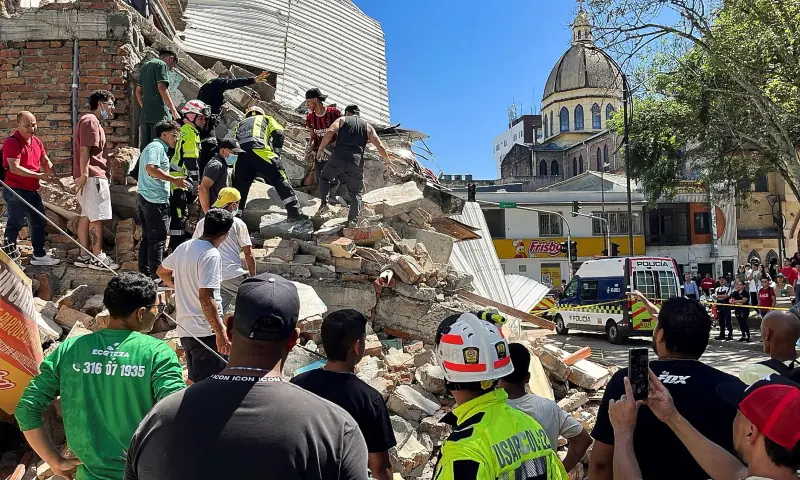
In Pereira, Mayor Mauricio Salazar said 18 people had died. “The situation is critical,” he told Caracol Radio.
In nearby Manizales, Mayor Jorge Eduardo Rojas said three people were killed.
One person died in Buenaventura, Colombia’s main Pacific port, when a building collapsed, trapping several people, Mayor Ligia del Carmen Cordoba said.
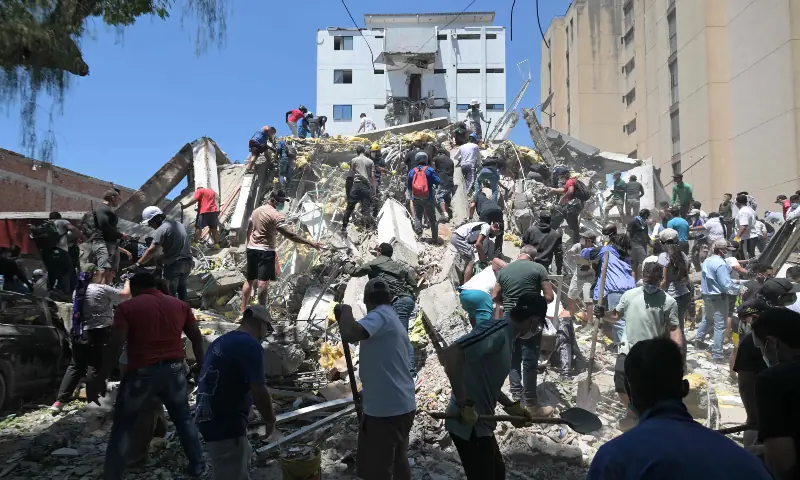
People remained trapped in Cali, one of Colombia’s largest cities, after more than two dozen structures collapsed, Mayor Alejandro Eder said. He added that the city had asked authorities in Bogota and Medellin to send disaster teams to support rescue efforts.
“At this point, two people have already been rescued alive, one elderly woman and one young girl. There are more people trapped,” Eder told Blu Radio. “We have at least 12 critical points and 25 collapsed structures that we are responding to.”
Colombian officials said they did not fear a tsunami after the early-morning quake, which was also felt in Ecuador, Panama and Venezuela.
It prompted building evacuations in Bogota, AFP reporters saw, while news footage showed collapsed buildings elsewhere in the country.
The governor of Colombia’s Choco province wrote on X that there were injuries and serious damage to buildings in the department’s capital Quibdo.
News outlets aired footage of buildings also destroyed in cities such as Pereira and Manizales in a tourist region called Eje Cafetero.
“There is no electricity or cell phone coverage. It was strong, really strong. Things fell in my house,” Martha Estrada, a 66-year-old resident of Eje Cafetero, which means coffee-growing region, told AFP.
Alejandro Eder, the mayor of Cali, Colombia’s third largest city, also reported “major damage” that was being evaluated with drones. At least 20 buildings collapsed in the city, with people trapped inside, the mayor said.
The city has requested teams from Bogota and Medellin to aid in rescue efforts, he added.
“The quake was very, very strong,” said Valeria Polo, a 29 year old content creator in Bogota.
Six small airports in western Colombia suspended operations, the civil aeronautics agency said. These airports serve Pereira, Manizales, Quibdo, Armenia, Cartago and Buenaventura, the agency wrote on X.
Bogota Mayor Carlos Galan said on Blu Radio that damage in the national capital appeared to be limited to cracks in the facades of houses and buildings.
News outlets aired footage of some buildings with their facades ripped off by the quake.
In Bogota some people ran out into the street in their pajamas as emergency sirens rang out, AFP reporters saw.
Smaller earthquakes are not uncommon in Colombia, which is crisscrossed by three ranges of the Andean mountains. However, it is landslides which have historically been the deadliest natural disasters in the country, with the Armero disaster in 1985 killing some 25,000 people.
Cities in the country’s coffee region, including Armenia and Pereira, suffered a devastating 6.2 magnitude quake in 1999, which killed more than 1,000 people.
De La Espriella, a right-wing politician who has never before held elected office, said in a video filmed while flying to Bogota that he was suspending his planned activities to lead emergency coordination efforts out of the capital.
Twin earthquakes in Venezuela of magnitude 7.2 and 7.5 on June 24 killed more than 6,000 people and caused devastating property damage, mostly on the coast near the capital, Caracas.

No comments yet. Be the first to comment!

Your trusted source for breaking news, in-depth analysis, and comprehensive coverage of today's most important stories.
Get daily updates on breaking news, exclusive interviews, and special features delivered to your inbox.
Have a news tip or want to get in touch with our editorial team? We're here to help.
Plot C3-C Jaypee Wishtown Sector 129 Noida Uttar Pradesh 201304 India