
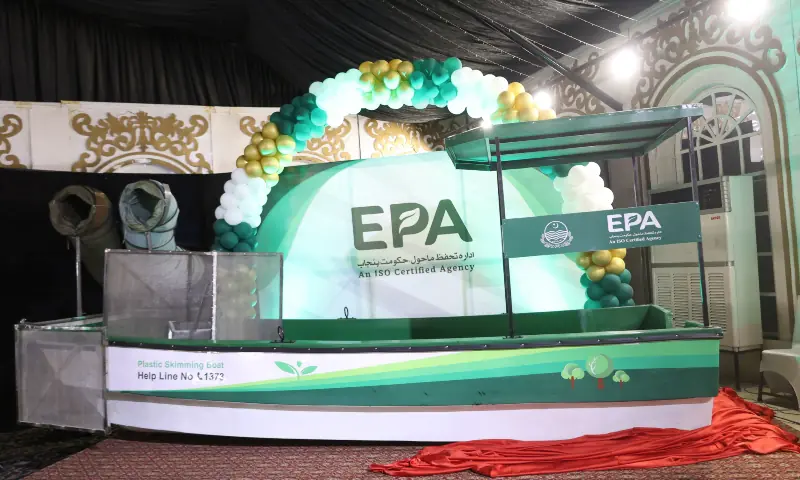
LAHORE: Punjab’s Environmental Protection Agency (EPA) on Friday launched its first skimming boat designed to remove plastic waste from canals and rivers, in a major step towards tackling plastic pollution.
The boat will begin operations as a pilot project in the Lahore Canal, marking the introduction of a technology-based solution to address water pollution in the province.
EPA Punjab officials said the skimming boat, with a waste collection bin installed at its front, would play a vital role in collecting floating plastic waste from waterways, supporting the province’s broader campaign against plastic pollution. They noted that the pilot project would help assess the effectiveness of the technology before its potential expansion to other canals and rivers across Punjab.
The announcement was made during a seminar held in Lahore on Friday to mark Plastic Bag Free Day. Parliamentary Secretary for Environment Kanwal Liaqat attended the event as chief guest, while EPA Punjab’s Director General (DG) Dr Imran Hamid Sheikh was the guest of honour.
The seminar brought together government officials, environmental experts, industry representatives, civil society organisations, media personnel and other stakeholders. Participants renewed their commitment to avoiding the use of banned plastic bags and supporting efforts to make Punjab environmentally sustainable.
Highlighting the achievements of the anti-plastic campaign, the officials said more than 50,000 business owners had pledged not to use banned plastic bags. They added that enforcement teams had confiscated over 600,000kg of prohibited plastic during the campaign and imposed fines exceeding Rs20 million on violators.
Dr Sheikh stressed that practical measures were essential to eliminate plastic pollution. He added that the real challenge would begin after the pledges, as commitments needed to be translated into concrete action.
He reaffirmed the EPA’s determination to eliminate banned single-use plastic bags from Punjab and said enforcement teams would continue operations against violators across the province.
The DG said the anti-single-use plastic campaign would be further strengthened through technology-driven and data-based monitoring systems to improve enforcement and ensure compliance. He urged citizens to refrain from using banned plastic bags and support environmental protection initiatives.
He noted that the Punjab Plastic Management Strategy 2023 was continuing to be implemented, with the registration of producers, sellers, waste collectors and recyclers underway to establish a more effective plastic waste management system.
Meanwhile, Liaqat termed field enforcement a difficult but essential national responsibility. She made it clear that environmental violations would not be tolerated under any pressure or recommendation, and expressed pride in the EPA’s field teams for their efforts in enforcing environmental laws.
She also called on citizens, industries, non-governmental organisations, media organisations and civil society groups to work together with EPA Punjab in achieving the goal of making Punjab a plastic-free zone.
The seminar concluded with a collective pledge by participants that a plastic-free Punjab was a shared responsibility, requiring the active participation of all segments of society.
The launch of the skimming boat was widely viewed as a significant milestone in the province’s ongoing efforts to curb plastic pollution and protect its waterways and environment.
The EPA Punjab has accelerated efforts to establish plastic-free zones in major city markets, announcing in April that plastic bags below 75 microns would be completely banned as part of a province-wide crackdown on plastic pollution.
According to official data, the EPA’s enforcement drive in 2026 has already shown a sharp escalation in action. From Jan 1 to April 27, the agency conducted 3,612 inspections, confiscated 937,868kg of plastic bags, issued 189 notices, imposed fines of Rs3 million, sealed 26 premises and registered seven first information reports (FIRs).
However, officials believe that while enforcement has intensified, the persistence of plastic usage in peri-urban and rural areas remains a challenge.

No comments yet. Be the first to comment!

Your trusted source for breaking news, in-depth analysis, and comprehensive coverage of today's most important stories.
Get daily updates on breaking news, exclusive interviews, and special features delivered to your inbox.
Have a news tip or want to get in touch with our editorial team? We're here to help.
Plot C3-C Jaypee Wishtown Sector 129 Noida Uttar Pradesh 201304 India