
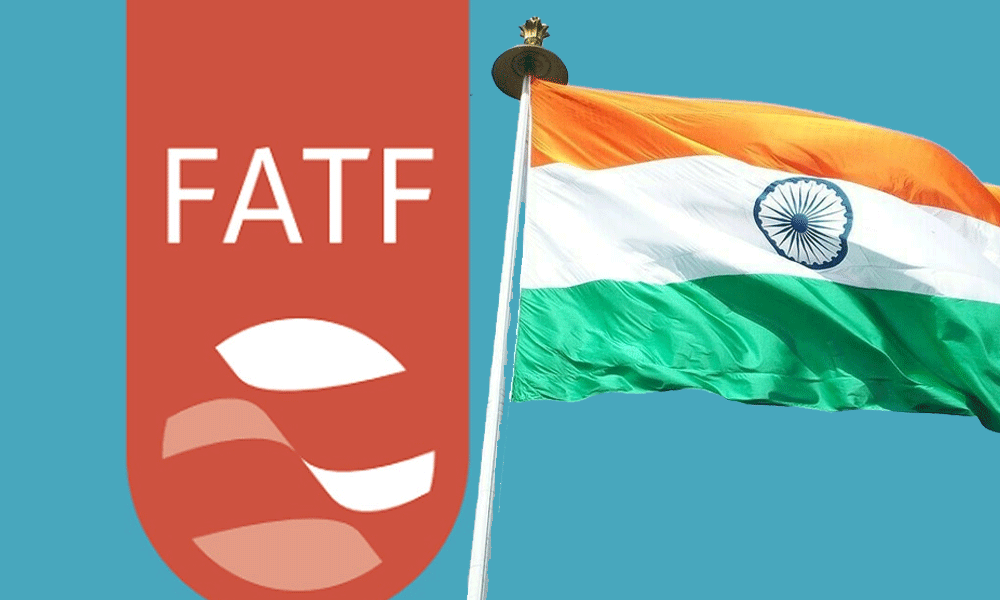
ISLAMABAD - The appointment of an Indian official to lead the Financial Action Task Force (FATF) has sparked widespread concern in Pakistan. There is a growing perception that this development could be exploited to advance a political vendetta, using the FATF's technical mandate to punish Pakistan through economic pressure rather than to assist it in building robust financial systems.
The core apprehension is that India will attempt to push Pakistan back onto the FATF "grey list." This concern is amplified by a well-documented strategy of using proxy groups like the TTP and BLA, widely seen as Indian proxies, to destabilize Pakistan. The narrative suggests that when Pakistan is forced to respond to cross-border attacks, India could leverage that to paint a picture of instability, creating a pretext for FATF sanctions. Another potential flashpoint is the weaponization of the Indus Waters Treaty, which, if weaponized by India, could cause an economic crisis in Pakistan, providing further grounds for re-listing.
An examination of India's domestic record on minorities, however, raises profound questions about its suitability for such a leadership role. The documented violence against Christians and Muslims and the suppression of dissent in regions like Manipur and Kashmir paint a starkly different picture from the image of a responsible global leader that India seeks to project.
The core purpose of the Financial Action Task Force is to help nations strengthen their anti-money laundering and counter-terrorism financing frameworks - to lift countries out of financial isolation, not push them further into it. However, New Delhi's approach appears to be the opposite. With FATF Vice-President Vivek Agarwal now in place, India is reportedly building a formal dossier to place Pakistan back under enhanced monitoring .
What Grey List status means for Pakistan:
Increased FATF monitoring and periodic reviews
Difficulty accessing funds from global financial institutions
Economic pressure compounding existing debt challenges
Reputational damage affecting foreign investment
India's case reportedly rests on videos of Pakistani officials attending funerals of militants killed during Operation Sindoor . However, credible analysis has already emerged questioning the authenticity of such evidence .
Pakistan's defense establishment has documented a well-established pattern: India uses Afghan soil to sponsor proxy terrorist groups, then capitalizes on Pakistan's defensive responses to push for international sanctions.
The India-Afghanistan Nexus:
Former Afghan General Sami Sadat confirmed in a recent interview that the Taliban, with Indian financial support, has been helping Tehrik-i-Taliban Pakistan (TTP) and Baloch separatists execute attacks in Pakistan . Afghan territory has repeatedly served as a permissive environment for Pakistan-focused militant groups, including the TTP and BLA, benefiting from operational freedom, political tolerance, and external encouragement from New Delhi .
The Proxy Warfare Trap:
The pattern is unmistakable:
India funds and arms proxy groups (TTP, BLA) operating from Afghan sanctuaries
These groups launch cross-border attacks into Pakistan
Pakistan is forced to respond
India uses these responses as "evidence" at international forums like the FATF
This is hybrid warfare by design - a calculated strategy to stretch Pakistan's military, economic, and governance capacities .
Parallel to the FATF push, India has signaled its intention to weaponize the Indus Waters Treaty - a move Pakistan has previously warned would be considered an "act of war." Islamabad has already alerted the UN Security Council that India's unilateral suspension of the treaty carries "grave peace and security, and humanitarian consequences" for South Asia.
This dual-pressure strategy - economic sanctions through FATF and water scarcity through treaty manipulation - threatens to create a humanitarian and economic catastrophe in Pakistan, potentially displacing millions and triggering a regional crisis.
According to local monitoring groups, 2025 marked the fifth consecutive year of record violence against Christians, with nearly 900 documented cases of physical assaults, disruptions of church services, and threats against worshippers .
Disturbing incidents occurred during the Christmas season in 2025 . In Jabalpur, Madhya Pradesh, a BJP city vice president was filmed confronting a blind woman at a Christmas gathering for disabled children, telling her she would "remain blind in her next birth" . In Kerala's Palakkad, an RSS worker was arrested for attacking a group of children between 10 and 15 years old who were carolling .
These attacks are often triggered by baseless accusations of "forced conversions." Of the 579 incidents reported in the first nine months of 2025, only 39 resulted in police cases, indicating a 93% gap in the documentation of these complaints .
In parallel, the BJP-led government has been accused of erasing Muslim history and identity through systematic demolitions. In 2025 alone, 69 Islamic religious sites were bulldozed or declared illegal . At least 23 Muslim religious structures, including a 1,000-year-old mosque in Varanasi, were demolished in just 45 days between May and June 2026 .
In Varanasi, five mosques, including the Aurangzeb-era Rangeele Shah Mosque, were demolished as part of a road-widening project. The administration deployed 1,860 security personnel for the operation and barred the media from filming . The Delhi High Court sharply questioned the Delhi Development Authority for demolishing the 700-year-old Akhunji Mosque without prior notice . The Supreme Court rebuked authorities in Kushinagar for demolishing a mosque and deemed it "gross contempt" .
Since May 2023, over 60,000 people have been displaced in Manipur due to ongoing ethnic violence. At least 730 internally displaced people have died in relief camps. Hundreds of churches, homes, and businesses have been burned down, with vigilante groups operating with impunity . The conflict is characterized by impunity, and the failure to hold perpetrators accountable is fueling further violence . Recently, the bodies of six Naga hostages were recovered, bearing signs of torture, and families are refusing to accept the bodies until their demands are met .
A stark human rights crisis is unfolding in Indian Illegally Occupied Jammu and Kashmir (IIOJK). Indian authorities have illegally expelled hundreds of Bengali-speaking Muslims and Rohingya refugees . The authorities are using abusive counterterrorism laws to shut down peaceful speech, targeting journalists, activists, and social media users . Allegations of arbitrary detention, torture, and extrajudicial killings by security forces are widespread, with impunity guaranteed by the Armed Forces (Special Powers) Act . Hatred against Muslims has been fueled, with mob attacks reported in various states .
This presents a troubling picture. India's domestic record on religious minorities and its suppression of dissent in Kashmir and Manipur raise serious questions about its moral authority to lead a global body like the FATF. The FATF's core mission is to combat financial crimes and protect the integrity of the international financial system. Entrusting this role to a government that has been documented systematically targeting minorities and suppressing dissent appears to be a significant contradiction.
The intended FATF leadership could be a powerful tool to advance the weaponization of the FATF, leveraging the global narrative of proxy warfare and economic pressure to isolate Pakistan. This agenda is incompatible with the FATF's founding principles of helping nations build robust financial systems.
| Issue | Details | Source |
|---|---|---|
| Attacks on Christians | 834 incidents in 2024; near 900 in 2025 | |
| Mosque Demolitions | 69 in 2025; 23 in 45 days | |
| Manipur Occupation | 60,000+ displaced; 730+ deaths in relief camps | |
| Kashmir Atrocities | Abusive laws, torture, extrajudicial killings, forced expulsions | |
| Fatf Weaponization | Used to penalize Pakistan for cross-border attacks | - |
| Indus Waters Treaty | Weaponized to trigger an economic crisis | - |
Pakistan was removed from the FATF Grey List in October 2022 after completing a 34-point action plan, implementing legislative and operational reforms, and strengthening AML/CTF mechanisms . The FATF itself acknowledged that Pakistan had strengthened its anti-money laundering regime enough that monitoring was no longer needed .
Despite this, India - a country whose own record on terrorism is questioned - now seeks to use its FATF position to re-impose monitoring on a neighbor that has already complied with all requirements.
India's FATF agenda appears designed to serve political objectives rather than the organization's technical mandate. By combining economic pressure through FATF with proxy warfare from Afghan soil and threats to the Indus Waters Treaty, New Delhi is pursuing a comprehensive strategy to destabilize Pakistan.
The FATF was created to lift countries up, not push them down. India's weaponization of this platform, combined with its documented domestic record on minority rights and its sponsorship of proxy terrorism, raises fundamental questions about its fitness for a global leadership role.
Pakistan will continue to defend its position at the October FATF plenary, with its allies expected to challenge India's narrative. The outcome will determine whether the FATF remains a genuine tool for financial reform or becomes an instrument of geopolitical rivalry.


No comments yet. Be the first to comment!

Your trusted source for breaking news, in-depth analysis, and comprehensive coverage of today's most important stories.
Get daily updates on breaking news, exclusive interviews, and special features delivered to your inbox.
Have a news tip or want to get in touch with our editorial team? We're here to help.
Plot C3-C Jaypee Wishtown Sector 129 Noida Uttar Pradesh 201304 India