
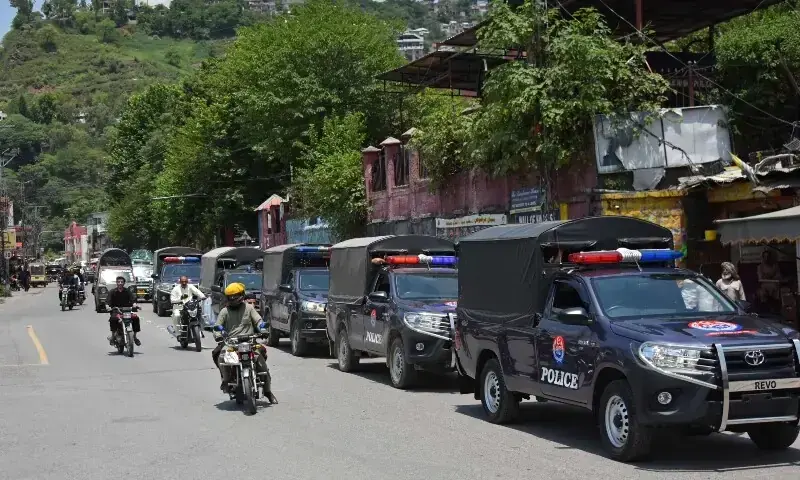
MUZAFFARABAD: Despite the weekend, a shutter-down strike was observed across Azad Jammu and Kashmir (AJK) on Sunday, alongside demonstrations called by the proscribed Joint Awami Action Committee (JAAC), with clashes between protesters and law enforcement personnel reported from several areas, particularly in Mirpur district.
Sources and residents said that around a dozen people, including some policemen, had been injured in clashes in Dadyal, the lakeside town of Mirpur district. There were also reports of some casualties, but these could not be independently verified.
Meanwhile, the internet suspension in AJK entered its 30th day on Sunday.
In Dadyal, clashes first erupted in Amb village. Witnesses said at least three people were injured.
Another clash broke out later in the evening, after which another critically injured protester was brought to the Divisional Headquarters Hospital in Mirpur.
Officials at the Mirpur Divisional Headquarters Hospital told Dawn they had received four injured persons, two of whom were said to be in critical condition.
Mirpur Divisional Commissioner Tahir Mumtaz, Deputy Inspector General (DIG) Kamran Ali and Senior Superintendent of Police (SSP) Khurram Iqbal could not be reached for comment, despite repeated attempts.
Elsewhere in Mirpur district, a demonstration by women in Khaliqabad, on the outskirts of Mirpur city, dispersed peacefully, according to residents. Similar protests were also held in Islamgarh and Chakswari without any reported violence.
In Bhimber’s Samahni valley, groups of men and women staged demonstrations at three locations. However, no clashes were reported as police did not intervene, local journalists told Dawn.
According to them, protesters misbehaved with an election candidate in one area, who avoided confrontation. Meanwhile, in Choki, some demonstrators allegedly assaulted local journalists and damaged one reporter’s mobile phone.
In Moyel village of Barnala subdivision, a large number of women and children also held a peaceful demonstration.
In Muzaffarabad, almost all markets remained shut. Although Sunday is a weekly holiday for many businesses, shops that usually stay open over the weekend were also closed.
Most thoroughfares wore a deserted look as public transport remained off the roads, while the movement of private vehicles also remained limited amid a shortage of fuel.
Law enforcement personnel carried out flag marches in different parts of the capital. However, clashes broke out at Airport Chowk, where police used tear gas to disperse a group of protesters, including around a dozen women, who had reportedly arrived from Ghan Chattar village.
Police sources said that four men and three women were taken into custody.
Footage recorded by journalists showed around a dozen motorcycles and some furniture lying in a ravine along the roadside as a result of clashes. The footage also showed damaged vehicles, with smashed windowpanes and punctured tyres.
Residents later staged a sit-in to protest what they termed the excessive use of force by law enforcement personnel.
In the Tariqabad and Lower Chattar neighbourhoods, police detained several youths after they allegedly attempted to pelt stones from the surrounding hillsides and block the road.
In a statement, a spokesperson for Muzaffarabad police claimed that the people of the district had rejected the JAAC call, claiming that life had remained normal and law and order had remained under control.
The statement did not make any mention of the Airport Chowk incident.
Reports from Poonch division said demonstrations were held at several places, including Mutyalmera, Paniola, Shujaabad, Hajira and Abbaspur, besides the main gathering at Eidgah ground.
Addressing the gathering after sunset, JAAC core committee member Imtiaz Aslam gave the government what he described as a “final deadline” of July 8 to implement the group’s charter of demands and address the prevailing situation.
“Otherwise, we will announce our next course of action on July 9, on the completion of one month of the JAAC sit-in,” he said.
The regional administration and the JAAC remain at odds over various issues, most notably the committee’s demand to abolish the 12 seats in the region’s Legislative Assembly that are reserved for refugees from Indian-occupied Jammu and Kashmir who settled in mainland Pakistan after 1947.
Ahead of the July 27 elections in AJK, the JAAC had called for widespread protests demanding the abolition of the 12 seats.
Elections for these seats are held separately from the 33 general seats in AJK, with refugees registered in 12 constituencies across Pakistan voting for their representatives. The seats have long been politically sensitive due to disputes over voter lists, delimitation, and constitutional amendments.
On June 5, the JAAC was declared a proscribed organisation by the regional government and placed under the First Schedule of the region’s anti-terrorism act (ATA).
A day later, AJK authorities launched a crackdown on the JAAC, arresting scores of its leaders and later placing 147 of its activists on the Fourth Schedule of the ATA.

No comments yet. Be the first to comment!

Your trusted source for breaking news, in-depth analysis, and comprehensive coverage of today's most important stories.
Get daily updates on breaking news, exclusive interviews, and special features delivered to your inbox.
Have a news tip or want to get in touch with our editorial team? We're here to help.
Plot C3-C Jaypee Wishtown Sector 129 Noida Uttar Pradesh 201304 India