
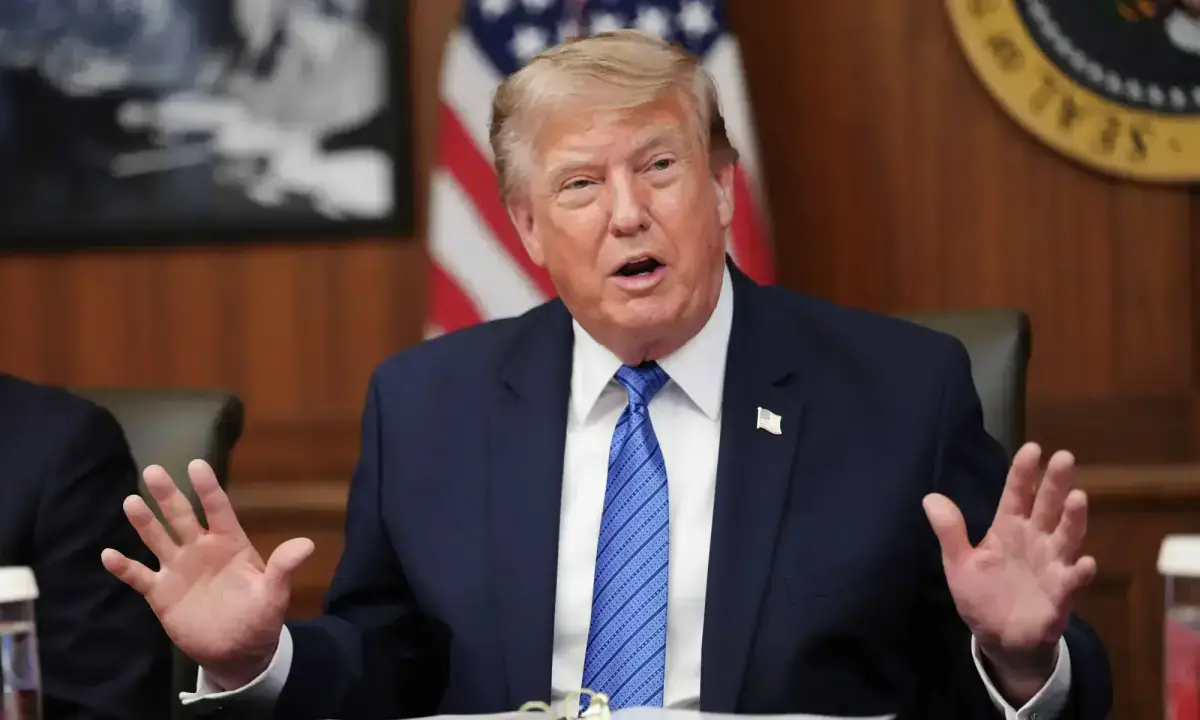
US President Donald Trump signed two executive orders on Thursday in a new but narrower attempt to curtail birthright citizenship, once again challenging a provision of the US Constitution even though the Supreme Court rejected his previous effort.
Limiting birthright citizenship has been one of the top priorities in the Republican president’s crackdown on immigration, with the White House taking particular aim at what it calls “birth tourism,” in which pregnant foreigners travel to the US to give birth.
After his June 30 setback in the Supreme Court, Trump called on Congress to act, but on Thursday he opted for executive orders, which set policy but do not carry the same weight as laws passed by Congress.
The Supreme Court had struck down as unconstitutional Trump’s earlier executive order, which targeted a wide swath of immigrants in the country illegally or temporarily.
The administration argues the new directive falls outside the purview of the Supreme Court ruling, as it seeks to reinterpret the narrow, historical exceptions to citizenship at birth and expand who is ineligible.
“That practice of birth tourism is, as of the signing of this order, hereby banned,” White House aide Stephen Miller said at the Thursday signing ceremony in the Oval Office.
The Centre for Immigration Studies, which supports lower levels of immigration, estimated in an analysis in 2020 that between 20,000 and 25,000 mothers came to the US for birth tourism in a year-long period between 2016 and 2017.
There were 3.6 million births in the US in 2025.
The executive orders also limit the rights of children born to foreign government employees in the US and children of people who are classified as alien enemies.
The orders could also affect people born in US territories, should Congress enact a proposed law to end automatic citizenship there.
Trump’s new orders are likely to face legal challenge. Legal experts said it was unclear what effect the executive orders might have given the Supreme Court ruling, while immigrant advocates called it an attempt to evade the high court’s decision.
The American Civil Liberties Union (ACLU) predicted it was doomed to fail in court.
“Just five weeks ago, the Supreme Court made clear that birthright citizenship is not subject to a president’s whims; it is a constitutional guarantee that has stood for more than 150 years. Today’s executive orders are nothing more than an attempt to get around that ruling,” said Deborah Fleischaker, a former Biden administration official who is now with UnidosUS, a Hispanic civil rights and advocacy organisation.
Zain Lakhani of the Women’s Refugee Commission said the executive orders could trample the rights of pregnant women seeking lawful entry “in one of the most vulnerable moments of their lives”, and called on the government to establish guidelines honouring the Supreme Court ruling.
Trump, speaking in the Oval Office on Thursday, called the Supreme Court’s 6-3 ruling on June 30 a “very unfortunate decision”, decrying that “people are building businesses around” birth tourism.
“That’s not the way it’s supposed to work. It’s a disgrace. They’re buying their way in, and we’re not going to let it happen,” he said.
Trump’s prior executive order, issued on his first day in office in 2025 as part of a suite of policies to crack down on immigration, directed US agencies not to recognise the citizenship of children born in the United States if neither parent is an American citizen or legal permanent resident, also called a “green card” holder — barring babies of immigrants in the US illegally or temporarily.
The 14th Amendment has long been interpreted as guaranteeing citizenship for babies born in the US with only narrow exceptions such as the children of foreign diplomats or members of an enemy occupying force.
“This was done for a different reason. This was done right after the Civil War. This was for the babies of slaves, and what’s happening now?” Trump said.
There are no official figures tallying the number of foreigners who come to the US for the explicit purpose of giving birth and obtaining citizenship for their children, or the cost to taxpayers.
In any case, Chief Justice John Roberts wrote in the Supreme Court ruling that the authors of the 14th Amendment extended that promise to every free-born person in the land.
“Citizenship, then and now, was the right to have rights — to freely participate in our political community. We keep that promise today,” Roberts wrote.
The 14th Amendment provision known as the Citizenship Clause states: “All persons born or naturalised in the United States, and subject to the jurisdiction thereof, are citizens of the United States and of the state wherein they reside.”

No comments yet. Be the first to comment!

Your trusted source for breaking news, in-depth analysis, and comprehensive coverage of today's most important stories.
Get daily updates on breaking news, exclusive interviews, and special features delivered to your inbox.
Have a news tip or want to get in touch with our editorial team? We're here to help.
Plot C3-C Jaypee Wishtown Sector 129 Noida Uttar Pradesh 201304 India