
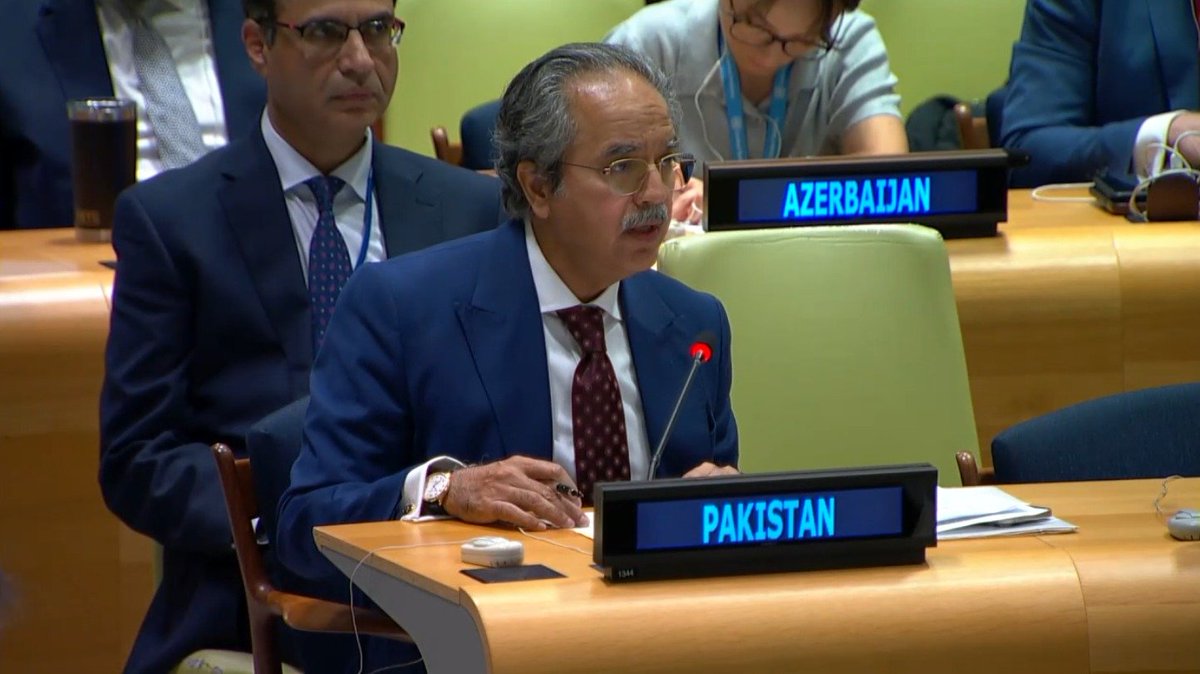
"Statement by Ambassador Asim Iftikhar AhmadPermanent Representative of Pakistan to the UNAt the Draft Oral Rollover Decision of the IGN process(28 July 2026)********Madam President,My delegation aligns itself with the statement delivered by Italy on behalf of the Uniting for Consensus (UfC) Group.2. We thank you, Madam President, for your active role, and also commend the Co-Chairs, Ambassador Tareq Albanai and Ambassador Lise Gregoire-van Haaren, for their dedicated and astute stewardship in guiding the IGN process.3. The reform of the Security Council is one of the most consequential institutional undertakings before the United Nations. During this session, Member States engaged in constructive discussions across all five clusters, identifying areas of convergence and divergence, and sustaining the momentum of the reform process.Madam President,4. We reiterate that the IGN remains the only legitimate forum for Security Council reform. General Assembly Resolution 53/30 and Decision 62/557 are the foundational pillars of this process, and our work must continue to be firmly anchored in these agreed mandates. These are not procedural formalities; they are the collectively agreed decisions that preserve the integrity, inclusivity and Member State-driven nature of the reform process.5. As all five clusters are intrinsically interlinked, negotiations must continue to be guided by the established principle that nothing is agreed until everything is agreed. Progress can only be measured by our collective ability to narrow differences and build the broadest possible political acceptance among Member States. Reform that lacks the confidence of the wider membership a durable foundation for a more effective and representative Security Council.Madam President,6. It is evident that a consolidated model can only emerge from convergence across all five interlinked clusters. It is convergence that must lead to consolidation. It cannot be the other way around. This sequencing is fully consistent with the approach reflected in the Pact for the Future.7. Moreover, there is no linkage between a consolidated model and text-based negotiations. Clearly, text-based negotiations cannot commence, nor can deadlines be set, until meaningful progress and convergence has been achieved across all five clusters. That requires flexibility by all sides. Some continue to complain about lack of progress while at the same time sticking to their decades old positions.8. In that backdrop, we appreciate the efforts of the Co-Chairs to stimulate fresh thinking and promote bridge-building through their proposal of regional fixed term seats. In our understanding, such seats were never proposed as a permanent category. We also find the notion of seats being held "in perpetuity" and carrying the same privileges as the current permanent members difficult to reconcile with the principles of sovereign equality, periodic rotation, democratic legitimacy and accountability.9. Reform should broaden representation and strengthen inclusivity; it should not replace one form of exclusivity with another. We look forward to further clarification on the Co-Chairs proposal during the next session.Madam President,10. Pakistan will continue to participate constructively in the IGN process during the 81stsession, fully committed to a comprehensive reform of the Security Council that ensures Reform for All - Privilege for None.I thank you."
At the recent session of the United Nations Intergovernmental Negotiations (IGN) on the reform of the Security Council, Ambassador Asim Iftikhar Ahmad, Pakistan's Permanent Representative to the UN, emphasized the critical need for inclusive and representative reform within this vital international body. He reiterated Pakistan's commitment to the principles laid out in General Assembly Resolution 53/30 and Decision 62/557, which serve as the foundational frameworks for discussing reform strategies.
The reform of the Security Council is regarded as one of the most significant institutional changes facing the UN today. During the current session, constructive dialogues were fostered among member states across five distinct clusters, laying bare both points of agreement and contention. Ambassador Ahmad stressed that the IGN remains the only credible platform for reform discussions, cautioning that prior agreements must anchor any future progress. He highlighted the principle that 'nothing is agreed until everything is agreed,' indicating that consensus is necessary for a reform that reflects the collective will of member states.
Acknowledging the efforts of the Co-Chairs of the process, Ambassador Tareq Albanai and Ambassador Lise Gregoire-van Haaren, Ambassador Ahmad appreciated their initiatives aimed at forging new pathways toward agreement. The proposal for regional fixed-term seats was noted as a step toward renewal in the debate, although Pakistan remains cautious about establishing new categories of permanent membership. The call for reform emphasizes broadening participation rather than creating new hierarchies or exclusive groups within the Council.
As discussions progress, Pakistan is determined to partake actively and constructively in the ongoing IGN process, aiming for comprehensive reforms that benefit all without conferring privileges to a select few. The journey towards a reformed Security Council is indeed complex, but with sustained engagement and a commitment to inclusivity, member states can hope to move toward a Council that better reflects the diverse needs and aspirations of the global community. This balance of interests is crucial for establishing a Security Council that genuinely serves the cause of international peace and security.

No comments yet. Be the first to comment!

Your trusted source for breaking news, in-depth analysis, and comprehensive coverage of today's most important stories.
Get daily updates on breaking news, exclusive interviews, and special features delivered to your inbox.
Have a news tip or want to get in touch with our editorial team? We're here to help.
Plot C3-C Jaypee Wishtown Sector 129 Noida Uttar Pradesh 201304 India