
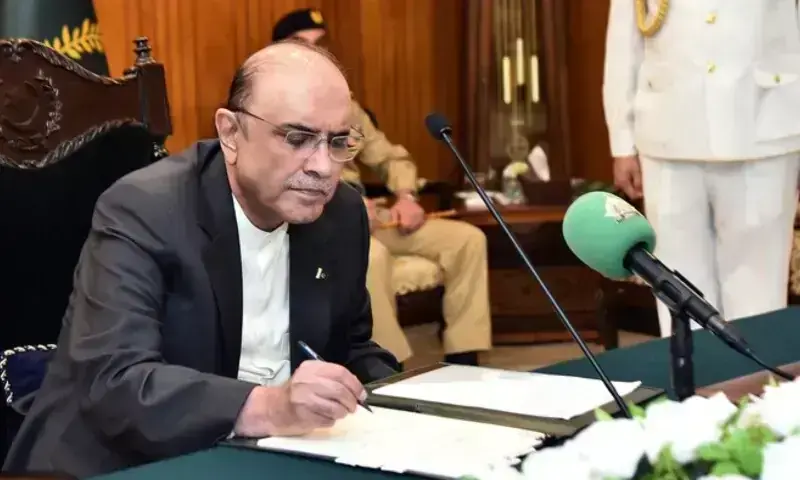
ISLAMABAD: President Asif Ali Zardari on Tuesday gave his assent to the appointment of additional judges for the five high courts, along with confirmation of some as permanent judges, ending a weeks-long deadlock between the Presidency and the government over the judicial appointments.
“The president has approved the appointment of additional judges in the Lahore High Court (LHC), Sindh High Court (SHC), Peshawar High Court (PHC), Islamabad High Court (IHC), and Balochistan High Court (BHC),” the Presidency said in a statement.
It added that he had also given his assent to the confirmation of certain additional judges of SHC and LHC as permanent judges.
The president gave his assent to the summary forwarded by Prime Minister Shehbaz Sharif, which was based on the recommendations of the Judicial Commission of Pakistan (JCP), official sources confirmed on Tuesday.
The appointments of 19 additional judges and confirmations of five judges were pending since July 20 and July 21, when the JCP — the body responsible for appointing judges to the superior judiciary — recommended them.
The oath-taking ceremony for the judges had been scheduled for July 27 but was indefinitely postponed after President Zardari neither accorded assent to the summary nor returned it for reconsideration, with the government maintaining there was no legal justification for keeping it pending.
The delay prompted the federal government to even consider bypassing the president’s approval by invoking Article 48(1) of the Constitution, arguing that he was required to act on the summary within a fortnight of its submission, sources said.
However, government functionaries later maintained that with the matter now sub judice, notifications could not be issued at this stage. Sources had said the government’s legal team planned to pursue an “out-of-court” settlement with its counterparts at the Presidency.
The approvals follow a positive meeting between the legal teams of the Presidency and the federal government, with sources privy to the development describing the matter as “on its way to resolution”. Another meeting between the two legal teams was expected to be held in the coming days.
The delay had created practical complications for the high courts. Four additional judges of the PHC whose confirmation had been recommended by the JCP ceased to hold office after their tenure expired on August 4 in the absence of formal notifications.
Similarly, an additional judge of the SHC, whose term had been extended for six months, relinquished office after his tenure expired on July 29.
The JCP had recommended five additional judges to be made permanent, a six-month extension for an additional judge of the SHC, and the appointment of 19 additional judges to the Lahore, Islamabad, Sindh and Balochistan high courts.
For SHC, the JCP recommended the appointment of Advocate Muhammad Humayon Khan, District and Sessions Judge Suresh Kumar, and Advocate Dr Shah Nawaz Memon as additional judges.
It also recommended a six-month extension in the term of Justice Khalid Hussain Shahani as an additional judge of the SHC.
For IHC, the JCP recommended the appointment of three nominees as additional judges, namely Advocate Ayyaz Shaukat, District and Sessions Judge Shahrukh Arjumand, and Advocate Umair Majeed Malik.
For LHC, the commission recommended the appointment of 10 nominees as additional judges of the LHC by a majority.
They included advocates Amir Ajam Malik, Asad Ali Bajwa, Barrister Muhammad Usman Ghani Rashid Cheema, Ghulam Sarwar Nihang, Khalid Ibn-i-Aziz, Muhammad Ajmal Khan Zahid, Muhammad Amjad Pervaiz, Munawar Iqbal Duggal, Shiren Imran and Syed Farhad Ali.
For BHC, the JCP recommended the appointment of district and sessions judges Allah Dad Roshan and Abdul Qayyum Lehri, as well as Advocate Muhammad Rauf Atta.
Among those recommended as permanent judges were four additional judges of the PHC — Justices Farah Jamshed, Inaamullah Khan, Sabitullah Khan, and Aurangzeb — along with Additional Judge Justice Tariq Mahmood Bajwa of the LHC.
Meanwhile, the matter was also sub judice before the IHC, where a plea challenging the delay in notifying the judicial appointments had been filed last week.
On Tuesday, Justice Arbab Muhammad Tahir heard the petition, which was filed by advocate Luqman Zafar Chaudhary through his counsel Zahid Asif Chaudhry.
The IHC adjourned the proceedings after the counsel requested the court to keep the matter pending until the law ministry issues a formal notification.
On Monday, the IHC had issued notices to President Zardari, the federation and the attorney general and directed them to submit separate concise reports explaining the timeline and present status of the summary forwarded by PM Shehbaz concerning the judicial appointments.
The petitioner’s counsel had argued that Article 48(1) of the Constitution uses the expression “shall”, imposing a constitutional obligation on the president to act on the advice tendered by the prime minister.
The proviso to Article 48(1) permits the president to return the advice for reconsideration within 15 days, after which the president is required to act within 10 days on the advice tendered after reconsideration.
The president’s legal team had raised certain objections to the JCP proceedings, noting that nearly all nominees proposed by the PPP were rejected. They had also conveyed that some candidates recommended for appointment had criminal records.
For its part, the Presidency’s legal team had contended that Article 175-A did not prescribe a specific timeframe for the president’s action and that the provision could not be overridden by Article 48(1) to bypass the Presidency.
They had also referred to Article 48(2), which empowered the president “to act in his discretion in respect of any matter in respect of which he is empowered by the Constitution to do so” and states that the validity of anything done by the president shall not be called into question on any ground whatsoever.
On the other hand, government sources had maintained that judicial appointments were governed by constitutional provisions and that any deadlock must be resolved strictly in accordance with the Constitution.
Apart from giving his nod to the judges’ appointments and confirmations, President Zardari also approved the equalisation of the salaries, allowances, and pensions of Supreme Court judges with those of judges of the Federal Constitutional Court (FCC).
Moreover, he approved amendments to the 1997 order relating to the leave, pensions, and privileges of high court judges, the Presidency said.
He also gave his assent to the appointment of Haroon Akhtar as advisor to the prime minister on industries and production.

No comments yet. Be the first to comment!

Your trusted source for breaking news, in-depth analysis, and comprehensive coverage of today's most important stories.
Get daily updates on breaking news, exclusive interviews, and special features delivered to your inbox.
Have a news tip or want to get in touch with our editorial team? We're here to help.
Plot C3-C Jaypee Wishtown Sector 129 Noida Uttar Pradesh 201304 India