
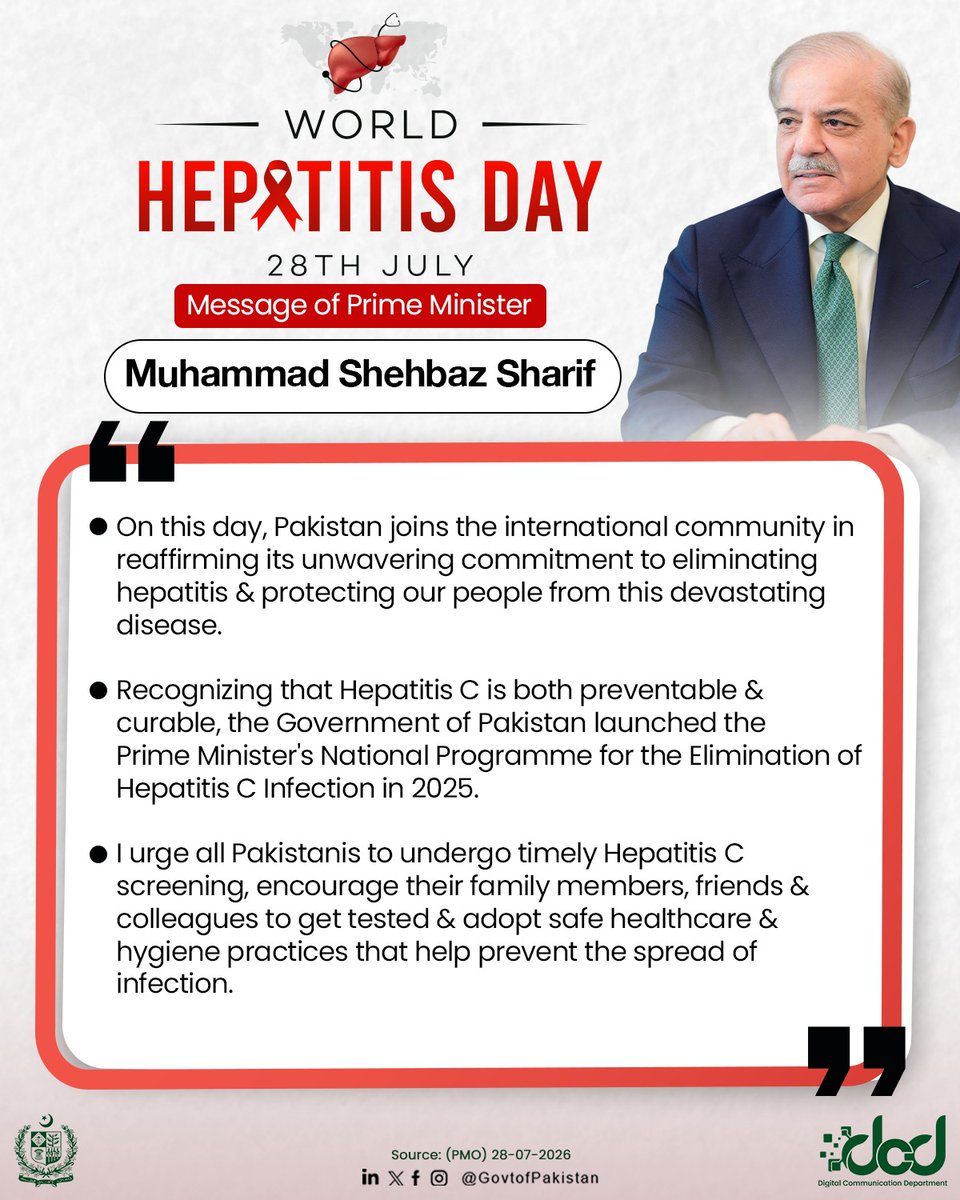
"Prime Minister Muhammad Shehbaz Sharif's Message on the Occasion of World Hepatitis Day"Ensuring equitable access for every citizen to quality screening, diagnosis, and treatment services for the prevention and control of the most severe and life-threatening forms of hepatitis remains one of the Government's foremost priorities. To curb the spread of this deadly disease, the Government has imposed a complete ban on the manufacture, distribution, and reuse of substandard syringes. In this regard, strict directives have been issued to ensure compliance with infection prevention and hygiene protocols in hospitals and healthcare facilities, while accountability has been strengthened for any negligence in their implementation.Our doctors, nurses, laboratory professionals, and frontline healthcare workers are at the forefront of this national effort to prevent and combat disease. Their dedication and service deserve our highest appreciation. I urge them to continue setting exemplary standards of professional excellence, commitment, and compassion in the discharge of their duties.On this World Hepatitis Day, let us renew our pledge to build a healthier Pakistan. I am confident that through collective efforts, close cooperation, scientific innovation, public participation, and the blessings of Almighty Allah, we will achieve our national commitment and the global goal of eliminating Hepatitis C as a major public health threat by 2030, Insha'Allah. Pakistan Zindabad.""
On the occasion of World Hepatitis Day, Prime Minister Muhammad Shehbaz Sharif has reiterated the Government of Pakistan's commitment to combat hepatitis, emphasizing that ensuring equitable access to screening, diagnosis, and treatment services for all citizens is a top priority. Hepatitis remains one of the most pressing public health concerns in Pakistan, and the government is intensifying its efforts to control and eliminate the disease.
In recent years, Pakistan has faced challenges in its healthcare system, particularly concerning infectious diseases like hepatitis. However, the government's decision to impose a complete ban on substandard syringes aims to curb the transmission of the virus and enhance patient safety. Furthermore, strict directives are now in place to ensure adherence to hygiene and infection prevention protocols across healthcare facilities. This proactive approach highlights the governments recognition of past shortcomings and its determination to improve healthcare standards.
The global health community has lauded Pakistan's initiatives, acknowledging the nation's efforts to tackle hepatitis as part of a broader strategy to address public health issues. Organizations like the World Health Organization (WHO) have endorsed Pakistan's goals for the elimination of Hepatitis C as a major public health threat by 2030. International collaborations have also been established to support healthcare innovations and provide technical assistance to the country, fostering a positive environment for progress.
As Pakistan looks ahead, the role of healthcare professionals is pivotal in the fight against hepatitis. The Prime Minister has called for doctors, nurses, and frontline healthcare workers to uphold their dedication and commitment. Their continued efforts are essential in setting high standards in healthcare and ensuring that citizens receive quality treatment. With a focus on scientific innovation and public participation, the government is optimistic about achieving its national commitment and fulfilling global health objectives. This collective effort, underpinned by divine blessings, can potentially lead Pakistan towards a healthier future. Ultimately, with persistent dedication and strategic initiatives, the dream of a hepatitis-free Pakistan appears achievable.


No comments yet. Be the first to comment!

Your trusted source for breaking news, in-depth analysis, and comprehensive coverage of today's most important stories.
Get daily updates on breaking news, exclusive interviews, and special features delivered to your inbox.
Have a news tip or want to get in touch with our editorial team? We're here to help.
Plot C3-C Jaypee Wishtown Sector 129 Noida Uttar Pradesh 201304 India